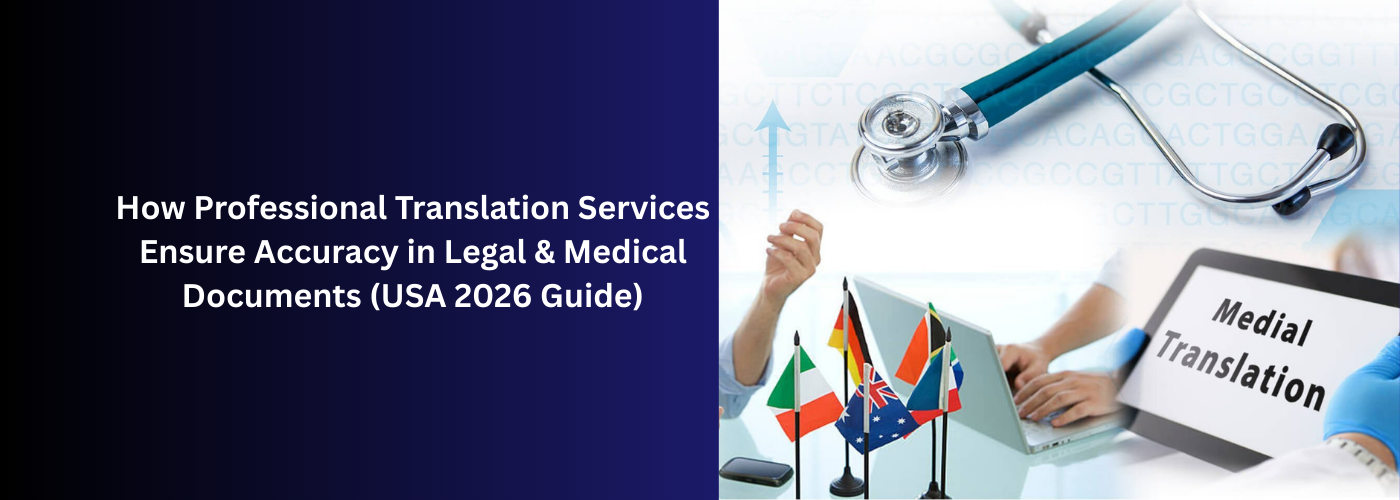
Professional translation services ensure accuracy in legal and medical documents by using certified linguists, subject-matter experts, multi-layer quality checks, and strict compliance standards. In the United States, legal and medical translations must meet regulatory, ethical, and institutional requirements — where even minor errors can lead to legal disputes, immigration delays, or patient safety risks.
Key Takeaways:
Legal and medical translations require subject-matter expertise.
Certified translators verify accuracy and compliance.
Multi-step quality control prevents costly errors.
AI tools assist — but human review is mandatory.
USCIS, courts, and hospitals require certified translations.
If there’s one area where translation mistakes are unacceptable, it’s legal and medical documentation.
I’ve seen businesses try to cut corners only to face rejected immigration filings or compliance issues in court. In healthcare, errors can directly impact patient safety.
Accuracy isn’t optional.
Let’s break down exactly how professional translation services protect against those risks.
Why Accuracy Is Critical in Legal & Medical Translation
Legal and medical documents carry consequences.
In legal contexts, mistranslating one contractual clause can:
- Shift liability
- Void agreements
- Change enforcement terms
- Trigger financial penalties
In medical settings, translation errors can:
Misstate a diagnosis
Alter dosage instructions
Misrepresent informed consent
Create malpractice risks
This is where professional translation services step in.
They don’t just translate language they safeguard meaning.
What Makes Legal Translation So Sensitive?
Legal language is precise. It’s layered. It’s intentionally structured.
Professional legal translation services ensure accuracy by:
- Using translators trained in legal terminology
- Understanding U.S. court standards
- Maintaining exact formatting
- Preserving clause structure
- Following jurisdictional requirements
Legal translation often includes:
- Contracts and agreements
- Court transcripts
- Immigration documentation
- Affidavits and sworn statements
- Patents and intellectual property filings
Here’s what most people don’t realise:
Legal language rarely translates word-for-word. Concepts must be interpreted within the legal framework of the target country especially in the United States.
That requires expertise, not software.
Why Medical Translation Requires Even Greater Precision
Medical translation services demand technical knowledge.
Accuracy ensures:
- Patient safety
- Regulatory compliance
- Clinical integrity
- Proper treatment outcomes
Professional medical translation services handle:
- Patient records
- Prescription instructions
- Clinical trial documentation
- Medical device manuals
- Pharmaceutical labeling
- Informed consent forms
Medical translators must understand:
- Medical terminology
- Anatomy and physiology
- Drug classifications
- Regulatory frameworks like FDA standards
- HIPAA confidentiality requirements
A minor mistranslation in dosage instructions isn’t just an error.
It’s a liability.
How Professional Translation Services Ensure Accuracy
Professional translation providers use structured processes to eliminate risk.
Here’s how accuracy is maintained:
- Assignment to subject-matter experts (legal or medical specialists)
- Native-language proficiency validation
- Terminology database alignment
- Glossary consistency checks
- Multi-stage editing and proofreading
- Final quality assurance review
- Certification when required
This multi-layer review system is critical.
Machine translation tools do not provide this.
Certified Translation: A Legal Requirement in the USA
In the United States, certified translations are required for:
- USCIS immigration applications
- Federal and state court submissions
- Academic transcript evaluations
- Government documentation
A certified translation includes:
- A signed statement confirming completeness
- Confirmation of translator competency
- Assurance of accuracy
Without certification, documents may be rejected.
Professional translation services ensure compliance with USCIS and U.S. legal standards.
The Role of AI in Legal & Medical Translation (2026 Reality)
AI-powered translation tools like Google Translate and ChatGPT have improved significantly.
But here’s the reality:
AI translation tools:
- Do not guarantee legal accuracy
- Cannot certify translations
- Do not assume liability
- May misinterpret technical context
Professional translation services may use AI-assisted workflows — but always with human review.
Human translators:
- Detect contextual errors
- Recognize cultural nuances
- Validate terminology
- Confirm regulatory compliance
AI is a tool.
Accuracy requires accountability.
Quality Assurance Methods Used by Professional Translation Providers
To maintain precision in legal and medical documents, reputable providers implement:
- Dual-linguist review systems
- Terminology management software
- Subject-matter expert verification
- Formatting accuracy checks
- Confidential document handling protocols
- Secure file transmission systems
- Regulatory compliance audits
These processes ensure:
- Consistency
- Confidentiality
- Legal defensibility
- Medical clarity
Skipping these steps increases risk.
Common Risks of Inaccurate Legal & Medical Translation
When non-professional translation services are used, risks include:
- Contractual misunderstandings
- USCIS application delays
- Court document rejection
- Clinical trial compliance issues
- Misdiagnosis
- Insurance claim disputes
These consequences are costly — financially and legally.
Accuracy prevents escalation.
Who Needs Professional Legal & Medical Translation Services?
You likely need professional services if you are:
- Filing immigration documents
- Submitting court evidence
- Operating a healthcare practice
- Managing international patient records
- Conducting clinical research
- Expanding medical or pharmaceutical products globally
- Drafting multilingual contracts
If compliance matters, professional translation matters.
How to Choose a Reliable Translation Service Provider
When selecting a provider, look for:
- Certified translators
- Legal and medical specialization
- Confidentiality policies
- Multi-step quality control
- Compliance with U.S. standards
- Clear turnaround times
- Transparent pricing
Experience in your specific industry is critical.
Not all translators are qualified for legal or medical work.
Why Professional Translation Services Remain Essential in 2026
The demand for accurate legal and medical translation is increasing in the U.S.
Key drivers include:
- Immigration growth
- International business expansion
- Multilingual healthcare environments
- Global clinical trials
- Regulatory documentation requirements
As AI adoption increases, human oversight becomes more valuable — not less.
Accuracy is trust.
And trust is non-negotiable in legal and medical fields.
FAQs – Legal & Medical Translation Services
1. Why is accuracy so important in legal translation?
Legal translation accuracy ensures that contractual terms, court filings, and immigration documents maintain their original legal meaning. Even minor errors can change liability, invalidate agreements, or lead to rejected submissions in U.S. courts or government agencies.
2. What happens if medical documents are mistranslated?
Mistranslated medical documents can lead to incorrect diagnoses, improper treatment, medication errors, and regulatory violations. Professional medical translation ensures terminology precision and patient safety while complying with U.S. healthcare standards.
3. Are AI translation tools safe for legal or medical documents?
AI translation tools are not recommended for official legal or medical documentation. They cannot certify translations, may misinterpret terminology, and do not provide accountability or regulatory compliance required by U.S. authorities.
4. Do courts and USCIS require certified translations?
Yes. U.S. courts and USCIS require certified translations for foreign-language documents. The translation must include a signed certification statement confirming accuracy and translator competency.
5. How long does legal or medical translation take?
Turnaround time depends on document length and complexity. Certified documents may take 24–72 hours, while complex legal or clinical materials may require additional review time to ensure accuracy and compliance.
6. What languages are commonly requested for legal and medical translation in the USA?
Spanish to English is the most requested language pair, followed by Chinese, Arabic, Portuguese, and Vietnamese. Demand reflects immigration patterns and multilingual healthcare needs.
Ensure Accuracy with Analokalize
Legal and medical documents demand precision, compliance, and confidentiality.
At Analokalize, we provide:
- Certified translation services are accepted across the United States
- Specialized legal and medical translators
- USCIS-compliant documentation
- Multi-layer quality control
- Secure and confidential document handling
- Fast and reliable turnaround
When accuracy affects legal standing or patient safety, there’s no room for error.
Request a Free Quote Today at Analokalize.com
Let’s make sure your documents are translated accurately — the first time.