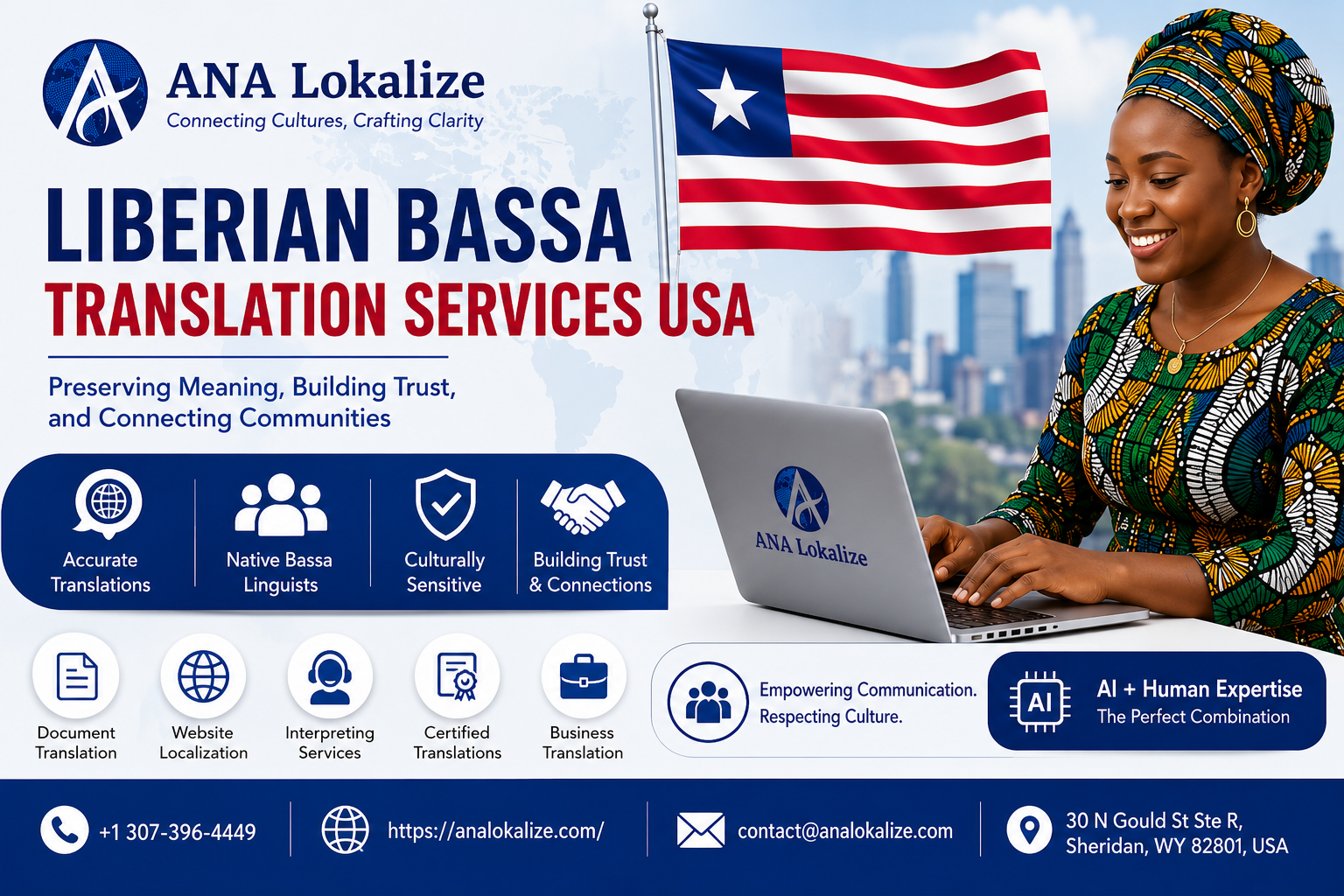
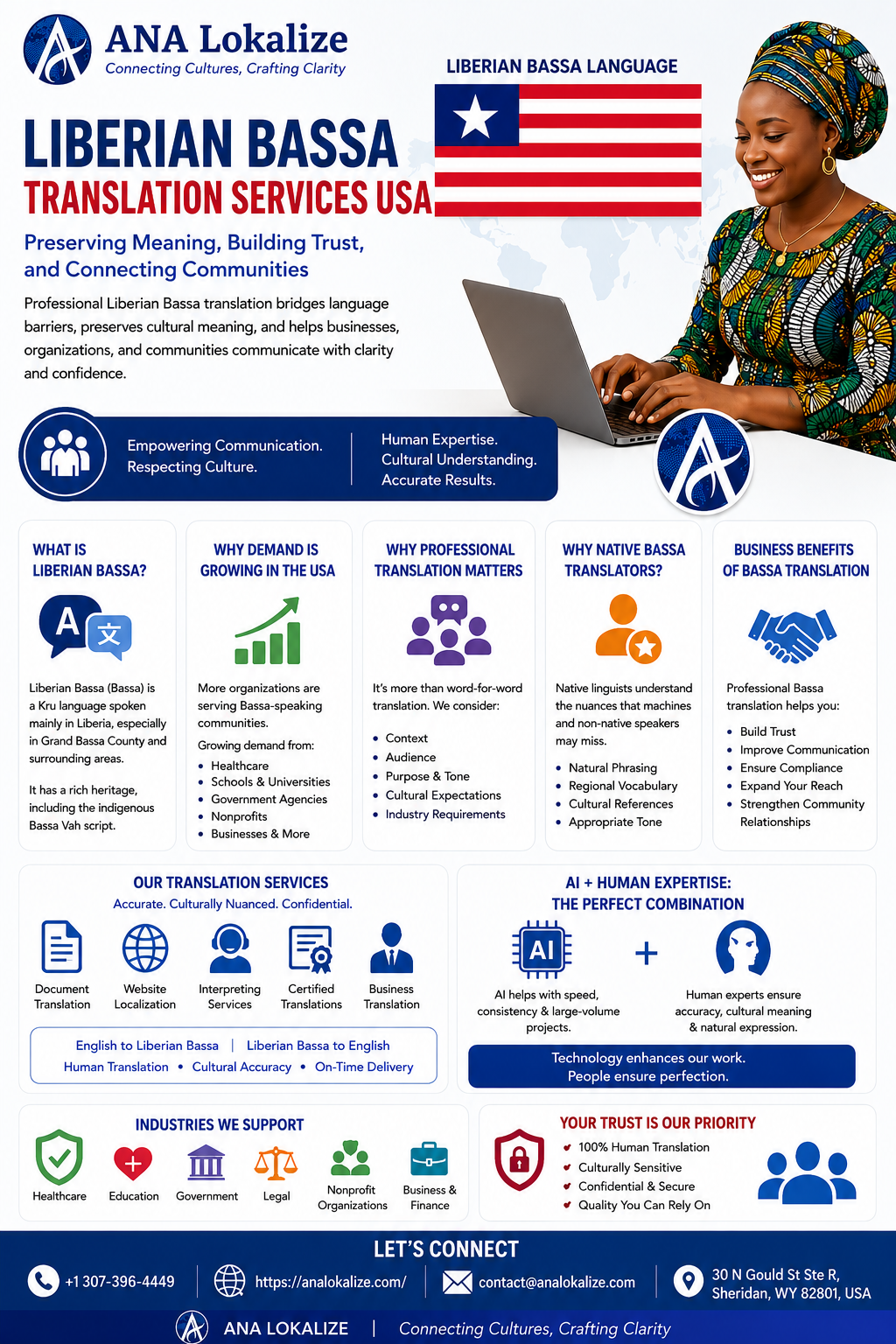
If you're searching for Liberian Bassa Translation Services USA, you're likely looking for far more than a simple word-for-word translation. Whether you need Professional Liberian Bassa Translation Services USA, English to Liberian Bassa Translation Services, Native Liberian Bassa Translators USA, Liberian Bassa Document Translation Services, Liberian Bassa Website Localization Services, Certified Liberian Bassa Translation Company, Liberian Bassa Interpreting Services USA, or Business Translation Services in Liberian Bassa, choosing the right language partner matters. In this guide, I'll explain why Liberian Bassa is a unique language, why professional translation is essential, how businesses and organizations benefit from culturally accurate communication, and how AI is improving—but not replacing—professional language services.
Every Language Carries a Story
One of the
reasons I love working in the language industry is that every language
represents much more than vocabulary.
A language
reflects history.
It preserves
traditions.
It strengthens
identity.
It connects
generations.
Liberian Bassa
is a perfect example.
Although it may
not be one of the world's largest languages, it remains an important part of
Liberia's cultural heritage and continues to be spoken by communities both in
Liberia and across the United States.
Whenever we
translate Liberian Bassa, we're not simply converting sentences.
We're helping
preserve culture while making communication possible across languages.
As Nelson
Mandela famously said:
"If you
talk to a man in a language he understands, that goes to his head. If you talk
to him in his own language, that goes to his heart."
That quote
perfectly captures what professional translation should accomplish.
What Is Liberian Bassa?
Liberian
Bassa—often simply called Bassa—is a member of the Kru branch of the
Niger-Congo language family and is primarily spoken in Liberia, particularly in
Bassa-speaking regions such as Grand Bassa County and neighboring areas.
Linguists
estimate that there are hundreds of thousands of Bassa speakers, making it one
of Liberia's important indigenous languages. In addition to Liberia,
Bassa-speaking communities have established themselves in countries including
the United States through immigration, education, employment, and family
reunification.
One of the most
fascinating aspects of Liberian Bassa is its indigenous writing system known as
the Bassa Vah script, developed to represent the language using its own unique
alphabet rather than relying entirely on Latin characters. While the Latin
alphabet is widely used today, the existence of Bassa Vah highlights the rich
literary and cultural heritage of the language.
Why Demand for Liberian Bassa Translation Services USA Is Growing
People often
assume language services are only needed for globally dominant languages like
Spanish, French, Mandarin, or Arabic.
That simply
isn't true.
Demand for
translation is driven by people—not population rankings.
Across the
United States, organizations increasingly work with multilingual communities
that speak languages such as Liberian Bassa.
We've seen
growing demand from:
- Hospitals
- Healthcare providers
- Universities
- Schools
- Government agencies
- Immigration attorneys
- Nonprofit organizations
- Community outreach programs
- Financial institutions
- International businesses
As these
organizations become more inclusive, the need for accurate Liberian Bassa
translation continues to increase.
Professional Translation Is About
More Than Language
When clients
contact us for translation, they often say something like:
"We just
need someone to translate this document."
I understand why
they say that.
But professional
translation involves much more than replacing English words with Liberian Bassa
equivalents.
Every
translation requires us to think about:
- Context
- Audience
- Purpose
- Tone
- Cultural expectations
- Subject matter
For example, the
same sentence might require different translations depending on whether it
appears in:
- A legal agreement
- A medical record
- A government notice
- A school handbook
- A business proposal
- A marketing brochure
Professional
translators understand those differences.
Why English to Liberian BassaTranslation Services Require Expertise
Many people
assume bilingual ability automatically qualifies someone to translate
professionally.
In reality,
professional translation is a specialized skill.
An experienced
translator doesn't simply understand two languages.
They also
understand:
- Grammar
- Sentence structure
- Technical terminology
- Industry standards
- Cultural references
- Communication style
That's
especially important when translating between English and Liberian Bassa
because the languages differ significantly in structure and expression.
Literal
translation often creates awkward or misleading results.
Professional
translation communicates ideas naturally.
Native Liberian Bassa Translators USA
Make a Difference
One question
clients ask us regularly is:
"Why
should we work with native or fluent Liberian Bassa linguists?"
The answer is
straightforward.
Native speakers
understand nuances that machines—and even many bilingual speakers—may overlook.
They recognize:
- Regional vocabulary
- Natural phrasing
- Community preferences
- Cultural references
- Appropriate tone
Those details
help translations sound authentic rather than mechanical.
Language isn't
just about grammar.
It's about
sounding human.
Why Businesses Need Liberian Bassa
Translation
Business
communication has become increasingly global.
Organizations no
longer communicate with only one language or one culture.
Professional
Business Translation Services in Liberian Bassa help organizations communicate
effectively with customers, employees, partners, and communities.
Common business
applications include:
Corporate Communication
Including:
- HR documentation
- Employee training
- Workplace policies
- Internal announcements
Marketing
Helping
businesses translate:
- Brochures
- Advertisements
- Email campaigns
- Social media
- Promotional materials
Marketing isn't
simply translated.
It's adapted.
Ecommerce
Online
businesses increasingly translate:
- Product descriptions
- Customer support pages
- FAQs
- Shipping policies
- Return policies
Helping customers understand products improves trust and confidence.
Customer Support
Businesses often
translate:
- Help center articles
- User guides
- Knowledge bases
- Customer communication
Clear communication creates better customer experiences.
Liberian Bassa Website Localization
Services
Translation
converts content.
Localization
adapts experiences.
That's an
important distinction.
Website
localization considers:
- Cultural expectations
- Navigation
- Images
- Tone
- Regional language preferences
- User experience
A localized
website feels like it was created specifically for its audience.
That makes a significant difference in customer engagement.
Industries That Frequently Need
Liberian Bassa Translation
Professional
translation supports many industries.
Healthcare
Healthcare
organizations often translate:
- Medical records
- Patient education
- Consent forms
- Prescription information
- Public health campaigns
Accurate healthcare communication improves patient understanding and safety.
Education
Schools and
universities frequently translate:
- Enrolment materials
- Parent communication
- Student resources
- Educational programs
- Community outreach
Translation helps families participate more fully in education.
Government
Government
agencies often communicate:
- Public notices
- Community services
- Housing information
- Public safety information
- Emergency preparedness
- Voting information
Professional translation improves accessibility for diverse communities.
Nonprofit Organizations
Many nonprofit
organizations serve multilingual populations.
Translation
supports:
- Community education
- Healthcare outreach
- Social services
- Environmental initiatives
- Grant programs
- Volunteer training
Effective communication helps these organizations maximize their impact.
AI Is Changing Translation—But Human
Expertise Still Leads
Artificial
intelligence has transformed nearly every industry.
Translation is
no exception.
At Ana Lokalize,
we embrace AI because it helps us work more efficiently.
AI can assist
with:
- Initial translation drafts
- Terminology consistency
- Translation memory
- Workflow automation
- Large document processing
- Project management
These
capabilities improve productivity and reduce turnaround times.
However, AI
isn't perfect.
Especially for
languages like Liberian Bassa.
Because Liberian
Bassa is considered a relatively low-resource language, AI systems have access
to far less training data than they do for English, Spanish, French, or
Mandarin.
That means AI
may struggle with:
- Cultural references
- Community terminology
- Idiomatic expressions
- Context
- Tone
- Specialized vocabulary
Technology can
accelerate translation.
Professional linguists ensure quality.
Why We Believe in Human + AI
Collaboration
One of the
biggest misconceptions about AI is that it replaces translators.
We don't see it
that way.
Instead, we
believe AI enhances professional translators by handling repetitive tasks while
humans focus on what machines still struggle with.
Our workflow
combines:
Artificial Intelligence
For:
- Speed
- Consistency
- Productivity
- Translation memory
- Automation
Human Linguists
For:
- Context
- Accuracy
- Cultural understanding
- Subject expertise
- Quality assurance
- Natural communication
This balanced approach produces stronger results than relying entirely on either humans or machines.
Looking Ahead
Global
communication continues to evolve.
Organizations
increasingly recognize that inclusion begins with language.
Whether they're
serving customers, patients, students, employees, or communities, businesses
and institutions are investing in professional language services that foster
understanding and trust.
Liberian Bassa may not be one of the world's largest languages, but it represents a vibrant culture and an important community that deserves clear, accurate, and respectful communication.
Certified Liberian Bassa Translation
Services: Accuracy You Can Trust
There are many
situations where translation isn't just helpful—it's essential.
Over the years,
I've worked with organizations that needed translations for immigration, legal
proceedings, healthcare, education, and government agencies. In these
situations, accuracy isn't simply about good communication. It can directly
affect important decisions, official approvals, and people's lives.
That's where
Certified Liberian Bassa Translation Services USA become invaluable.
Certified
translations are commonly requested for:
- Birth certificates
- Marriage certificates
- Divorce decrees
- Academic transcripts
- Diplomas
- Immigration documents
- Court records
- Police clearances
- Medical reports
- Financial documents
- Employment records
- Government applications
Many institutions require a signed certification confirming that the translation is complete and accurate to the best of the translator's knowledge. Working with experienced professionals helps ensure documents meet the required standards while maintaining confidentiality.
Liberian Bassa Document Translation
Services
Every document
has a purpose.
A legal contract
protects rights.
A medical report
supports patient care.
A technical
manual helps people use equipment safely.
A university
transcript reflects years of academic achievement.
Professional
Liberian Bassa Document Translation Services ensure these important documents
remain clear, accurate, and meaningful after translation.
Some of the
documents we frequently help clients with include:
Legal Documents
- Contracts
- Affidavits
- Court filings
- Immigration paperwork
- Power of attorney
- Legal correspondence
Medical Documents
- Medical records
- Discharge summaries
- Patient education materials
- Consent forms
- Healthcare brochures
- Clinical research documentation
Business Documents
- Company policies
- Employee handbooks
- HR documentation
- Financial reports
- Business proposals
- Corporate presentations
Educational Documents
- Academic transcripts
- Student records
- Training materials
- School handbooks
- Parent communication
- Research papers
Each project deserves careful review because even small translation errors can create significant misunderstandings.
Liberian Bassa Interpreting Services
USA
Translation
helps people read.
Interpretation
helps people communicate.
Although these
services often work together, they serve different purposes.
Interpretation
becomes essential whenever people need to communicate live but don't share the
same language.
At Ana Lokalize,
we primarily provide Remote Interpretation Services, allowing organizations to
communicate with Liberian Bassa speakers efficiently from virtually anywhere.
Our
interpretation services include:
- Video Remote Interpreting (VRI)
- Over-the-Phone Interpreting (OPI)
These flexible solutions make professional language support more accessible than ever.
Video Remote Interpreting (VRI)
Some
conversations benefit greatly from visual communication.
Facial
expressions, gestures, and demonstrations often help people understand complex
information more clearly.
That's why Video
Remote Interpreting (VRI) has become an increasingly popular solution.
VRI is commonly
used for:
- Healthcare consultations
- Hospital admissions
- Telemedicine appointments
- Educational meetings
- Government services
- Community outreach
- Business meetings
- Legal consultations
Because everyone can see each other, communication often feels more natural and engaging.
Over-the-Phone Interpreting (OPI)
Sometimes
organizations simply need immediate language support during a phone
conversation.
Over-the-Phone
Interpreting (OPI) provides fast, convenient access to professional
interpreters without requiring video.
OPI works well
for:
- Customer service
- Appointment scheduling
- Insurance calls
- Banking support
- Technical assistance
- Government inquiries
- Emergency communication
- General business conversations
For many organizations, OPI offers a practical and efficient way to remove language barriers in real time.
Why Human Interpreters Still Matter
Artificial
intelligence has made impressive advances in speech recognition and automated
translation.
However,
interpretation requires much more than converting spoken words.
Professional
interpreters must instantly understand:
- Context
- Tone
- Intent
- Cultural expectations
- Technical terminology
- Emotional meaning
Imagine a doctor
explaining treatment options.
Or an attorney
discussing legal rights.
Or a teacher
meeting with a student's parents.
These
conversations require professional judgment, empathy, and cultural awareness.
Technology can
support communication.
Human
interpreters build understanding.
Website Localization for Liberian
Bassa Audiences
Many
organizations assume translating their website is enough.
In reality,
localization often delivers far better results.
Professional
Liberian Bassa Website Localization Services adapt digital experiences by
considering:
- Cultural expectations
- Navigation
- Tone of voice
- Calls to action
- Images
- User experience
- Local terminology
Instead of
sounding translated, localized websites feel natural to the people using them.
This improves
trust, engagement, and overall user experience.
Business Translation Services in
Liberian Bassa
Modern
businesses communicate across many channels.
Professional
language support helps organizations engage employees, customers, and partners
more effectively.
Common business
translation projects include:
Marketing Content
- Brochures
- Advertising
- Email campaigns
- Social media
- Product catalogs
Ecommerce
- Product descriptions
- Shipping policies
- Return policies
- FAQs
- Customer support content
Human Resources
- Employee onboarding
- Workplace safety manuals
- Company policies
- Benefits information
- Internal communications
Technical Documentation
- Product manuals
- User guides
- Installation instructions
- Maintenance documentation
- Safety information
Professional
communication strengthens credibility while reducing misunderstandings.
How We Combine AI with Human
Expertise
Artificial
intelligence has become one of the most exciting developments in the language
industry.
At Ana Lokalize,
we view AI as a valuable tool—not a replacement for professional translators.
AI helps improve
efficiency by assisting with:
- Translation memory
- Terminology management
- Initial draft generation
- Workflow automation
- Project organization
- Repetitive content
However, every
important translation still benefits from professional human review.
Especially for languages
like Liberian Bassa, where cultural nuance and community-specific expressions
play a significant role.
The strongest
translation workflows combine:
AI
- Speed
- Consistency
- Productivity
Human Linguists
- Cultural understanding
- Subject expertise
- Context
- Quality assurance
- Natural communication
That combination
helps us deliver accurate, reliable translations while maintaining efficiency.
Choosing the Right Liberian Bassa
Translation Company
Whenever clients
ask me how to evaluate a translation provider, I recommend looking beyond
price.
Instead,
consider questions like:
- Do they work with experienced
Liberian Bassa linguists?
- Can they provide certified
translations?
- Do they offer interpretation
services?
- Do they understand your industry?
- Do they protect confidential
information?
- Is every translation reviewed before
delivery?
- Do they combine modern technology
with human expertise?
Quality language
services should inspire confidence from beginning to end.
The Future of Liberian Bassa Language
Services
Language
technology continues to evolve rapidly.
We're seeing
advances in:
- Artificial Intelligence
- Machine Translation
- Translation Memory
- Speech Recognition
- Remote Collaboration
- Secure Cloud Platforms
These
innovations are making language services faster and more accessible.
Yet one thing
remains constant.
Language is
about people.
Professional
translators and interpreters don't simply translate information.
They help people
understand one another.
That's something
technology alone cannot fully replace.
Final Thoughts
Throughout my
career, one lesson has remained constant:
Communication
builds relationships.
Whether we're
translating legal documents, localizing websites, supporting healthcare
providers, interpreting business meetings, or helping nonprofit organizations
serve multilingual communities, our goal is always the same—to help people
connect.
Liberian Bassa
is more than a language.
It represents
identity, history, family, and culture.
Every
translation should reflect that respect.
As author Rita
Mae Brown wisely observed:
"Language
is the road map of a culture."
Professional
translation isn't simply about changing words.
It's about
preserving meaning.
Frequently Asked Questions
What are Liberian Bassa Translation
Services?
Liberian Bassa
Translation Services involve professionally translating written content between
Liberian Bassa and English while preserving meaning, cultural context, and
accuracy.
What are Certified Liberian Bassa
Translation Services?
Certified
translations include a signed certification confirming that the translation is
accurate and complete. These are commonly required for legal, immigration,
educational, and government purposes.
Do you provide Liberian Bassa
document translation services?
Yes. We
translate legal, medical, educational, business, technical, government, and
personal documents with professional quality assurance.
Do you offer Liberian Bassa
interpreting services?
Yes. We
primarily provide Remote Interpretation Services, including Video Remote
Interpreting (VRI) and Over-the-Phone Interpreting (OPI).
What is Video Remote Interpreting
(VRI)?
VRI connects
participants with professional interpreters through secure video technology,
making it ideal for healthcare, education, legal, government, and business
communication.
What is Over-the-Phone Interpreting
(OPI)?
OPI provides
real-time interpretation over the telephone, allowing organizations to
communicate quickly with Liberian Bassa speakers during customer service,
healthcare, government, and business conversations.
Can AI accurately translate Liberian
Bassa?
AI can improve
translation efficiency and consistency, but professional human linguists remain
essential for ensuring cultural accuracy, natural language, and contextual
understanding.
Why should I choose native Liberian
Bassa translators?
Native or highly
fluent linguists understand regional language usage, cultural nuances, and
natural communication patterns that automated tools often miss.
Which industries benefit from
Liberian Bassa language services?
Healthcare,
education, legal services, government agencies, nonprofit organizations,
businesses, financial institutions, and community organizations all frequently
require professional Liberian Bassa translation and interpretation.
How do you ensure translation quality?
Every project follows a structured workflow that includes professional translation, editing, proofreading, terminology verification, and final quality assurance before delivery.
Ready to Communicate with Confidence?
At Ana Lokalize,
we're committed to helping businesses, government agencies, healthcare
providers, educational institutions, nonprofits, and individuals communicate
accurately across languages and cultures. Whether you need Professional
Liberian Bassa Translation Services USA, Certified Liberian Bassa Translation
Services USA, Liberian Bassa Document Translation Services, Website
Localization, or Remote Interpretation Services (VRI & OPI), our
experienced linguists are here to help.
We combine the
efficiency of AI-assisted workflows with the expertise of professional human
translators and interpreters to deliver language solutions that are accurate,
culturally respectful, and tailored to your needs.
Let's Build Stronger Connections
Through Language
Contact AnaLokalize today for a free quote and discover how our Liberian Bassa Translation
Services USA can help your organization communicate with confidence, improve
accessibility, and connect more effectively with Liberian Bassa-speaking
communities.