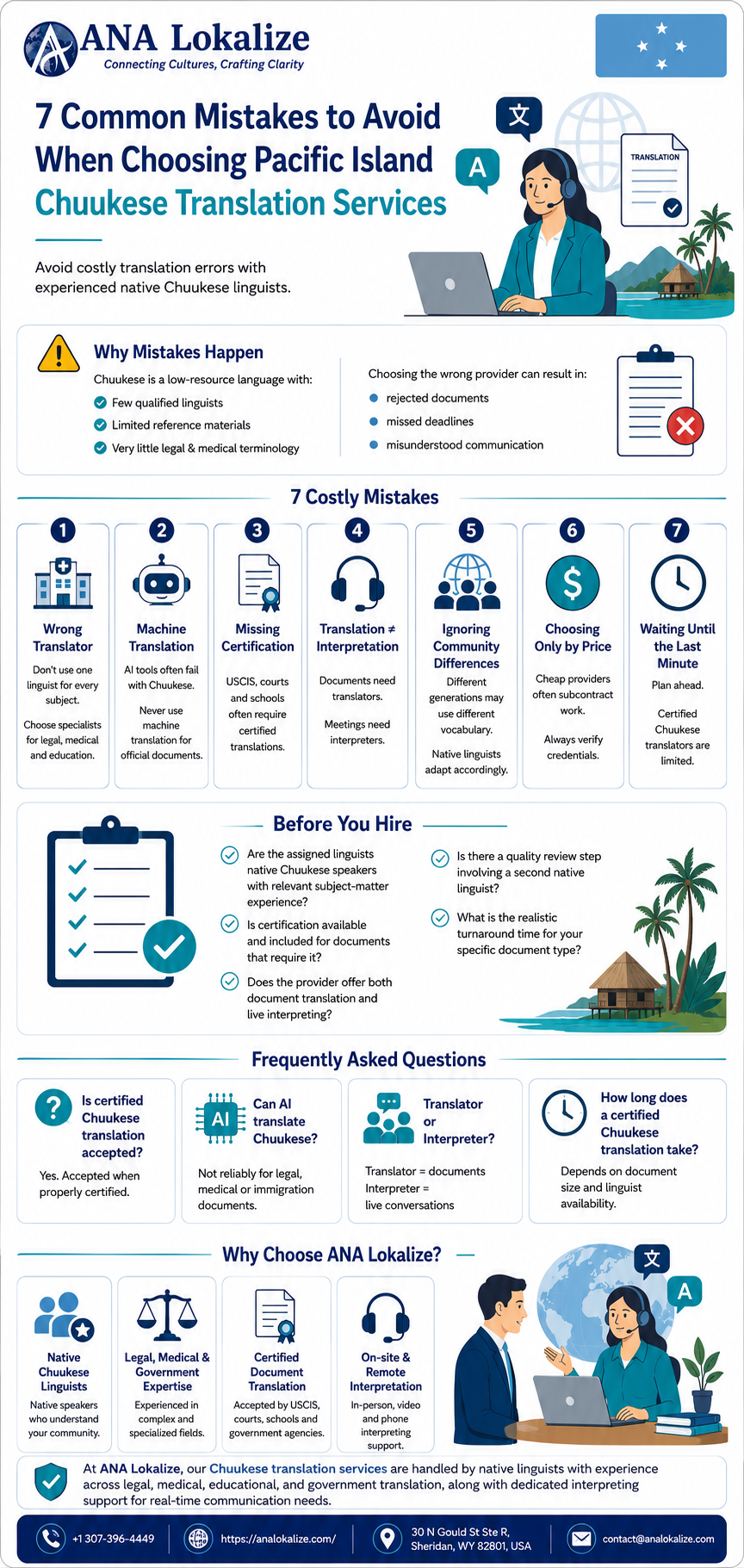
Chuukese is a low-resource Pacific Island language, which means the margin for error in translation is much smaller than it is for widely spoken languages like Spanish or French. There are fewer qualified linguists; fewer reference materials, and almost no standardized glossaries for specialized fields such as law or medicine. That combination makes it easy for businesses and institutions to make mistakes when sourcing Pacific Island Chuukese translation services, often without realizing it until a document is rejected, a deadline is missed, or a message is misunderstood by the person who needed it most.
Below are the most common mistakes organizations make when working with Chuukese
translation and interpreting, along with how partnering with the right Pacific
Island Chuukese language translators helps you avoid each one.
Mistake 1: Assuming One Translator Can Cover Every Subject
Legal, medical, and educational Chuukese translation each involves different
vocabulary, tone, and formatting expectations. A translator skilled in everyday
conversational Chuukese may not be equipped to accurately translate a medical
consent form, an insurance policy, or a court summons, where a single
misinterpreted term can change the meaning of an entire sentence. Always
confirm that your pacific island professional Chuukese translationservices provider assigns linguists based on subject-matter
experience, not simply on who happens to be available that week.
Mistake 2: Relying on Machine Translation for Official Documents
Machine translation tools have very limited
training data for Chuukese, since it is not widely represented online compared
to major world languages. This makes automated English to Chuukese
translation services unreliable for anything beyond casual, low-stakes
communication. For immigration forms, medical records, or legal filings,
machine output can distort meaning entirely, invert instructions, or produce
grammatically broken sentences that native speakers find confusing. Most
agencies will not accept an uncertified, machine-generated translation
regardless of how accurate it appears on the surface.
Mistake 3: Skipping Certification When It's Required
Not every Chuukese translation needs
certification, but many important ones do, including documents submitted to
USCIS, courts, school districts, and licensing boards. Certification is a
signed statement from the translator or agency confirming the translation is
complete and accurate to the best of their knowledge. Without it, agencies
frequently reject the submission outright, creating delays, missed deadlines,
and sometimes additional fees to expedite a corrected version. Confirming
certification requirements before the project begins, rather than after
submission, saves both time and money.
Mistake 4: Treating Interpreting and Translation as the Same Service
Document translation and live interpreting
require different skill sets, even though both involve the same language pair.
A linguist who translates written material well is not automatically equipped
to interpret in real time during a medical appointment, a courtroom hearing, or
a school parent-teacher conference, where split-second accuracy and composure
under pressure matter. If your organization regularly interacts with Chuukese
speakers face-to-face or over the phone, confirm that your provider offers
dedicated interpreting support, whether on-site or through remote video and
phone interpreting, rather than assuming document translators can fill that
role.
Mistake 5: Overlooking Dialectal and Community Variation
While Chuukese is generally standardized compared
to some other Pacific Island languages, regional and generational differences
in vocabulary and phrasing still exist, particularly between older speakers
from Chuuk State and younger Chuukese Americans raised in Hawaii, Guam, Oregon,
or Washington. A translation that sounds natural to one generation may feel
overly formal, outdated, or unfamiliar to another. Experienced Chuukese translators account for these differences by asking about the
intended audience upfront, rather than applying a single fixed version of the
language to every project.
Mistake 6: Choosing the Lowest-Cost Provider Without Vetting Credentials
As qualified Chuukese linguists are scarce
relative to demand, unusually low pricing is often a sign that a provider is
subcontracting the work to a third party, relying on non-native translators, or
skipping quality review steps altogether. This increases the risk of errors
that are difficult to catch without a native Chuukese reviewer on staff. Before
signing a contract, ask directly whether the linguists assigned to your project
are native speakers, where they are based, and what industry-specific experience
they bring. A provider that cannot answer clearly is a warning sign, not a
bargain.
Mistake 7: Not Planning for Turnaround Time
As so few certified Chuukese translators are
available nationwide, last-minute requests can be difficult to fulfill without
sacrificing quality, and rushed translations are where most errors occur.
Organizations that regularly need Chuukese translation, such as hospitals,
school districts, and legal aid groups, benefit significantly from establishing
an ongoing relationship with a provider in advance, including pre-approved
glossaries and preferred linguists, rather than searching for help for the
first time during an urgent situation.
A Quick Checklist Before You Hire
Before starting a Chuukese translation or interpreting project, confirm the
following with your provider:
- Are the
assigned linguists native Chuukese speakers with relevant subject-matter
experience?
- Is
certification available and included for documents that require it?
- Does the
provider offer both document translation and live interpreting?
- Is there a
quality review step involving a second native linguist?
- What is
the realistic turnaround time for your specific document type?
Answering these five questions upfront resolves the majority of issues
organizations run into after the fact.
Frequently Asked Questions
Is certified Chuukese translation
accepted by US government agencies?
Yes, when completed by a qualified provider that
issues a signed certification statement confirming the translation's accuracy
and completeness.
Can machine translation be used for
Chuukese business documents?
It is not recommended for official or high-stakes
documents, since Chuukese has limited machine-translation training data and
errors are common, particularly with grammar and context.
Do I need an interpreter or a translator
for a medical appointment?
A live medical appointment requires an
interpreter for real-time spoken communication, while translation applies to
written documents like intake forms, discharge instructions, or lab results.
How long does a certified Chuukese
translation typically take?
Turnaround depends on document length and
linguist availability, but planning ahead rather than requesting same-day
service significantly improves both speed and accuracy.
Work With a Provider That Gets It Right the
First Time
Avoiding these mistakes comes down to one
decision: working with a translation partner that has direct access to
qualified, native Chuukese linguists, rather than a generalist agency
stretching into a language it rarely handles. The cost of a rejected document,
a missed appointment, or a miscommunication in a legal or medical setting
almost always outweighs the cost of choosing the right provider from the start.
At ANA Lokalize, our Chuukese translation services
are handled by native linguists with experience across legal, medical,
educational, and government translation, along with dedicated interpreting
support for real-time communication needs. Before your next Chuukese
translation project, make sure your provider can answer every question above
with confidence.