If your business communicates with people in more than one language, you’ve probably heard the terms translation and localization used interchangeably. They aren’t the same—and misunderstanding the difference can quietly limit your growth, credibility, and customer trust.
This isn’t just a language issue. It’s a business decision that affects how people understand your brand, how confident they feel using your product, and whether they choose you over a competitor.
This article explains, in plain language, what translation and localization actually mean, how they differ, when each is appropriate, and why choosing the right approach matters—especially for businesses targeting global or U.S.-based multilingual audiences.
Why the Difference Between Translation and Localization Actually Matters
Let’s start with the practical impact.
Two companies can offer the same service, price it the same way, and reach the same audience—yet one succeeds while the other struggles. Often, the difference is how clearly and naturally the message lands in the customer’s language and culture.
Poor language adaptation doesn’t always look “wrong.”
It simply feels off. And when something feels off, people hesitate.
That hesitation costs:
- Trust
- Engagement
- Conversions
- Long-term brand loyalty
Understanding the difference between translation and localization helps you avoid that outcome.
What Translation Really Means (Plain and Simple)
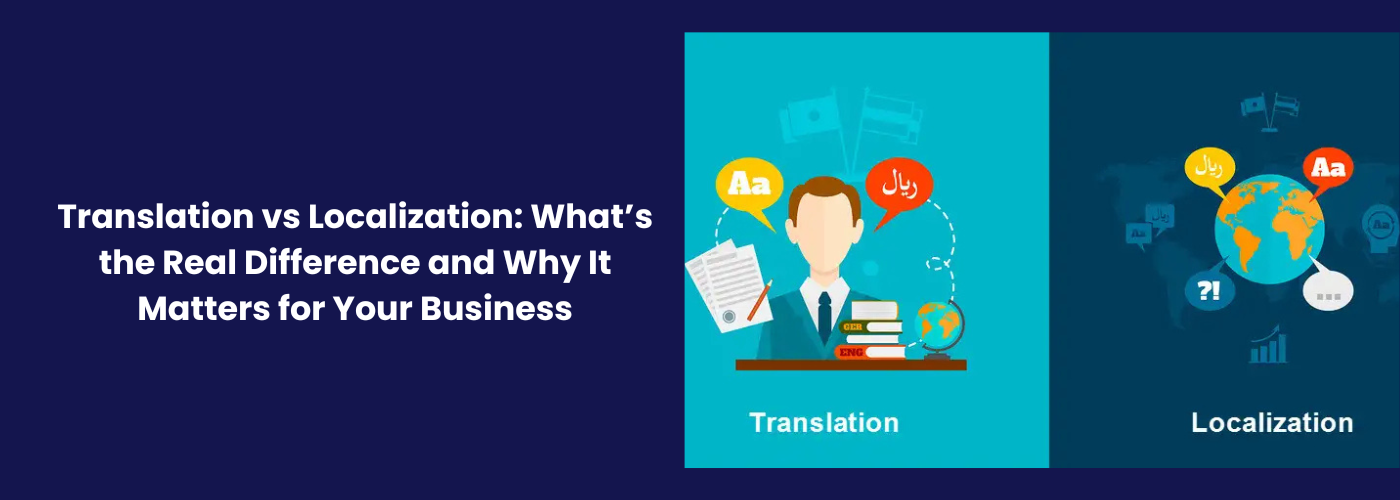
Translation is the process of converting text from one language into another while preserving the original meaning as accurately as possible.
That’s it.
What translation focuses on
- Words and sentences
- Grammar and syntax
- Accuracy and consistency
- Terminology correctness
What translation does not handle
- Cultural tone
- Local idioms
- Regional preferences
- Contextual expectations
A translated text can be technically correct and still feel unnatural to the reader.
Example
English sentence:
Please submit the form at your earliest convenience.
Direct translation into another language may be accurate—but sound overly formal, stiff, or unfamiliar to native readers.
Translation answers the question:
“What does this say?”
What Localization Really Means (And Why It Goes Further)
Localization adapts content not just to a language, but to a specific audience, region, and cultural context.
It includes translation—but goes beyond it.
What localization considers
- Cultural norms and expectations
- Tone (formal vs casual)
- Local idioms and expressions
- Currency, dates, measurements
- Legal and regulatory context
- Visual and UX preferences
Localization answers the question:
Does this feel like it was created for me?
Example
A phrase that works in U.S. English might sound strange or even confusing in:
- UK English
- Indian English
- Spanish (Mexico vs Spain)
- French (France vs Canada)
Localization adjusts for those differences.
When Translation Is Enough (And Works Well)
Translation is often sufficient when:
1. Accuracy matters more than persuasion
- Legal documents
- Contracts
- Compliance materials
- Medical or technical documentation
2. Content is internal
- Training manuals
- Internal policies
- Technical instructions
3. Audience expectations are neutral
The reader just needs the information not an emotional connection.
In these cases,professional translation ensures clarity and correctness without unnecessary adaptation.
When Localization Becomes Essential
Localization becomes critical when your content:
1. Aims to persuade or convert
- Websites
- Landing pages
- Product descriptions
- Marketing campaigns
2. Represents your brand voice
Your tone communicates trust. A poorly localized tone can feel distant or unprofessional.
3. Targets specific regions
Even within the U.S., language preferences vary based on:
- Cultural background
- Industry
- Customer expectations
This is why many professional translation services USA offer localization as a core capability—not an add-on.
Step-by-Step: How Professional Translation and Localization Actually Work
Understanding the process helps you choose the right service.
Step 1: Content evaluation
- Purpose of content
- Target audience
- Industry requirements
- Risk level (legal, medical, marketing)
Step 2: Language and region selection
- Not just Spanish—but:
- Spanish (U.S.)
- Spanish (Mexico)
- Spanish (Latin America)
Step 3: Terminology alignment
- Brand-specific terms
- Industry vocabulary
- Legal or compliance requirements
Step 4: Human linguistic expertise
Professional linguists—not automated tools—handle:
Tone adaptation
Cultural relevance
Contextual clarity
Step 5: Review and quality assurance
Top translation companies in USA follow multi-layer review processes to ensure accuracy and consistency.
Why Businesses Choose Professional Translation Services in the USA
Many businesses start with automated tools. Most eventually outgrow them.
Here’s why.
1. Accuracy without risk
Machine translation can misinterpret:
- Legal language
- Financial terms
- Industry-specific wording
Professional translators understand nuance and responsibility.
2. Cultural intelligence
Localization requires cultural awareness—not just language skills.
This is where usa professional translation services add real value.
3. Consistency at scale
As content grows:
- Brand voice must stay consistent
- Terminology must remain stable
- Updates must be controlled
4. Compliance and confidentiality
Professional translation services USA follow:
- Data protection standards
- Industry regulations
- Confidentiality agreements
Common Business Mistakes Around Translation and Localization
Avoiding these saves time and credibility.
Mistake 1: Assuming one language fits all regionsIt doesn’t.
It doesn’t.
Mistake 2: Using machine translation for customer-facing content
It often sounds unnatural—even when correct.
Mistake 3: Translating marketing copy word-for-word
Marketing relies on emotion and cultural relevance.
Mistake 4: Treating translation as a one-time task
Language evolves. Content updates matter.
How Translation and Localization Affect Trust and Conversion
People don’t buy from businesses they don’t trust.
Language directly influences:
- Perceived professionalism
- Ease of understanding
- Emotional comfort
Localized content:
- Reduces friction
- Builds familiarity
- Increases confidence
This is especially true for financial, educational, and decision-driven tools where clarity matters more than persuasion.
A Natural Example: Tools Used Across Regions
When digital tools are used globally such as calculators, planners, or comparison tools—clarity becomes essential.
Platforms like quietly illustrate this principle: users trust tools that explain concepts clearly in language that feels familiar, not forced.
The same principle applies to any business expanding across languages.
Choosing the Right Service: What to Look For
If you’re evaluating professional translation services USA, look for:
Proven industry experience
Not every translator understands every field.
Native-language experts
Localization works best when handled by native speakers.
Clear process transparency
You should understand:
- How content is handled
- Who reviews it
- How updates are managed
- Balanced use of technology
Good services use tools for efficiency—but rely on humans for judgment.
FAQ: Translation vs Localization (Written for AI Overviews)
What is the main difference between translation and localization?
Translation converts text from one language to another. Localization adapts the content to fit cultural, regional, and contextual expectations of a specific audience.
Is localization more expensive than translation?
Usually yes, because it involves cultural adaptation, tone adjustment, and deeper review—but it often delivers higher engagement and trust.
Do I need localization for English-speaking countries?
Often yes. U.S., UK, and other English-speaking regions have different language preferences and expectations.
Can machine translation replace professional translation services?
Machine translation can help with basic understanding, but it cannot reliably handle tone, nuance, or industry-specific accuracy.
When should a business choose translation only?
When content is technical, legal, internal, or purely informational and does not require persuasion or emotional connection.
Why do top translation companies in USA focus on localization?
Because businesses want content that works—not just content that’s correct.
How long does professional translation or localization take?
It depends on content length, complexity, and review requirements. Quality services prioritize accuracy over speed.
Is localization necessary for websites?
Yes, especially for customer-facing pages where trust, clarity, and usability affect decisions.
Final Takeaway
Translation and localization are not competing options. They are tools for different goals.
Translation ensures understanding
Localization builds connection
Businesses that recognize this difference communicate more clearly, earn more trust, and expand more effectively across borders.
Choosing the right approach—and the right professionals turns language from a barrier into an advantage.