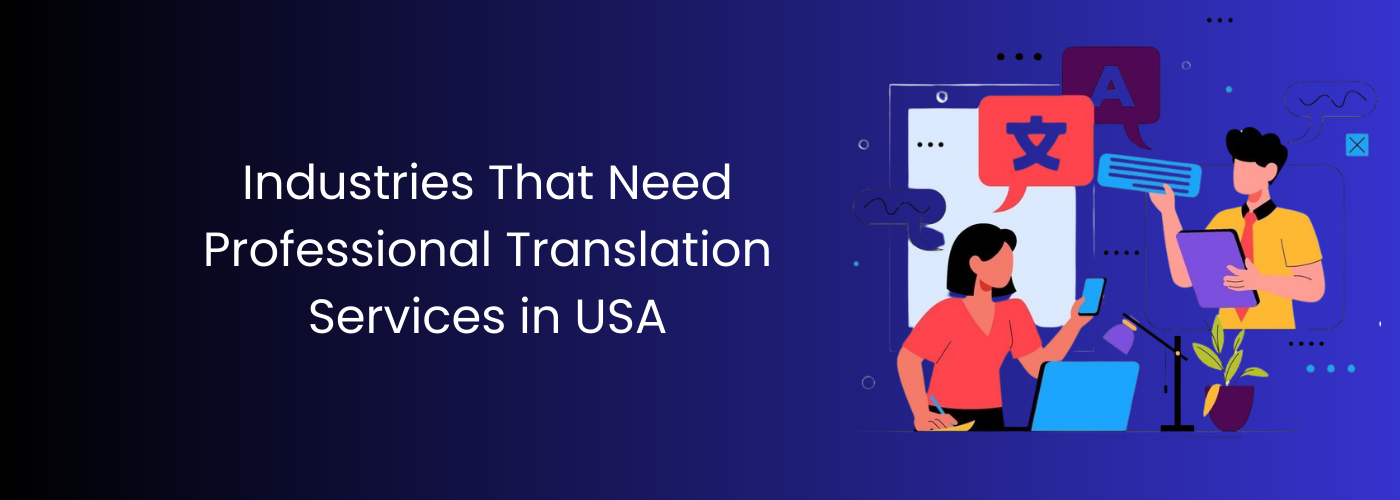
Professional translation services are essential in the United States for industries that rely on legal accuracy, regulatory compliance, patient safety, international trade, and multicultural communication. Sectors like healthcare, legal services, immigration, finance, education, manufacturing, and e-commerce depend on certified, industry-specific translation to avoid costly errors and maintain credibility.
Key Takeaways
- Healthcare and legal industries require precise, certified translations.
- Immigration filings must meet USCIS standards.
- Financial and corporate sectors need multilingual compliance documentation.
- E-commerce and marketing require cultural localization, not just translation.
- Machine translation is not sufficient for regulated industries.
Here’s the reality in 2026.
The United States is one of the most linguistically diverse countries in the world. More than 68 million residents speak a language other than English at home. That diversity drives opportunity — and responsibility.
Businesses that operate across languages don’t just need translation.
They need accuracy, compliance, and cultural precision.
Let’s explore the industries that rely most heavily on professional translation services in the USA — and why it matters.
1. Healthcare & Medical Industry
The healthcare sector depends on precise communication.
Professional medical translation services are critical for:
- Patient records
- Prescription instructions
- Informed consent forms
- Clinical trial documentation
- Medical device manuals
- Pharmaceutical labeling
Inaccurate translation can:
- Lead to incorrect treatment
- Cause dosage errors
- Trigger malpractice risks
- Violate HIPAA compliance
Hospitals and healthcare providers serving multilingual communities must ensure language access. Federal regulations require meaningful language access for limited English proficient (LEP) patients.
Machine translation cannot guarantee patient safety.
Professional human translators with medical expertise ensure terminology accuracy and confidentiality.
2. Legal Industry & Law Firms
Legal language is precise and structured.
Professional legal translation services are required for:
- Contracts and agreements
- Court transcripts
- Immigration filings
- Affidavits
- Intellectual property documents
- Arbitration and litigation materials
Even minor translation errors in legal documents can:
- Shift liability
- Invalidate agreements
- Lead to rejected court submissions
Certified translations are often mandatory for U.S. courts and immigration proceedings.
Legal professionals rely on translation accuracy because legal meaning cannot be approximated.
3. Immigration & Government Services
Immigration is one of the largest drivers of certified translation demand in the USA.
USCIS requires certified English translations for:
- Birth certificates
- Marriage certificates
- Divorce decrees
- Academic transcripts
- Foreign-language identification documents
Incomplete or inaccurate translations can delay visa processing or naturalization.
Government agencies, courts, and immigration attorneys depend on professional translation providers to ensure compliance.
Machine translation tools cannot provide certification or accountability.
4. Financial & Banking Industry
The financial sector operates in highly regulated environments.
Professional translation services are used for:
- Financial translation
- Audit reports
- Investment documentation
- Compliance filings
- Loan agreements
- Insurance contracts
Translation errors in financial documents can:
- Misstate liabilities
- Create regulatory violations
- Confuse investors
- Trigger legal disputes
Financial terminology requires subject-matter expertise.
Literal translation is not sufficient in compliance-driven industries.
5. Manufacturing & Engineering
Manufacturers operating internationally require technical translation for:
- Equipment manuals
- Safety instructions
- Product specifications
- Engineering documentation
- Supply chain contracts
Inaccurate translation in manufacturing can:
- Cause workplace safety incidents
- Lead to product misuse
- Trigger warranty disputes
Technical translators must understand industry-specific terminology and standards.
Precision protects operational safety.
6. E-Commerce & Retail
Global commerce has expanded dramatically in 2026.
E-commerce businesses rely on professional translation for:
E-commerce businesses rely on professional translation for:
- Product descriptions
- Website localization
- Multilingual SEO content
- Customer support documentation
- Return policies
- Marketing campaigns
Machine translation may convert words — but it does not adapt tone, cultural nuance, or search behavior.
Localization ensures:
Localization ensures:
- Higher conversion rates
- Improved search visibility
- Brand consistency
- Customer trust
Multilingual SEO translation is a competitive advantage.
7. Education & Academic Institutions
Universities and academic institutions depend on professional translation for:
Universities and academic institutions depend on professional translation for:
- Academic transcripts
- Research publications
- Enrollment materials
- Student visa documentation
- Multilingual marketing
International students submitting foreign transcripts often require certified translations.
Research collaboration across borders requires technical accuracy.
Educational institutions cannot risk misinterpretation.
8. Pharmaceutical & Clinical Research
Clinical research is highly regulated.
Professional translation is required for:
Professional translation is required for:
- Clinical trial protocols
- Regulatory submissions
- Patient consent forms
- Drug labeling
- Safety reporting documentation
Regulatory agencies require accurate documentation in multiple languages.
Errors in pharmaceutical translation can:
Errors in pharmaceutical translation can:
- Delay approvals
- Compromise patient safety
- Trigger compliance violations
Professional translation providers understand regulatory language standards.
9. Technology & Software Companies
Technology companies expanding globally require localization services for:
- Software interfaces
- User manuals
- SaaS dashboards
- Privacy policies
- Technical support materials
Software translation must consider:
Software translation must consider:
- User experience
- Character limits
- Technical terminology
- Legal compliance (privacy laws)
Machine translation often produces awkward user interfaces.
Professional localization ensures a seamless user experience across languages.
10. Real Estate & Property Development
Real estate companies working with international investors require translation for:
- Property contracts
- Purchase agreements
- Mortgage documentation
- Investment proposals
- Property marketing materials
Misinterpreted clauses in property agreements can lead to financial disputes.
Professional translation ensures clarity in high-value transactions.
11. Media, Entertainment & Publishing
The media industry depends on language adaptation.
Professional translation services support:
- Subtitling
- Dubbing scripts
- Publishing contracts
- Licensing agreements
- Multilingual content adaptation
Entertainment content requires cultural sensitivity and tone adaptation.
Machine translation often fails in humor, idioms, and creative writing.
Why Regulated Industries Cannot Rely on Machine Translation
AI translation tools have improved in 2026.
But they cannot:
- Certify translations
- Assume legal liability
- Guarantee regulatory compliance
- Understand nuanced legal or medical terminology
Industries that operate under compliance standards must prioritize accuracy over speed.
Professional translation ensures accountability.
The Growing Demand for Professional Translation in the USA
Several factors drive demand:
- Immigration growth
- Multilingual healthcare requirements
- International trade expansion
- Global remote workforce
- Cross-border e-commerce
- Federal language access regulations
Businesses serving diverse communities must invest in accurate communication.
Language access is no longer optional.
It’s operational infrastructure.
How to Choose the Right Translation Partner
Industries requiring professional translation should look for:
- Certified translation services
- Industry-specific expertise
- Confidentiality and data protection
- Multi-layer quality assurance
- Fast turnaround without sacrificing accuracy
- Compliance with U.S. standards
Specialization matters.
Not every translation provider is qualified for regulated industries.
FAQs – Professional Translation Services by Industry
1. Which industries need certified translation services in the USA?
Healthcare, legal, immigration, financial, pharmaceutical, and government sectors frequently require certified translation services. These industries operate under regulatory standards where document accuracy and compliance are mandatory.
2. Why can’t regulated industries rely on machine translation?
Machine translation cannot provide certification, legal accountability, or guaranteed regulatory compliance. In industries like healthcare and law, errors can lead to lawsuits, rejected filings, or patient safety risks.
3. What is industry-specific translation?
Industry-specific translation involves translators with subject-matter expertise in areas such as medicine, law, finance, or engineering. This ensures terminology accuracy and contextual understanding beyond literal language conversion.
4. Are professional translation services required for USCIS documents?
Yes. USCIS requires certified English translations for foreign-language documents submitted with immigration applications. The translation must include a signed certification statement confirming accuracy.
5. How do professional translation services ensure accuracy?
Professional providers use multi-step quality control, subject-matter experts, terminology management systems, proofreading layers, and certification processes to maintain precision and compliance.
6. Is multilingual SEO important for e-commerce businesses?
Yes. Multilingual SEO translation adapts keywords and content to target markets, improving search visibility and conversion rates. Literal translation alone does not optimize for local search behavior.
Partner with Analokalize for Industry-Specific Translation
At Analokalize, we provide professional translation services tailored to regulated and high-risk industries across the United States.
We offer:
- Certified translation services
- Legal and medical specialization
- Multilingual SEO localization
- Confidential document handling
- AI-assisted efficiency with human review
- Fast, reliable turnaround
Whether you operate in healthcare, law, finance, manufacturing, or global e-commerce, we ensure your communication is accurate, compliant, and culturally precise.
Request a Free Quote at Analokalize.com
Because in regulated industries, translation isn’t just language.
It’s protection.