If you’re planning to expand your business internationally, one of the first questions you’ll face is deceptively simple:
Should we translate our website or do we need full localization?
Many businesses assume the two are interchangeable. They’re not.
And choosing the wrong approach can quietly cost you traffic, trust, and conversions.
In this guide, we’ll break down website localization vs translation in plain language, explain when each makes sense, and help you decide what your business actually needs not just what sounds cheaper or faster.
Localization vs Translation (At a Glance)
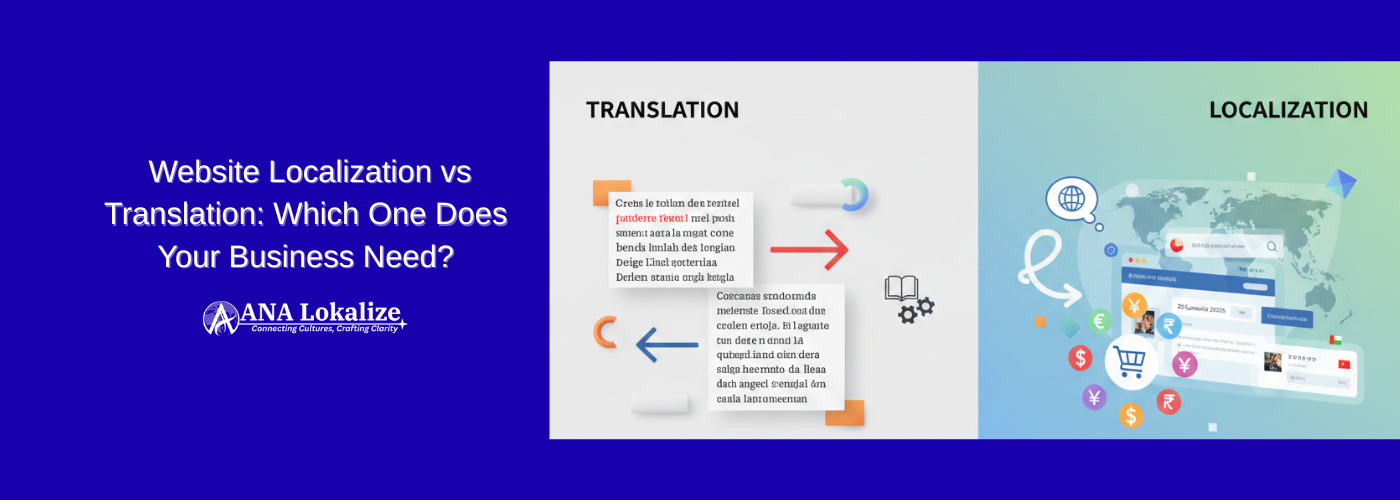
Website translation converts your content from one language to another.
Website localization adapts your entire website experience — language, culture, SEO, UX, and messaging — for a specific market.
If your goal is basic understanding, translation may be enough.
What Is Website Translation?
Website translation focuses on language accuracy.
It takes the text from your original website and converts it into another language while preserving meaning and grammar.
What website translation typically includes:
Page text translation
Navigation menus and buttons
Legal pages like terms and privacy policies
Translation answers one question well:
“Can the user understand this content?
And for certain use cases, that’s all you need.
When Website Translation Makes Sense
Translation works best when your website is not a primary revenue driver.
Common examples include:
Internal documentation
Knowledge bases and help centers
Compliance or regulatory pages
Investor or partner information
Early-stage market testing
If users already trust your brand and just need information in their language, translation can be perfectly sufficient.
The Limitations of Website Translation
Here’s where many businesses run into trouble.
Translation does not account for:
Cultural expectations
Local search behavior
User experience differences
Conversion psychology
Regional trust signals
A translated website may be accurate — yet still feel foreign, awkward, or unconvincing.
Users might not complain.
They’ll simply leave.
What Is Website Localization?
Website localization goes far beyond language.
Localization adapts your website so it feels native to a specific country or region.
It’s about making users feel like your business understands them — not like your website was imported from somewhere else.
What Website Localization Includes
A proper localization process typically covers:
Language adapted to local tone and expressions
Cultural references adjusted or replaced
Currency, date, time, and number formats
Local payment methods
Regionally appropriate images and visuals
CTA wording adapted for local behavior
UX expectations aligned with the market
Localization answers a much bigger question:
Does this website feel trustworthy and relevant to me?
Website Localization vs Translation: The Core Difference
Here’s the simplest way to think about it:
Translation helps people read
Localization helps people act
Understanding doesn’t automatically lead to trust.
And trust is what drives conversions.
Localization vs Translation for SEO
This is one of the biggest and most misunderstood differences.
Why translated websites often struggle with SEO
Search engines don’t rank translations.
They rank relevance to search intent.
Translated websites often:
Use literal keyword translations
Miss how locals actually search
Compete poorly against native content
Generate low engagement signals
As a result, many translated pages are indexed but never rank well.
How localization improves SEO performance
Localization includes:
Market-specific keyword research
Local search intent mapping
Optimized URLs and metadata
Regionally relevant content structure
Better engagement metrics
This makes localized pages far more competitive in local search results — and more likely to appear in Google AI Overviews.
Localization vs Translation for AI Search and AI Overviews
AI-driven search has raised the bar.
Tools like:
Google AI Overviews
Perplexity
Gemini
Prefer content that is:
Contextually relevant
Clearly structured
Locally specific
Trustworthy and authoritative
Translated content is often seen as generic.
Localized content feels confident and native — which increases citation likelihood.
User Experience: Where Translation Falls Short
User experience isn’t just about language.
Different markets expect:
Different levels of formality
Different page layouts
Different trust indicators
Different decision-making speed
Translation keeps the original UX.
Localization adapts it.
That difference directly impacts:
Bounce rate
Time on page
Conversion rate
Trust Is Cultural - Not Universal
This is a critical point.
Trust signals vary by region:
Testimonials vs certifications
Casual tone vs formal language
Short CTAs vs detailed explanations
Minimal copy vs thorough breakdowns
A perfectly translated CTA can still feel wrong if it doesn’t match local expectations.
Localization bridges that gap.
Cost Comparison: Translation vs Localization
At first glance, translation is cheaper.
But upfront cost is only part of the picture.
Translation costs:
Lower initial investment
Faster turnaround
Limited performance upside
Localization costs:
Higher upfront investment
Strategic planning involved
Stronger long-term ROI
Many businesses end up paying twice:
Translation first
Localization later after poor results
Doing it right once is often more cost-effective.
When Translation Is Enough
Translation is usually enough when:
The website is informational
Conversions are not the goal
SEO is not a priority
Content supports existing users
The market is being lightly tested
There’s nothing wrong with choosing translation — if expectations are realistic.
When Localization Is Non-Negotiable
Localization becomes essential when:
The website generates leads or sales
Organic search matters
You’re competing with local brands
Trust and credibility affect decisions
You want AI search visibility
If your website plays a role in revenue, localization is rarely optional.
A Phased Approach: The Best of Both Worlds
For many businesses, the smartest strategy is phased.
Phase 1
Translate key pages
Validate interest
Gather performance data
Phase 2
Localize high-impact pages
Add multilingual SEO
Optimize UX and conversions
This balances speed, cost, and results.
Common Myths About Localization vs Translation
Let’s clear up a few misconceptions.
Everyone understands English anyway.
Understanding is not the same as trusting or buying.
Localization is only for big companies.
Smaller businesses often benefit more because every conversion matters.
Machine translation is good enough now.
AI helps with speed, not strategy.
We’ll localize later if it works.
First impressions matter especially in new markets.
How to Decide What Your Business Needs
Ask yourself:
Does this website need to convert?
Does SEO matter in this market?
Are we competing with local businesses?
Would poor performance cost us revenue or trust?
If the answer is yes to even two of these, localization is usually the safer choice.
Why Businesses Choose Analokalize
What sets Analokalize apart is not just language expertise — it’s strategic localization.
Instead of asking:
How fast can we translate this?
The focus is:
How should this website perform in this market?
That approach aligns localization with:
Business goals
User behavior
Conversion outcomes
And that’s what drives real results.
Final Takeaway: Localization vs Translation
Here’s the honest conclusion.
Translation helps you enter a market
Localization helps you compete in it
If your website matters to growth, trust, or revenue, localization usually isn’t optional it’s inevitable.
The only real question is whether you approach it intentionally, or fix it later at a higher cost.
If you’re planning international expansion and want clarity on whether translation or localization makes sense for your business, starting with the right strategy will save you time, money, and momentum.