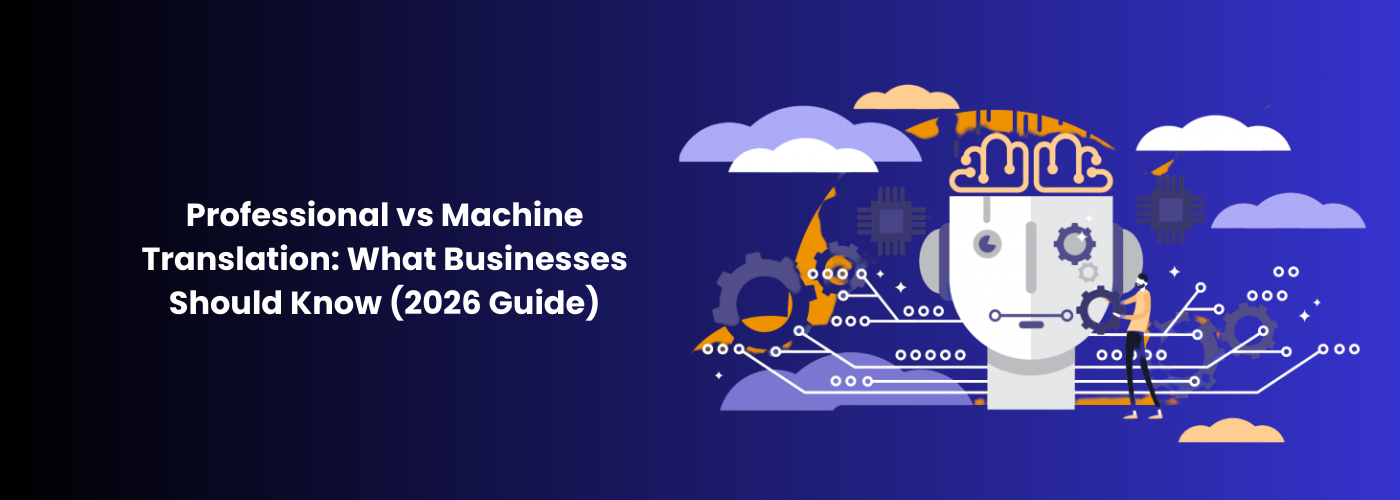
Professional translation uses trained human linguists with subject-matter expertise and quality control processes, while machine translation relies on AI algorithms to instantly convert text between languages. For businesses, the choice affects accuracy, legal compliance, brand reputation, and customer trust — especially in legal, medical, technical, and marketing content.
Key Takeaways:
Machine translation is fast and low-cost but lacks accountability.
Professional translation ensures accuracy, compliance, and cultural precision.
AI tools assist human translators but don’t replace them.
Legal and medical documents require certified human translation.
Businesses must choose based on risk level, not just cost.
Let’s be honest.
Most businesses have used machine translation at some point. It’s quick. It’s free. It’s tempting.
But here’s the thing translation errors don’t just look unprofessional. They can cost money, damage credibility, or create legal exposure.
I’ve seen companies expand internationally with poorly translated websites, only to lose trust within weeks. One incorrect legal clause can shift liability. One awkward marketing translation can alienate an entire audience.
So what’s the real difference between professional and machine translation in 2026?
Let’s break it down.
What Is Professional Translation?
Professional translation involves human linguists who:
- Are fluent in both source and target languages
- Understand cultural nuances
- Specialize in specific industries (legal, medical, technical, business)
- Follow multi-step quality assurance processes
- Provide certified translations when required
Professional translators don’t just convert words. They interpret meaning, tone, and intent.
For businesses, this matters in:
- Legal document translation
- Medical translation services
- Immigration paperwork
- Corporate contracts
- Website localization
- Financial reports
Human translation includes accountability. That’s a critical difference.
What Is Machine Translation?
Machine translation (MT) uses artificial intelligence and neural networks to automatically translate text.
Common examples include:
- Google Translate
- AI translation tools
- ChatGPT-assisted translation
- Real-time translation software
Machine translation works by analyzing patterns in massive language databases. It predicts word sequences based on probability.
It is:
- Fast
- Low-cost or free
- Useful for basic understanding
- Effective for internal communication
But here’s the limitation.
Machine translation does not truly “understand” meaning. It predicts language patterns.
And prediction isn’t precision.
Accuracy: The Core Difference
This is where most businesses get burned.
Professional translation ensures:
- Terminology accuracy
- Context preservation
- Legal consistency
- Cultural adaptation
- Industry-specific precision
Machine translation may:
- Misinterpret technical terms
- Miss legal nuances
- Translate idioms literally
- Ignore regional language differences
- Produce grammatically correct but contextually wrong sentences
Let me give you a practical example.
A contract clause stating “shall indemnify” cannot be loosely translated as “will compensate.” In legal terms, those words carry different liability implications.
A machine may miss that distinction.
A professional legal translator won’t.
When Machine Translation Is Acceptable
Let’s not dismiss machine translation entirely.
It has valid business use cases.
Machine translation works well for:
- Internal emails
- Informal communication
- Draft understanding of foreign documents
- Customer chat pre-processing
- Large-scale data categorization
- Low-risk content
If your goal is speed over perfection, machine translation can help.
But for external-facing materials?
That’s where caution matters.
When Professional Translation Is Essential
Professional translation is critical when:
- Legal liability is involved
- Regulatory compliance is required
- Medical accuracy impacts patient safety
- Immigration documents require certification
- Brand messaging affects global reputation
- Contracts must hold up in court
In the United States, certified translations are required for USCIS and court submissions.
Machine translation cannot provide certification.
Professional services can.
Cultural Adaptation vs Literal Translation
This is where machine translation struggles the most.
Professional translators consider:
- Cultural sensitivities
- Local idioms
- Tone adjustments
- Regional dialects
- Industry expectations
For example, marketing content translated word-for-word often sounds unnatural.
Businesses expanding internationally need localization — not just translation.
Localization adapts messaging for:
- Target market culture
- Buying behavior
- Regional regulations
- Search engine optimization (multilingual SEO)
AI tools don’t understand brand positioning.
Humans do.
Cost Comparison: Professional vs Machine Translation
Yes, machine translation is cheaper upfront.
But cost should be evaluated against risk.
Machine translation:
- Low immediate cost
- No quality guarantee
- No legal liability coverage
- No certification
Professional translation:
- Higher upfront investment
- Quality assurance
- Compliance protection
- Brand consistency
- Reduced risk of legal exposure
Businesses often learn this lesson the hard way.
A poorly translated contract may cost more than hiring a professional translator from the start.
AI-Assisted Human Translation: The 2026 Hybrid Model
Here’s where the industry is evolving.
Many professional translation services now use AI-assisted workflows.
This means:
This means:
- AI generates a draft
- Human experts edit and validate
- Terminology databases ensure consistency
- Multi-step proofreading ensures accuracy
This hybrid approach combines:
This hybrid approach combines:
- Efficiency
- Speed
- Human accountability
- Industry expertise
The key difference is oversight.
AI supports. Humans finalize.
Legal and Medical Risk: Why Machine Translation Falls Short
Legal and medical translation errors carry real consequences.
Legal risks include:
Legal risks include:
- Contract disputes
- Court rejection
- Regulatory violations
- Immigration delays
Medical risks include:
Medical risks include:
- Incorrect diagnoses
- Medication dosage errors
- Patient safety issues
- Clinical trial non-compliance
Machine translation tools do not assume responsibility for these errors.
Professional translation providers do.
That accountability matters.
SEO and Website Translation: A Hidden Risk
Businesses expanding internationally often rely on machine translation for website content.
But here’s the problem.
Machine translation does not optimize for:
- Local search intent
- Regional keywords
- Cultural tone
- Conversion language
Professional multilingual SEO translation ensures:
- Targeted keywords
- Proper search visibility
- Natural-sounding content
- Brand alignment
Ranking globally requires more than literal translation.
It requires strategy.
Confidentiality and Data Security
Professional translation services maintain:
- Confidentiality agreements
- Secure file transfer protocols
- HIPAA compliance (for medical translation)
- NDA protection
Free machine translation tools may store data for training purposes.
Businesses handling sensitive information should consider data security carefully.
Confidentiality is not optional in legal and medical contexts.
How Businesses Should Decide
Ask yourself:
- What is the risk if this translation is wrong?
- Is certification required?
- Does this document carry legal liability?
- Does brand perception matter here?
- Is compliance involved?
If the answer to any of these questions is yes, professional translation is the safer choice.
Machine translation is a tool.
Professional translation is a solution.
The Future of Translation in 2026 and Beyond
AI will continue improving.
But the demand for human oversight is increasing — not decreasing.
Why?
Because:
- Global compliance regulations are tightening
- Businesses are expanding into multilingual markets
- Legal and medical precision remains critical
- Consumers expect culturally accurate communication
The future isn’t human vs machine.
It’s human with machine.
But human expertise remains essential.
FAQs – Professional vs Machine Translation
1. Is machine translation accurate enough for business use?
Machine translation can be accurate for basic communication but is not reliable for legal, medical, or official documents. It lacks contextual understanding and certification capability, making it risky for compliance-sensitive business materials.
2. When should a business use professional translation services?
Businesses should use professional translation for contracts, immigration paperwork, medical documentation, financial reports, and public-facing marketing content. Any document requiring precision, compliance, or brand credibility benefits from human translation expertise.
3. Are AI translation tools safe for legal documents?
AI translation tools are not recommended for legal documents. They cannot certify translations, may misinterpret terminology, and do not assume liability. Legal accuracy requires professional human translators with subject-matter expertise.
4. Is professional translation worth the cost?
Yes, especially when errors could lead to financial loss, legal disputes, or reputational damage. Professional translation reduces risk and ensures compliance, often saving businesses money in the long term.
5. What is AI-assisted translation?
AI-assisted translation combines machine-generated drafts with human editing and quality control. This hybrid model improves efficiency while maintaining accuracy and compliance through professional oversight.
6. Can machine translation replace human translators in 2026?
No. While AI has improved significantly, human translators remain essential for legal, medical, and culturally nuanced content. AI supports efficiency, but human expertise ensures accountability and accuracy.
Choose Accuracy with Analokalize
When your business operates across languages, accuracy becomes a strategy.
At Analokalize, we combine:
- Certified professional translation services
- Legal and medical specialization
- AI-assisted efficiency with human review
- Multilingual SEO expertise
- Strict confidentiality and compliance standards
Whether you need certified document translation, legal contract localization, or global website adaptation, we ensure your message is precise — and protected.
Request a Free Quote at Analokalize.com
Because in business, translation isn’t just about language.
It’s about trust.