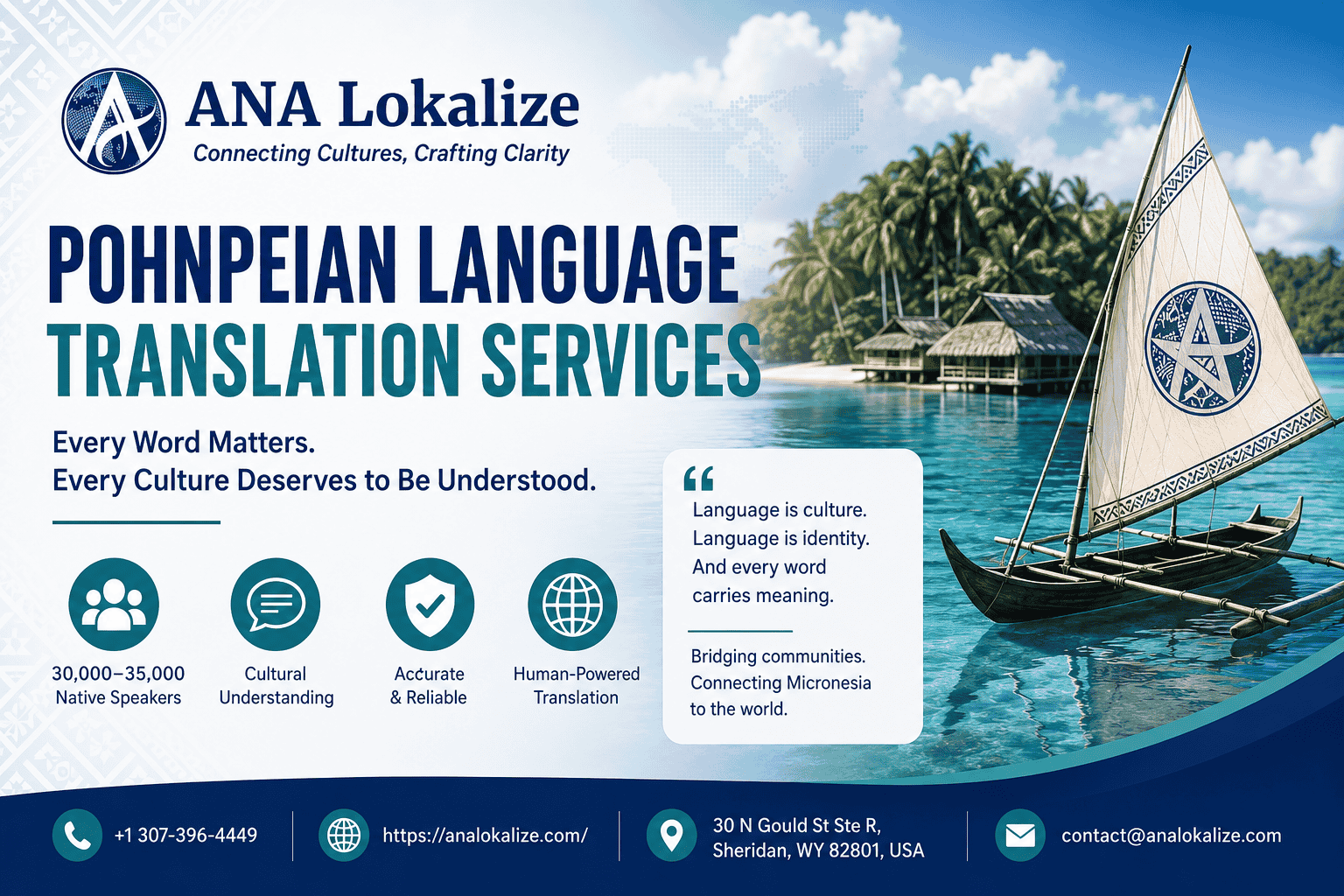
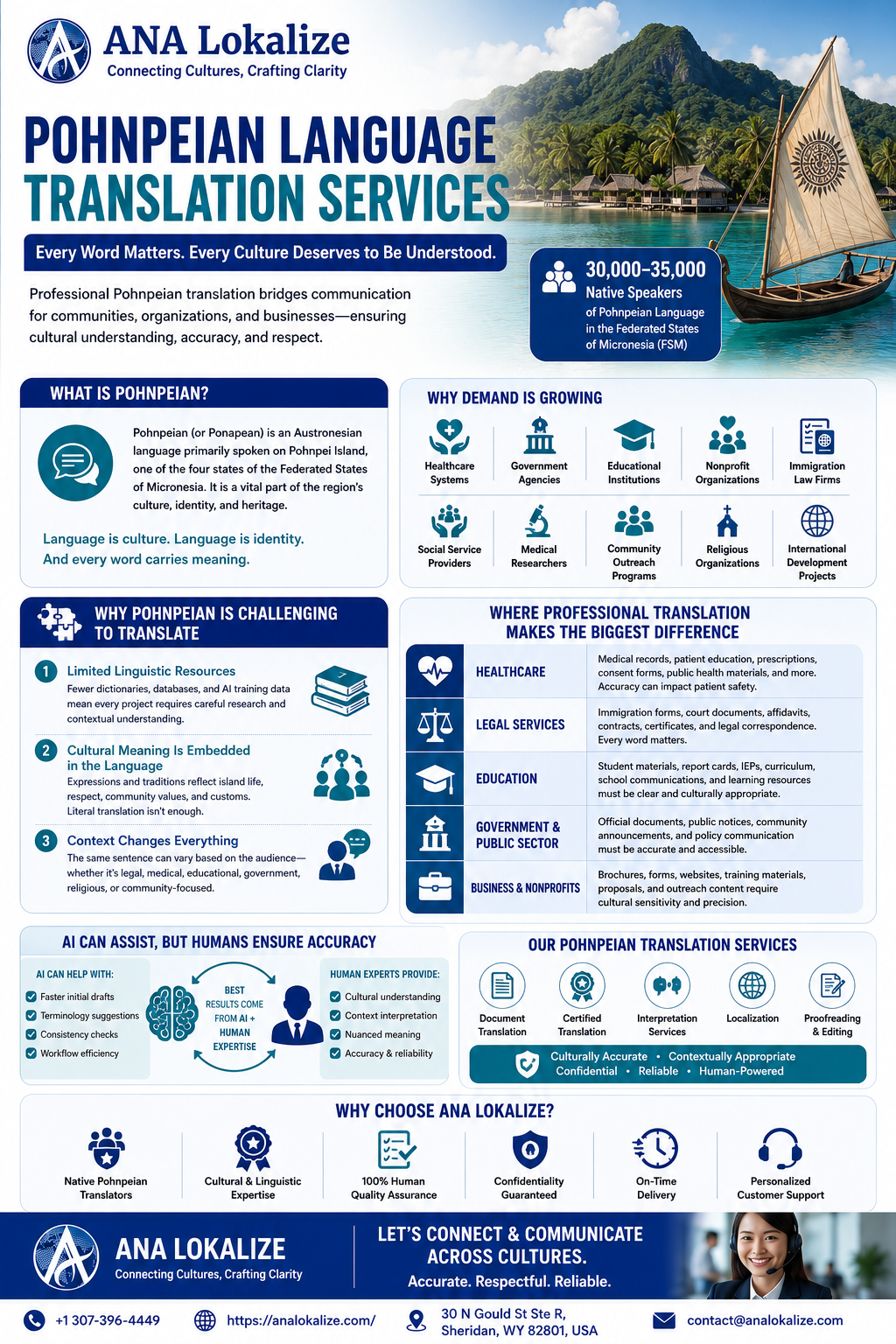
If you're searching for Pohnpeian Language Translation Services, chances are you're working on something that truly matters. It could be a healthcare initiative serving Pacific Island communities, an educational program, immigration paperwork, government communication, a nonprofit project, business expansion, or research involving the Federated States of Micronesia. Whatever your reason, one thing quickly becomes clear: translating Pohnpeian isn't simply about replacing one language with another. It requires cultural understanding, linguistic expertise, and careful attention to context. In this guide, I'll explain why professional Pohnpeian translation matters, the unique challenges of this language, how AI is beginning to influence translation workflows, and why experienced human translators continue to play an irreplaceable role.
A Language That Represents More Than Words
One of the things I've learned while
working with lesser-known languages is that they often carry some of the
richest cultural traditions in the world.
Pohnpeian is one of those languages.
Although it may not receive the same global
attention as Spanish, Mandarin, French, or Arabic, it represents the identity,
traditions, history, and daily lives of thousands of people living on Pohnpei
Island and throughout the Federated States of Micronesia (FSM).
Language isn't just communication.
It's culture.
It's history.
It's identity.
As the famous linguist Ludwig
Wittgenstein once wrote:
"The limits of my language mean the
limits of my world."
That quote perfectly captures why accurate
translation matters. Every language reflects a unique way of understanding the
world, and Pohnpeian is no exception.
What Is the Pohnpeian Language?
Pohnpeian (sometimes spelled Ponapean)
is an Austronesian language primarily spoken on the island of Pohnpei,
one of the four states that make up the Federated States of Micronesia.
According to linguistic research, Pohnpeian
has approximately 30,000 to 35,000 native speakers, making it one of the
major indigenous languages of Micronesia. While the number of speakers is
relatively small compared to global languages, Pohnpeian remains an important
language for government, education, community life, and cultural preservation
within the region.
The language belongs to the Micronesian
branch of the Austronesian language family, connecting it historically to
many Pacific Island languages while maintaining its own unique grammar,
vocabulary, pronunciation, and cultural expressions.
For many families living abroad—including
communities in Hawaii, Guam, and parts of the mainland United States—Pohnpeian
also serves as a vital connection to heritage and identity.
Why Demand for Pohnpeian Language Translation Services Is Growing
Many people assume that translation demand
only exists for languages with hundreds of millions of speakers.
In reality, demand is often driven by need,
not population size.
Over the last decade, globalization,
migration, healthcare accessibility, educational outreach, and digital
communication have increased the need for professional Pohnpeian translation.
We've seen growing demand from
organizations working in areas such as:
- Healthcare systems
- Government agencies
- Educational institutions
- Nonprofit organizations
- Immigration law firms
- Social service providers
- Medical researchers
- Community outreach programs
- Religious organizations
- International development projects
Each of these sectors requires accurate
communication because misunderstandings can have real-world consequences.
Why Pohnpeian Is Challenging to Translate
Whenever someone asks me why professional
translators are still needed in an era of AI, I often use languages like
Pohnpeian as an example.
There are several reasons why this language
requires specialized expertise.
1. Limited Linguistic Resources
Unlike English, Spanish, or Mandarin,
Pohnpeian has relatively limited digital language resources.
This means:
- Smaller bilingual dictionaries
- Fewer parallel translation databases
- Limited AI training data
- Fewer academic corpora
- Less commercially available terminology
For translators, this means every project
requires careful research and contextual understanding rather than relying
solely on automated tools.
2. Cultural Meaning Is Embedded in the Language
One of the biggest misconceptions about
translation is that every word has a direct equivalent.
In practice, that's rarely true.
Pohnpeian contains expressions, traditions,
and social concepts that reflect island life, community relationships, respect,
and cultural customs.
A literal translation may communicate the
words.
A professional translation communicates the
intended meaning.
That's an important difference.
3. Context Changes Everything
The same sentence may need different
translations depending on whether it's intended for:
- A government agency
- A healthcare provider
- A school
- A legal document
- A church community
- A nonprofit organization
- A family
Professional translators don't simply
translate vocabulary.
They interpret context.
Where Professional Pohnpeian Translation Makes the Biggest Difference
In my experience, some industries simply
cannot afford inaccurate translations.
Healthcare
Healthcare is one of the most critical
areas.
Translation may involve:
- Medical records
- Patient education materials
- Prescription instructions
- Consent forms
- Public health campaigns
- Clinical research
A small misunderstanding can affect patient
safety.
That's why qualified human review remains essential.
Legal Services
Legal translation requires absolute
precision.
Common documents include:
- Immigration paperwork
- Court documents
- Affidavits
- Contracts
- Birth certificates
- Marriage certificates
- Legal correspondence
In legal settings, every word matters.
Education
Schools and universities increasingly serve
multilingual communities.
Translation often supports:
- Student enrollment
- Parent communication
- Educational materials
- Academic transcripts
- Special education documentation
- Community outreach
Clear communication strengthens educational outcomes for everyone involved.
Government & Public Services
Government agencies frequently communicate
with residents whose primary language is not English.
Professional translation helps improve:
- Public announcements
- Voting information
- Emergency preparedness
- Social services
- Housing information
- Community programs
Accurate translation promotes accessibility and inclusion.
Nonprofit & Community Organizations
Many nonprofit organizations operate in
Pacific Island communities.
Their translation needs often include:
- Grant materials
- Community education
- Health awareness campaigns
- Disaster preparedness information
- Environmental initiatives
- Volunteer training
These organizations rely on language to build trust within local communities.
Why Machine Translation Still Struggles with Pohnpeian
People often ask me,
"Can't AI translate everything
now?"
The honest answer is:
Not yet.
Especially not for languages like
Pohnpeian.
Artificial intelligence performs best when
it has access to enormous quantities of high-quality bilingual data.
Major world languages benefit from decades
of digitized books, websites, government publications, research papers,
subtitles, and multilingual datasets.
Pohnpeian does not have that same level of
digital representation.
As a result, automated translation systems
often struggle with:
- Cultural references
- Local idioms
- Community-specific terminology
- Sentence structure
- Contextual meaning
- Formal versus informal language
This doesn't mean AI isn't useful.
It simply means it shouldn't be trusted without professional human review.
Human Expertise Still Matters
One observation I've made over the years is
that clients rarely judge a translation by whether each individual word is
technically correct.
They judge it by one simple question:
"Does this sound natural to the
person reading it?"
That's where experienced translators make
the difference.
Professional linguists consider:
- Cultural appropriateness
- Audience expectations
- Tone of voice
- Regional usage
- Technical terminology
- Readability
- Accuracy
Translation is both a science and an art.
The science ensures accuracy.
The art ensures communication.
A Quote Worth Remembering
Nelson Mandela once said:
"If you talk to a man in a language
he understands, that goes to his head. If you talk to him in his own language,
that goes to his heart."
Whenever I think about translation, this
quote comes to mind.
Professional translation isn't just about making
information understandable.
It's about making people feel understood.
That difference builds trust.
And trust is the foundation of every successful conversation, business relationship, healthcare interaction, and community partnership.
Why We Believe in Human + AI Collaboration
At Ana Lokalize, we don't see artificial
intelligence as a replacement for professional translators.
We see it as a productivity tool.
AI can help with:
- Initial translation drafts
- Terminology consistency
- Translation memory
- Large document processing
- Workflow efficiency
But every important project still benefits
from experienced human linguists who understand context, culture, and the
purpose behind the words.
The future of translation isn't human
versus AI.
It's human expertise enhanced by intelligent technology.
Looking Ahead
As global communication continues to
expand, languages like Pohnpeian deserve the same level of respect and
professional attention as any major international language.
Businesses, healthcare providers, educators, researchers, nonprofits, and government agencies are increasingly recognizing that meaningful communication begins with accurate translation.
Certified Pohnpeian Language Translation Services: When Accuracy Isn't
Optional
Not every translation project requires
certification.
However, there are situations where
certified translation isn't simply preferred—it is required.
Over the years, we've worked with clients
who needed translations for immigration applications, educational institutions,
legal proceedings, and government agencies. In these cases, a translation must
do more than communicate meaning; it must also satisfy official requirements.
Certified Pohnpeian translation services
are commonly requested for:
- Birth certificates
- Marriage certificates
- Divorce decrees
- Academic transcripts
- Diplomas
- Court documents
- Affidavits
- Immigration paperwork
- Police records
- Medical reports
- Financial documents
- Employment records
Many organizations require a signed
certification stating that the translation is complete and accurate to the best
of the translator's knowledge.
When submitting official documents, accuracy isn't just important—it can directly affect approvals, legal decisions, and administrative processes.
Localization Goes Beyond Translation
One mistake I often see businesses make is
assuming translation and localization are the same thing.
They're closely related, but they're not
identical.
Translation focuses on converting text from
one language to another.
Localization adapts the content so it feels
natural and culturally appropriate for the target audience.
For Pohnpeian-speaking audiences,
localization may include:
- Cultural references
- Date and time formats
- Educational terminology
- Government terminology
- Community expressions
- Units of measurement
- Tone of communication
- Visual content
Imagine translating a healthcare campaign.
The medical terminology might be
technically correct, but if the examples, wording, or communication style don't
resonate with local communities, the message becomes less effective.
Localization bridges that gap.
Business Opportunities Created by Professional Translation
Global business is no longer limited to
multinational corporations.
Today even small companies sell
internationally through:
- Ecommerce websites
- Amazon
- Shopify
- Etsy
- International distributors
- NGOs
- Government contracts
- Digital services
Professional Pohnpeian Language Translation
Services help organizations communicate more effectively with customers,
partners, employees, and communities.
Some common business applications include:
Website Localization
A multilingual website improves
accessibility and demonstrates respect for local audiences.
Businesses frequently translate:
- Home pages
- Product pages
- FAQs
- Customer support
- Contact information
- Service descriptions
Ecommerce Content
Online shopping continues to expand
worldwide.
Professional translation supports:
- Product descriptions
- User manuals
- Warranty information
- Shipping policies
- Return policies
- Customer support content
Clear communication reduces confusion and improves customer confidence.
Marketing Materials
Marketing isn't just about information.
It's about emotion.
That's why literal translation often fails.
Professional translators adapt:
- Advertising campaigns
- Social media content
- Brochures
- Newsletters
- Brand messaging
- Promotional materials
The goal is preserving the intent—not simply translating individual words.
AI Is Transforming Translation—But Not Replacing Translators
Artificial intelligence has become one of
the biggest topics in our industry.
Clients frequently ask us,
"Does AI mean translation will
become automatic?"
My answer is always the same:
AI has changed how translators work.
It hasn't eliminated the need for
translators.
Today's AI tools can dramatically improve
efficiency by helping with:
- Terminology consistency
- Draft generation
- Translation memory
- Quality checking
- Formatting assistance
- Large document processing
However, languages like Pohnpeian remain
challenging because available training data is far smaller than that of global
languages.
AI may generate a grammatically acceptable
sentence while completely missing:
- Cultural meaning
- Community expectations
- Emotional tone
- Technical precision
- Legal implications
That's why we believe in a hybrid workflow.
Technology accelerates the process.
Professional linguists protect the quality.
Common Mistakes People Make When Choosing Translation Services
I've reviewed many poorly translated
documents over the years.
Most problems come from a handful of common
mistakes.
Choosing the Lowest Price
Translation is a professional service.
Extremely cheap translations often
sacrifice quality, review, or subject expertise.
Poor translation can ultimately become far more expensive than getting it right the first time.
Ignoring Industry Expertise
A healthcare translator and a legal
translator require different knowledge.
Likewise, translating an engineering manual
requires completely different terminology from translating a marketing
campaign.
Always choose translators familiar with your subject matter.
Depending Entirely on Machine Translation
Machine translation can be helpful.
It should not be the final reviewer for:
- Legal documents
- Medical records
- Contracts
- Government communications
- Public information
- Business agreements
Human expertise remains essential.
Forgetting Cultural Context
Words rarely exist in isolation.
Every language reflects history, customs,
and social expectations.
Ignoring those factors often creates awkward—or even misleading—translations.
What We Look for in Every Translation Project
Whenever we begin a project, we ask
ourselves several questions before translating a single sentence.
- Who will read this?
- Why was it written?
- What action should the reader take?
- How formal should the language be?
- Are there cultural considerations?
- Does industry terminology require specialist review?
These questions help ensure the translation serves its real purpose—not just its linguistic purpose.
Why Trust Is the Foundation of Translation
Translation is ultimately built on trust.
Clients trust translators with:
- Confidential information
- Legal documents
- Medical histories
- Business strategies
- Financial information
- Intellectual property
That's why professional translation
providers should follow secure workflows, maintain confidentiality, and
implement quality assurance processes.
Accuracy alone isn't enough.
Reliability matters too.
The Future of Pohnpeian Language Translation Services
As AI improves, translation workflows will
undoubtedly become faster.
But I don't believe the role of
professional translators will disappear.
Instead, it will evolve.
The translators of tomorrow will combine:
- Linguistic expertise
- Cultural knowledge
- AI-assisted productivity
- Subject specialization
- Quality assurance
Technology will continue removing
repetitive work.
Human translators will continue protecting meaning.
Final Thoughts
One lesson I've learned throughout my
career is that every language deserves respect, regardless of how many people
speak it.
Pohnpeian may not be one of the world's
largest languages, but for the people who speak it, it represents family,
heritage, identity, history, and community.
Professional translation helps preserve
those connections while making communication possible across cultures.
Whether you're translating legal documents,
healthcare materials, educational resources, business communications, nonprofit
outreach, or digital content, investing in professional Pohnpeian Language
Translation Services helps ensure your message is understood exactly as
intended.
As author Rita Mae Brown wisely
observed:
"Language is the road map of a
culture."
That's why every translation deserves care, expertise, and cultural understanding.
Frequently Asked Questions
What is Pohnpeian?
Pohnpeian is an Austronesian language
primarily spoken in the State of Pohnpei within the Federated States of
Micronesia.
When should I use professional Pohnpeian Language Translation Services?
Professional translation is recommended
whenever accuracy is important, particularly for legal, medical, educational,
business, technical, government, or immigration-related documents.
Do you provide certified Pohnpeian translations?
Yes. Certified translations can be provided
for many official document types where certification is required.
Can AI accurately translate Pohnpeian?
AI can assist translators by improving
efficiency and terminology consistency, but human review remains essential
because Pohnpeian has limited digital language resources and many
context-dependent expressions.
What industries commonly need Pohnpeian translation?
Healthcare, legal services, education,
government, nonprofits, research organizations, international development
agencies, ecommerce businesses, and community organizations frequently require
Pohnpeian translation.
How long does a Pohnpeian translation project take?
Turnaround depends on document length,
complexity, certification requirements, formatting, and subject matter.
How do you ensure translation quality?
Professional translation typically includes
translation, editing, proofreading, terminology verification, and final quality
review before delivery.
Can you translate websites into Pohnpeian?
Yes. Website localization includes translating content while adapting terminology, tone, and cultural references for Pohnpeian-speaking audiences.
Is my information kept confidential?
Professional translation providers follow secure handling procedures and confidentiality practices to protect sensitive personal and business information.
Why choose human translators when AI exists?
Human translators understand culture, context, nuance, intent, and specialized terminology—areas where AI still has limitations, particularly for lower-resource languages like Pohnpeian.
Ready to Communicate with Confidence?
At Ana Lokalize, we believe every
language deserves the highest level of accuracy and cultural respect. Whether
you're an individual needing official document translation or an organization
communicating with Pohnpeian-speaking communities, we're here to help.
Our experienced linguists combine professional expertise with modern AI-assisted workflows to deliver translations that are accurate, natural, and culturally appropriate.
Get Your Free Translation Quote Today
If you're looking for trusted Pohnpeian Language Translation Services, let Ana Lokalize become your language
partner. Contact us today to discuss your project and discover how expert
translation can help you build stronger connections across cultures.