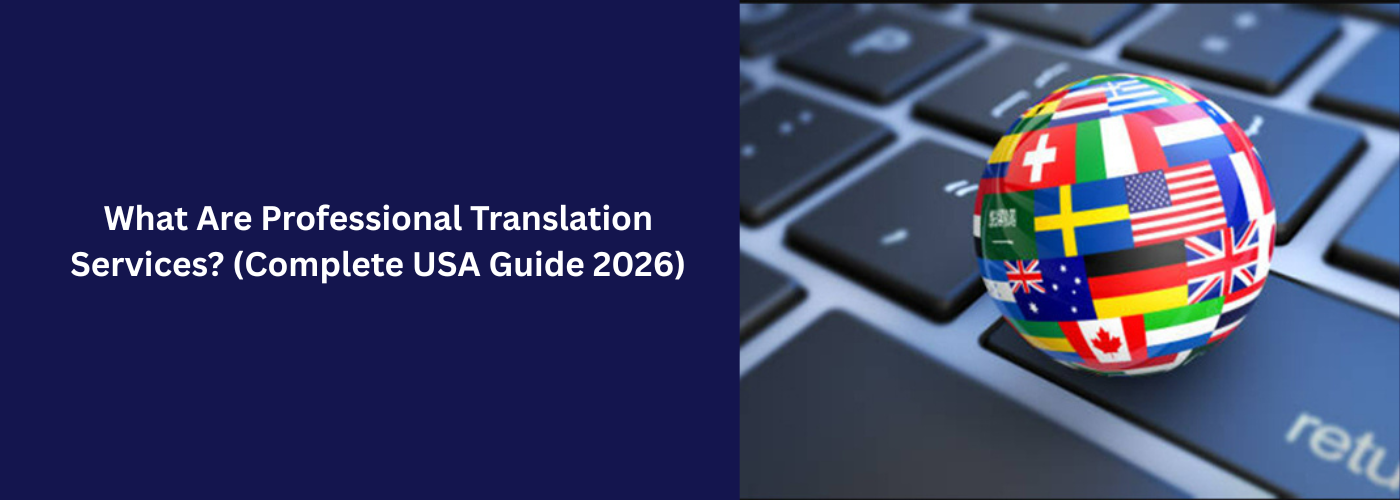
Professional translation services convert written or spoken content from one language to another using qualified human linguists, industry-specific expertise, and quality assurance processes. In the United States, these services are used for legal documents, immigration paperwork, medical records, business contracts, websites, and certified translations required by government agencies.
Key Takeaways
- Professional translation services go beyond word-for-word conversion.
- Used for immigration, legal, medical, and business purposes.
- Certified translations are required by USCIS and U.S. courts.
- AI tools help — but human translators ensure legal accuracy.
- Businesses use translation to expand globally and improve trust.
Let’s break this down properly.
If you’ve ever tried using a free translation app for an official document, you already know it doesn’t work. Not when accuracy matters. Not when compliance is involved.
I’ve seen companies delay visa approvals and lose contracts because they thought “Google Translate is enough.It’s not.
Here’s what professional translation actually means in 2026.
What Exactly Are Professional Translation Services?
Professional translation services are language solutions delivered by trained linguists who understand:
- Cultural context
- Legal terminology
- Industry-specific language
- Regulatory requirements in the United States
This is where most people get confused.
Translation is not just replacing words. It’s transferring meaning, tone, and legal validity from one language to another without distortion.
In the U.S. professional translation services typically include:
- Certified translation services
- Legal document translation
- Medical translation services
- Business and financial translation
- Website and localization services
- Immigration document translation
- Technical and software localization
When accuracy impacts immigration status, court cases, or medical treatment, there’s no room for error.
Why Professional Translation Services Matter in the USA (2026 Update)
Here’s the truth: The U.S. is one of the most linguistically diverse countries in the world.
According to the U.S. Census Bureau, over 68 million people speak a language other than English at home. That’s a massive demand driver for language services.
In practical terms:
- USCIS requires certified English translations for all foreign-language documents.
- U.S. courts require precise, sworn translations.
- Hospitals need accurate patient documentation.
- Businesses expanding globally require localized content.
Now here’s what surprises people.
Even in 2026 with AI everywhere human professional translators are still essential.
Why?
Because AI can generate translations. But it cannot legally certify them. It cannot take responsibility for compliance errors. And it cannot interpret complex cultural nuances in contracts or medical diagnoses.
That accountability matters.
What Is a Certified Translation in the United States?
A certified translation is a translated document accompanied by a signed statement from the translator or agency confirming that:
The translation is accurate and complete.
The translator is competent in both languages.
Certified translations are required for:
- USCIS immigration applications
- Birth certificates
- Marriage certificates
- Divorce decrees
- Academic transcripts
- Court documents
Most people don’t realize this, but notarization is not always required. USCIS only requires certification, not notarization, unless specifically requested.
Using non-certified translations can lead to delays or rejections.
That’s a costly mistake.
Types of Professional Translation Services in 2026
Professional translation services have expanded beyond traditional documents. Today, they include:
Legal Translation Services
Contracts and agreements
Court transcripts
Affidavits
Patents
Compliance documentation
Legal translation requires precision. One misinterpreted clause can change liability terms entirely.
Medical Translation Services
Patient records
Clinical trials
Pharmaceutical documentation
Informed consent forms
Medical terminology cannot be approximated. It must be exact.
Immigration Translation Services
USCIS documentation
Visa applications
Naturalization paperwork
Immigration affidavits
Even a small inconsistency can cause processing delays.
Business & Corporate Translation
Annual reports
Marketing materials
Financial statements
Employee handbooks
Businesses expanding internationally rely on accurate localization — not just translation.
Website Localization Services
SEO translation
Multilingual content adaptation
Cultural tone adjustments
Conversion optimization in different languages
How Professional Translation Services Work (Step-by-Step)
Here’s how reputable translation agencies in the USA operate:
- Initial document review
- Language pair assessment (e.g., Spanish to English translation)
- Subject matter expert assignment
- Human translation
- Editing and proofreading by a second linguist
- Certification (if required)
- Final quality check
Reputable providers use multi-layer quality assurance systems.
If an agency promises “instant certified translation in 5 minutes,” that’s a red flag.
Professional Translation vs Machine Translation (2026 Reality)
Let’s be honest.
AI translation tools like Google Translate and ChatGPT have improved dramatically.
But here’s the difference:
Machine translation:
- Fast
- Low-cost
- No legal liability
- No certification
Professional human translation:
- Accurate
- Legally compliant
- Industry-specific
- Quality-controlled
- Certified when required
AI is a tool. Not a replacement.
Most professional translation services now use AI-assisted translation workflows — but always with human review.
That hybrid model is the standard in 2026.
Who Needs Professional Translation Services?
You probably do if you fall into one of these categories:
Immigrants filing USCIS paperwork
International students applying to U.S. universities
Law firms handling foreign-language evidence
Healthcare providers treating non-English speakers
E-commerce brands entering global markets
Corporations expanding into Latin America, Europe, or Asia
This surprises small business owners every time.
Even if your website is in English, global customers may be searching in Spanish, French, or Mandarin.
Multilingual SEO is now a competitive advantage.
How Much Do Professional Translation Services Cost in the USA?
Pricing varies depending on:
- Language pair
- Document complexity
- Urgency
- Certification requirements
- Technical specialization
Common pricing models include:
- Per word rate
- Per page rate (for certified documents)
- Project-based pricing
- Hourly consulting rates
Rush services cost more.
Cheap services often skip editing layers.
You get what you pay for, especially when legal compliance is involved.
How to Choose the Best Professional Translation Service Provider
This is where businesses often slip up.
Before hiring a provider, check:
- Do they offer certified translations?
- Do they specialize in your industry?
- Do they have native-speaking linguists?
- Do they provide quality assurance processes?
- Can they meet USCIS standards?
- Do they guarantee confidentiality?
Also check reviews, case studies, and turnaround times.
Trust matters.
Are Professional Translation Services Worth It in 2026?
Yes, if accuracy, compliance, and credibility matter.
No, if you’re translating a casual social media caption for fun.
Professional translation services protect:
- Legal standing
- Immigration status
- Business contracts
- Medical safety
- Brand reputation
The risk of error is higher than the cost of proper translation.
The Future of Professional Translation Services (2026 & Beyond)
Here’s what we’re seeing:
- AI-assisted translation is standard.
- Human review remains mandatory for certified and legal documents.
- Demand for multilingual SEO translation is increasing.
- Video subtitle and multimedia localization are growing fast.
- Real-time business translation support is expanding.
Language services are no longer optional in a global economy.
They’re infrastructure.
If you're considering expanding globally, filing immigration paperwork, or handling multilingual documentation, professional translation services are not just helpful — they are essential.
Need Certified & Professional Translation Services You Can Trust?
When accuracy matters, shortcuts aren’t worth the risk.
Whether you're submitting documents to USCIS, preparing legal paperwork, expanding your business internationally, or translating medical records, precision and compliance are non-negotiable.
At Analokalize, we provide:
- Certified translation services accepted across the United States
- USCIS-compliant document translations
- Legal, medical, and business translation expertise
- Native-speaking professional linguists
- Fast turnaround with strict quality control
- Confidential and secure document handling
We combine human expertise with advanced translation technology to deliver reliable, accurate, and culturally precise translations — every time.
If you're unsure whether your documents require certification, notarization, or industry-specific terminology, our team is happy to guide you.
Request a Free Quote Today at Analokalize.com
Let’s make sure your translation is done right — the first time.
FAQs – Professional Translation Services (USA 2026)
1. What are professional translation services used for?
Professional translation services are used for legal documents, immigration paperwork, medical records, business contracts, website localization, and certified translations required by U.S. government agencies like USCIS. They ensure accuracy, compliance, and cultural precision beyond machine translation tools.
2. Do I need a certified translation for USCIS in 2026?
Yes. USCIS requires certified English translations for all documents issued in foreign languages. The translation must include a signed certification statement confirming accuracy and translator competence. Notarization is not always required unless specifically requested.
3. How much do professional translation services cost in the USA?
Costs vary based on language pair, document complexity, urgency, and certification needs. Pricing is typically charged per word or per page for certified translations. Technical and legal translations generally cost more due to specialized expertise requirements.
4. Are AI translation tools acceptable for official documents?
No. AI tools like Google Translate or ChatGPT cannot provide certified translations and may contain errors. Official agencies, courts, and USCIS require human-certified translations to ensure accuracy and legal validity.
5. How long does professional translation take?
Turnaround time depends on document length and complexity. Simple certified documents may take 24–48 hours, while large legal or technical projects can take several days. Rush services are often available for urgent cases.
6. What languages are most requested in the USA?
Spanish to English translation is the most requested service in the U.S., followed by Chinese, Arabic, French, Portuguese, and Vietnamese. Demand reflects immigration trends and global business expansion.