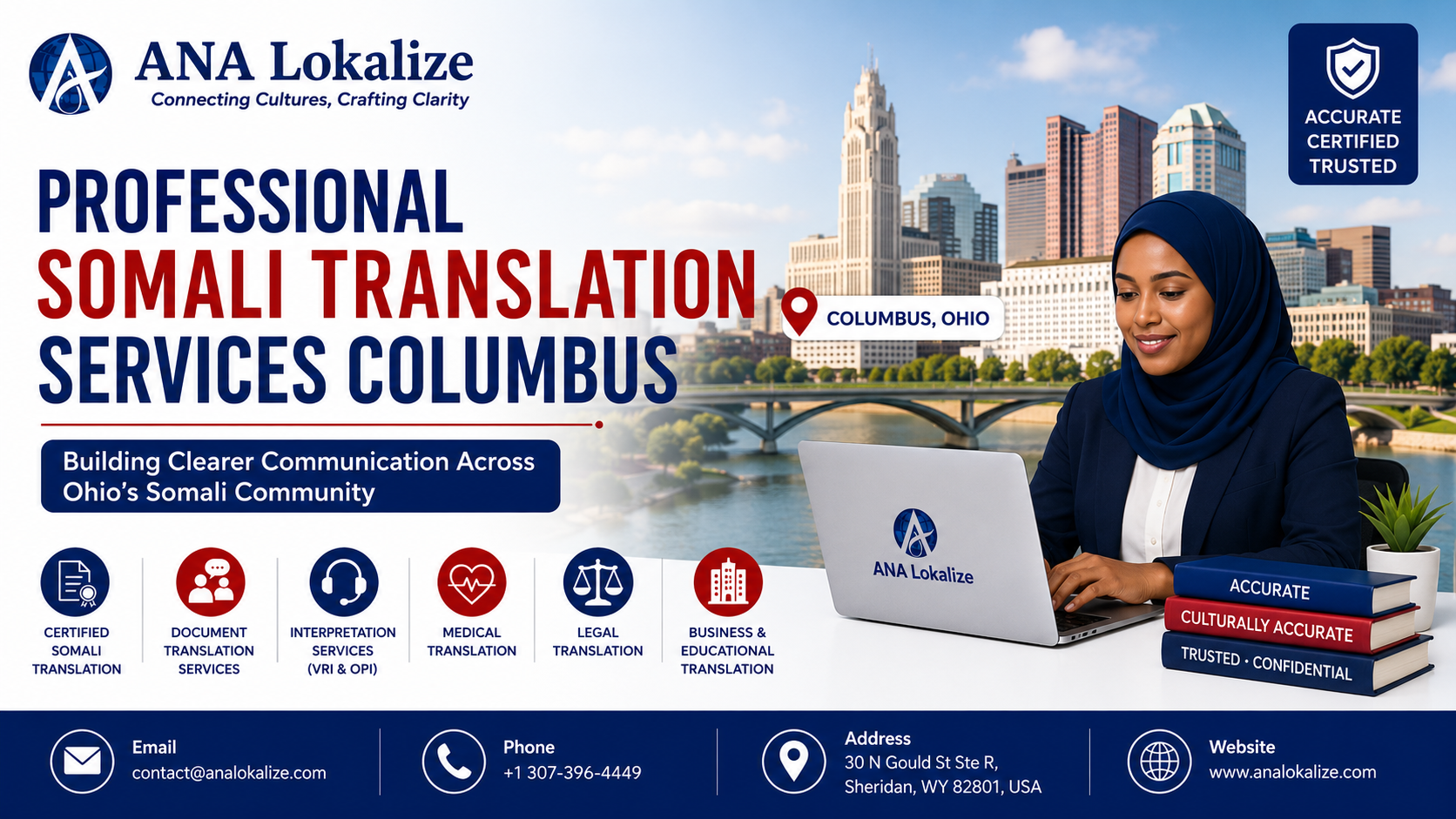
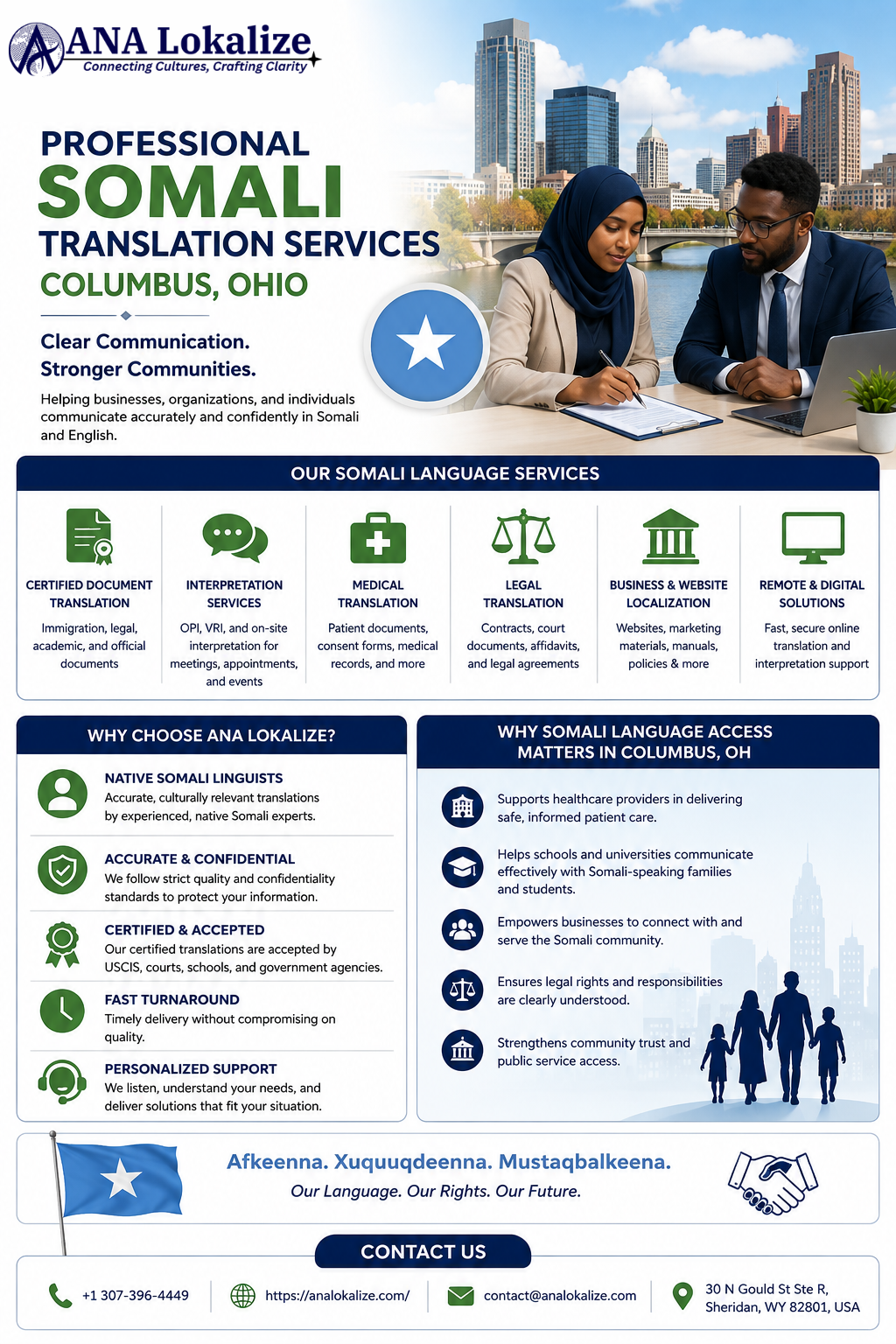
If you are searching for professional Somali translation services Columbus, certified Somali translation services Columbus Ohio, Somali document translation services Columbus Ohio, or an experienced Somali language translation company Columbus OH, you are probably dealing with communication that needs to be right the first time. It may be an immigration document, medical record, legal agreement, school communication, business material, or information intended for Somali-speaking families. In this guide, I want to go beyond simply explaining what translation is. We’ll look at how professional Somali translation and interpretation support people and organizations across Columbus, when certified document translation is appropriate, how English-to-Somali and Somali-to-English projects differ, why medical and legal content requires specialized expertise, how remote VRI and OPI interpretation can improve language access, and where AI can responsibly support—not replace—experienced human linguists.
At ANA Lokalize,
we approach this work with a simple principle: a translation should not merely
contain the right words. It should help the person receiving it understand the
message with the same confidence the original audience was meant to have.
That distinction
matters.
Google’s own
guidance for web publishers emphasizes creating useful, reliable content
primarily for people rather than content designed simply to attract search
traffic. It also makes clear that AI itself is not the problem; quality,
purpose, originality, and usefulness matter more than whether technology
assisted the creation process.
I think the same
principle applies surprisingly well to translation.
Technology can
help us work faster. But the final communication still has to help a real
person accomplish something.
Behind Every Translation Is a Real
Decision
It's easy to
look at translation as a technical process.
One file comes
in.
Another file
goes out.
But that's
rarely what the project means to the person who requested it.
A birth
certificate might be part of an immigration application.
A medical
document might help a patient understand what happens after leaving the
hospital.
A school notice
might tell parents about a decision affecting their child.
A legal
agreement might determine whether someone fully understands an obligation
before signing it.
A workplace
safety document could affect how an employee responds during an emergency.
That's why, when
I think about professional language services, I don't start with word counts.
I start with the
reader.
Who needs
this information?
Why do they
need it?
What could
happen if the meaning is unclear?
Those questions
help turn translation from a mechanical exercise into useful communication.
Why Somali Language Access Matters in
Columbus, Ohio
Columbus has an
established Somali community, making Somali language access particularly
relevant to healthcare providers, educational institutions, legal
professionals, public agencies, community organizations, employers, and
businesses serving the region.
That creates
communication needs across everyday situations—not only major legal or
government processes.
A
Somali-speaking resident might need help understanding healthcare information.
A school may
need to communicate with parents.
An employer may
want workplace policies available in Somali.
A law firm may
receive supporting documents written in Somali.
A business may
want to reach customers more effectively.
A healthcare
organization may need both translated patient materials and live interpretation
during appointments.
The language
requirement changes from situation to situation, which is why professional
language support should never be treated as a single generic service.
Sometimes the
right solution is written translation.
Sometimes it's
certified translation.
Sometimes it's
localization.
Sometimes the
person doesn't need a translated document at all—they need a professional
interpreter available during a live conversation.
Understanding
that difference is the beginning of good language access.
Understanding Somali Before
Translating It
Somali is a
Cushitic language within the Afroasiatic language family. It is spoken
primarily in Somalia and by Somali communities in neighboring East African
countries and throughout the global diaspora.
Modern Somali
uses the Latin alphabet for its official orthography, but sharing an alphabet
with English does not make the two languages structurally interchangeable.
Somali has its
own grammatical system, vocabulary, sentence patterns, cultural references, and
ways of expressing emphasis and relationships.
This is one
reason professional translation should not be reduced to replacing individual
English words with Somali equivalents.
Consider a
public-facing message.
The translator
needs to think about more than:
"What
does this sentence mean literally?"
They also need
to ask:
"How
would a Somali-speaking reader naturally expect this information to be
communicated?"
Those two
questions can lead to very different results.
And that
difference is particularly important when the content involves healthcare, law,
education, immigration, government services, or workplace instructions.
What Professional Somali Translation
Actually Involves
Good translation
begins with understanding the purpose of the source material.
Before
translating, a professional linguist should know things such as:
- Who will read the translation?
- Is the document informational or
official?
- Does it contain specialized
terminology?
- Will it be submitted to an
institution?
- Does formatting need to mirror the
original?
- Is certification required?
- Is the audience primarily in
Columbus, elsewhere in the United States, or abroad?
- Does the material require localization
rather than straightforward translation?
These questions
influence linguistic choices.
For example, a
promotional brochure shouldn't read like a legal document.
A patient
education sheet shouldn't sound like an academic research paper.
A contract
shouldn't be rewritten to sound conversational.
The best
translation respects both the original meaning and the purpose of the document.
Certified Somali Translation Services
Columbus Ohio
One of the most
common areas of confusion is the difference between a professional translation
and a certified translation.
A professional
translation focuses on producing an accurate, complete, usable target-language
version of the source material.
A certified
translation adds a formal certification statement attesting to the completeness
and accuracy of the translation.
Clients may need
certified Somali translation services Columbus Ohio for documents such
as:
- Birth certificates
- Marriage certificates
- Divorce documents
- Academic transcripts
- Diplomas
- Immigration documents
- Employment records
- Court documents
- Professional credentials
- Identification records
- Government documentation
The exact
requirement depends on the organization receiving the document, so I always
recommend checking what that organization specifically requests rather than
assuming every official document needs the same treatment.
That small step
can save considerable time.
At ANA Lokalize,
our existing Somali language service offering includes certified translation
and identifies immigration documents, academic credentials, personal
certificates, court documentation, medical records, and other official
materials among the types of documents it handles.
Somali Certified Document Translation
Columbus OH
When someone
asks us about Somali certified document translation Columbus OH, one of
the first things we consider is whether the document is going from Somali into
English or from English into Somali.
That direction
matters.
It affects who
will read the document, how terminology should be handled, and often what the
receiving institution expects.
The project may
involve a one-page certificate with relatively little text, or it may involve
multiple supporting records containing stamps, handwritten notes, dates,
tables, and official terminology.
A professional
workflow needs to account for all of it.
Accuracy isn't
limited to paragraphs.
Names matter.
Dates matter.
Numbers matter.
Document
headings matter.
Official seals
or stamps may need to be appropriately identified.
Missing or
illegible text needs to be handled transparently rather than guessed.
This is where
careful human review becomes especially valuable.
Somali Document Translation Services
Columbus Ohio
Not every
document needs certification.
Businesses and
organizations regularly require Somali document translation servicesColumbus Ohio for everyday communication.
Examples
include:
Healthcare Materials
- Patient information
- Appointment instructions
- Preventive care materials
- Discharge information
- Health education content
Education
- Parent communications
- Enrollment information
- School policies
- Student resources
- Community announcements
Workplace Communication
- Employee handbooks
- HR materials
- Training content
- Safety instructions
- Internal notices
Community and Public Information
- Outreach materials
- Program information
- Public notices
- Community resources
- Service instructions
Business Content
- Proposals
- Presentations
- Product information
- Customer communication
- Marketing materials
The language may
be the same, but the translation approach should change with the content.
A hospital
discharge instruction and a social media campaign should never sound as though
they came from the same template.
English to Somali Document
Translation Columbus Ohio
Professional English
to Somali document translation Columbus Ohio becomes especially valuable
when organizations originally create their information for English-speaking
audiences and later realize that part of their community cannot access it
comfortably.
The temptation
is often to translate the content as literally as possible.
I don't think
that's the right goal.
The goal should
be equivalent understanding.
Imagine an
English healthcare brochure written with short, reassuring sentences.
If the Somali
version technically preserves every word but becomes awkward, overly formal, or
difficult to follow, the translation has preserved vocabulary while losing the
purpose of the content.
A professional
translator therefore balances several priorities:
Accuracy: The meaning must remain faithful to the original.
Readability: The target-language reader should be able to understand it
naturally.
Terminology: Specialized terms need to be correct and consistent.
Tone: The translation should reflect whether the source is formal,
instructional, reassuring, persuasive, or conversational.
Cultural
context: Expressions that depend heavily on
English-language assumptions may need thoughtful and appropriate adaptation.
This becomes
even more important with customer-facing and community-facing communication.
A Somali Language Translation Company
Columbus OH Should Understand the Audience, Not Just the Language
When
organizations search for a Somali language translation company Columbus OH,
I encourage them to look beyond whether a provider simply lists Somali among
its supported languages.
Ask how the work
is handled.
Who translates
specialized medical material?
How are legal
documents reviewed?
How does the
provider manage terminology across recurring projects?
Can the same
language partner support both written translation and live interpretation?
How is sensitive
information handled?
What happens
when a source document contains ambiguous or unreadable content?
These questions
tell you much more about a language provider than a generic promise of
"accurate translation."
At ANA Lokalize,
our Somali service page includes native Somali speakers, certified document
translation, website localization, medical and legal subject-matter expertise,
and multiple interpretation options.
For clients who
expect their needs to grow, that breadth can matter.
A hospital may
start with translated patient materials and later require remote
interpretation.
A law firm might
first need a Somali document translated into English and later need an
interpreter for a client meeting.
A company might
begin with employee documents before eventually localizing customer-facing
content.
A strong
language strategy allows those services to work together rather than treating
each project as an isolated transaction.
Translation Should Sound Like
Communication, Not Translation
This is one of
the standards I keep coming back to.
When a
Somali-speaking reader opens a translated document, the language shouldn't
constantly remind them:
"Someone
translated this from English."
It should simply
communicate.
That doesn't mean
rewriting the author's message or taking creative liberties with important
information.
It means
understanding that linguistic accuracy and natural communication belong
together.
This becomes
even more apparent when we reverse the direction of the work.
Organizations
throughout Columbus also receive Somali-language certificates, correspondence,
records, legal materials, healthcare information, and other documents that need
to be understood or formally presented in English.
And translating
those materials well introduces its own set of decisions—because Somali to
English document translation Columbus OH is not simply English-to-Somali
translation performed backwards. It requires the same careful attention to
context, document purpose, specialized terminology, certification requirements,
and the expectations of the person or institution that will ultimately rely on
the English version.
Somali to English Document
Translation Columbus OH
A
Somali-language document may look straightforward on the surface, but
translating it accurately into English requires more than understanding
individual sentences.
The translator
has to understand what the document is, why it exists, and how the English
version will ultimately be used.
Professional Somali to English document translation Columbus OH
- Birth and marriage certificates
- Personal and family records
- Academic documents
- Medical records
- Legal correspondence
- Business documents
- Employment records
- Financial information
- Government-related materials
- Community documentation
The English
version should preserve the information in the source without unnecessarily
rewriting, interpreting, or simplifying it.
This becomes
particularly important with official records.
If a name
appears differently across several documents, the translator shouldn't quietly
decide which version is "correct." If text is unclear or illegible,
it shouldn't simply be guessed.
Transparency is
part of accuracy.
And when a
translation is being prepared for formal use, those small details can become
some of the most important parts of the entire project.
Official and Certified Documents
Require Extra Attention
Official
documents are often surprisingly compact.
A certificate
may contain only a few dozen words.
Yet those words
can carry enormous importance.
Consider how
much information might appear on a single record:
- Full legal names
- Dates of birth
- Places of birth
- Registration numbers
- Government offices
- Signatures
- Stamps
- Dates of issuance
A mistranslated
paragraph in marketing content is undesirable.
A mistake in
someone's name or date on an official record can create an entirely different
kind of problem.
That's why Somali certified document translation Columbus OH should prioritize completeness
and consistency rather than speed alone.
Professional
translators also need to distinguish between translation and administrative decision-making.
The translator's responsibility is to represent the source accurately—not to
decide whether a document will be accepted by a particular institution.
The receiving
organization determines its own requirements.
Medical Translation Is About Understanding,
Not Just Terminology
Healthcare
brings us to an entirely different level of responsibility.
When people hear
the phrase Somali medical translation services Columbus OH, they may
initially think about translating complicated medical terminology.
That's certainly
part of the work.
But I've found
that some of the most important healthcare translations involve ordinary
instructions.
When should I
take this medication?
What should I
avoid after the procedure?
When should I
return for another appointment?
What symptoms
should make me seek additional care?
What does this
consent form actually authorize?
These aren't
abstract linguistic questions.
They're
practical questions patients and families need to understand.
Professional
medical translation can support materials such as:
- Patient education resources
- Discharge instructions
- Medical histories
- Consent documentation
- Appointment instructions
- Preventive health materials
- Public health information
- Laboratory documentation
- Clinical reports
- Insurance-related communication
- Healthcare forms
Effective Somali
healthcare translation Columbus Ohio should preserve medical accuracy while
considering how the intended audience will actually use the information.
A translation
that is technically correct but unnecessarily difficult to understand may still
fail the reader.
Why Healthcare Terminology Needs
Context
Medical
terminology creates a particular challenge because the same concept may need to
be communicated differently depending on the audience.
A document
written for physicians can use specialized clinical terminology.
A patient
education handout may need to communicate the same underlying concept in more
accessible language.
That doesn't
mean the translator should independently simplify medical advice or change the
source.
It means the
translation should respect the communication level established by the original
material.
This is why
subject-matter experience matters.
A linguist needs
to recognize terminology, abbreviations, instructions, and contextual
relationships before deciding how they should appear in the target language.
Technology can
assist with terminology consistency, but healthcare translation still benefits
enormously from knowledgeable human review.
Medical Translation and Medical
Interpretation Solve Different Problems
It's also useful
to distinguish Somali medical translation services Columbus OH from
medical interpretation.
Translation
handles written material.
Interpretation
supports live communication.
A hospital might
need translated discharge instructions and a Somali interpreter during the
conversation in which those instructions are explained.
A clinic might
translate appointment preparation materials, but use a remote interpreter when
the patient speaks with the physician.
A healthcare
organization may therefore need both services within the same patient journey.
This distinction
will become especially important when we move from documents to real-time VRI
and OPI interpretation later in the communication process.
Somali Legal Translation Services
Columbus Ohio
Legal content
presents many of the same concerns about accuracy, but with a different type of
specialized language.
Professional Somali
legal translation services Columbus Ohio may support:
- Contracts
- Affidavits
- Court documents
- Legal correspondence
- Witness statements
- Immigration-related records
- Employment agreements
- Settlement documents
- Compliance materials
- Business agreements
- Powers of attorney
Legal
translation requires restraint.
The translator's
role isn't to improve the legal argument or provide legal advice.
It is to
communicate the source faithfully.
That's an
important distinction.
When a legal
sentence is dense or highly formal in the source, the translator needs to
understand what it means before reproducing that meaning accurately in another
language.
This is where
subject-matter expertise and linguistic expertise have to work hand in glove.
Somali Legal Document Translation
Columbus OH
With Somali
legal document translation Columbus OH, context becomes particularly
important because a single document may contain several different kinds of
language.
A contract may
combine:
- Defined legal terms
- Financial information
- Names and addresses
- Dates
- Obligations
- Conditions
- Signatures
- Technical descriptions
A court document
may contain quoted testimony alongside procedural terminology.
An
immigration-related legal record may include personal information, government
terminology, and narrative statements in the same file.
Professional
translators need to recognize these changes in register while maintaining
consistency throughout the document.
The objective is
not creative writing.
The objective is
reliable meaning.
Business Translation Requires a
Different Voice
The language
appropriate for a legal filing is rarely the language a business should use
with customers.
That's why Somali business translation services Columbus OH deserve their own approach.
Businesses may
require translation for:
- Employee handbooks
- Training materials
- HR communication
- Workplace safety information
- Customer service resources
- Product information
- Business proposals
- Presentations
- Marketing campaigns
- Websites
- Internal communication
The appropriate
tone depends on the purpose.
Employee
policies should be clear and consistent.
Safety
information should prioritize comprehension.
Marketing should
feel persuasive and natural.
Customer support
material should be helpful rather than bureaucratic.
Professional
translation adapts to these differences without losing the organization's
intended message.
Localization Goes Beyond Replacing
Words
Digital
communication makes this even more important.
A business may
ask for its website to be translated into Somali, but what it actually needs is
often localization.
Localization
considers how translated content functions within the complete user experience.
That can
include:
- Navigation
- Buttons and calls to action
- Help content
- Forms
- Product information
- Customer support pages
- Marketing messages
- Terminology consistency
The objective is
simple:
A
Somali-speaking visitor should be able to use the Website—not merely recognize
that it has been translated.
That difference
separates linguistic conversion from useful localization.
Remote Somali Translation Services
Columbus OH
Digital
workflows have also changed where professional translation happens.
Organizations
searching for remote Somali translation services Columbus OH aren't
limited to finding a translator sitting within Columbus city limits.
Documents can be
submitted electronically, project requirements can be discussed remotely,
qualified linguists can be assigned based on subject-matter expertise, and
completed translations can be delivered digitally.
For clients,
that can mean:
- Easier project submission
- Faster coordination
- Better access to specialized
linguists
- Convenient document delivery
- Support for ongoing projects
- Less dependence on physical location
Remote service
becomes particularly valuable for languages where specialized linguists may not
always be available locally for every subject area.
The important
question is therefore not simply:
"Where
is the translator sitting?"
It's:
"Is the
right professional handling my content?"
Where AI Fits Into Professional
Somali Translation
Artificial
intelligence deserves a careful discussion because it has changed translation
workflows significantly.
I don't believe
the useful question is whether AI is "good" or "bad" for
translation.
The better
question is:
What should we trust it to do?
Depending on the
project and confidentiality requirements, technology can support tasks such as:
- Terminology management
- Translation memory
- Repetitive-content identification
- Quality checks
- Workflow automation
- Project organization
- Draft assistance
Those
capabilities can make professional teams more efficient.
But efficiency
isn't the same thing as final quality.
This distinction
is especially important for specialized content.
A medical
instruction isn't the place to accept an uncertain automated translation simply
because it was produced instantly.
Neither is a legal
document, official certificate, or sensitive business agreement.
Lower-Resource Languages Make Human
Oversight Even More Important
AI performance
is not identical across every language.
Languages with
enormous quantities of digitized training material generally give automated
systems more data to learn from than languages with comparatively limited
digital resources.
That makes
professional oversight particularly important when working with languages and
domains where machine output may be less predictable.
Even when an
automated suggestion appears fluent, fluency doesn't prove accuracy.
A sentence can
sound completely natural and still communicate the wrong thing.
That's one of
the most important lessons organizations should understand about modern AI-assisted
translation.
Human reviewers
aren't there merely to correct grammar.
They're there to
ask whether the translation is actually true to the source.
The Human + Technology Model
For us, the
strongest approach is not "human versus AI."
It's using technology
where it genuinely adds value while keeping qualified professionals responsible
for the communication that matters.
Technology can
contribute:
- Speed
- Consistency
- Terminology support
- Workflow efficiency
- Repetitive-task reduction
Professional
linguists contribute:
- Contextual understanding
- Cultural knowledge
- Subject expertise
- Judgment
- Natural language
- Quality control
The combination
can create a more efficient workflow without pretending that software
understands every human communication challenge.
And this
distinction becomes even clearer when we move away from documents entirely.
A translator
working on a written file can stop, research a term, compare references, revise
a sentence, and perform a final quality check before anyone sees the result.
A live
conversation offers none of that luxury.
When a
Somali-speaking patient asks a doctor a question, when an attorney explains an
important legal issue, when a school meets with a parent, or when an
organization needs immediate language support, communication unfolds in real
time.
There is no
draft to revise before the next person speaks.
That is where
professional Somali interpretation begins—and where choosing between an
in-person interpreter, a phone interpreter, Video Remote Interpreting, and
other virtual interpretation options becomes just as important as choosing the
right translator for a document.
Professional Somali Interpreter
Columbus OH: When Communication Has to Happen in Real Time
That difference
between translation and interpretation is easy to overlook until you're
actually in the middle of an important conversation.
A translated
document can be reviewed before delivery. An interpreter has to understand the
speaker, process the meaning, and communicate it accurately in another language
almost immediately.
That's why
organizations looking for a professional Somali interpreter Columbus OH
should consider much more than whether someone is bilingual.
Professional
interpretation requires active listening, rapid language processing, cultural
awareness, subject familiarity, confidentiality, neutrality, and the ability to
remain composed when conversations become complicated or emotional.
The
interpreter's job isn't to take over the conversation.
It's to make the
conversation possible.
Whether the
participants are a physician and patient, attorney and client, teacher and
parent, business representative and customer, or public-service professional
and community member, they should remain the people speaking to one another.
The interpreter
provides the linguistic bridge between them.
Choosing the Right Type of Somali
Interpretation
Not every
conversation needs to be interpreted in the same way.
Sometimes having
someone physically present makes sense.
Sometimes video
provides the visual context people need without requiring travel.
Sometimes a
phone connection is the quickest and most practical solution.
That's why
professional language access increasingly combines several interpretation
models:
- In-person interpretation
- Video Remote Interpreting, or VRI
- Over-the-Phone Interpreting, or OPI
- Other scheduled virtual
interpretation options
At ANA Lokalize,
our interpretation offering is primarily focused on remote interpreting through VRI and OPI. This can be particularly useful when organizations
need flexible access to Somali language support without depending entirely on
the availability of an interpreter at a specific physical location.
The right format
depends on the conversation.
Somali In-Person Interpreter Columbus
Ohio
There are
situations where organizations may prefer a Somali in-person interpreter Columbus Ohio.
Face-to-face
interpretation can be useful when a meeting involves:
- Multiple participants
- Complicated physical demonstrations
- Lengthy discussions
- Formal proceedings
- Sensitive conversations
- Situations where visual context is
particularly important
An interpreter
physically present in the room can observe the overall interaction and follow
visual cues naturally.
However,
in-person interpretation also introduces logistical considerations.
An appropriate
interpreter needs to be available at the correct location and time. Travel may
be involved. Scheduling can become more complicated when a less commonly
available language is required on short notice.
This is one
reason remote interpretation has become such an important complement to
traditional in-person services.
Rather than
asking whether remote or in-person interpreting is universally
"better," I think organizations should ask which format best supports
the specific interaction.
Remote Somali Interpreter Columbus
Ohio
A remote
Somali interpreter Columbus Ohio can join the conversation without
traveling to the client's location.
That simple
change creates considerable flexibility.
Remote
interpretation can support:
- Healthcare appointments
- Legal consultations
- Parent-teacher meetings
- Social service appointments
- Business conversations
- Customer support
- Insurance discussions
- Employee communication
- Community services
- Scheduled consultations
For
organizations operating across several facilities or serving multilingual
communities regularly, remote access can also make language support easier to
integrate into daily workflows.
A clinic doesn't
necessarily know weeks in advance which languages patients will need.
A customer
service team can't always predict who will call.
A community
organization may need language support for people arriving from different
locations.
Remote
interpretation gives organizations another way to respond to those situations.
Somali Video Interpreter Columbus
Ohio: Why Visual Context Matters
Some
conversations become easier when participants can see one another.
A Somali
video interpreter Columbus Ohio connects remotely through video, allowing
the interpreter to hear the conversation while also observing relevant visual
information.
This model is
commonly known as Video Remote Interpreting (VRI).
VRI can provide
access to visual cues such as:
- Facial expressions
- Gestures
- Body language
- Demonstrations
- Visual materials
- Interaction between participants
That can make
video especially useful when visual context contributes to understanding.
Imagine a
healthcare professional demonstrating how a device should be used.
A teacher
reviewing material with a parent.
A business
representative showing a customer a product.
A social-service
professional walking someone through a form.
In each
situation, the interpreter may benefit from seeing what the participants are
discussing rather than relying solely on audio.
Virtual Somali Interpretation
Services Columbus Ohio
The growth of
telehealth, remote work, virtual meetings, and online services has made virtual
Somali interpretation services Columbus Ohio increasingly relevant.
A virtual
interpreter can participate in conversations where the other parties may themselves
be in different locations.
For example:
A patient could
be at home.
A healthcare
provider could be in a clinic.
The interpreter
could join remotely.
The same model
can support virtual legal consultations, business meetings, educational
discussions, and other scheduled interactions.
The value isn't
simply that the interpreter is remote.
It's that
language support can become part of the digital environment where the
conversation is already taking place.
That makes
multilingual access easier to build into modern service delivery.
Somali Phone Interpreter Columbus OH
Video isn't
necessary for every interaction.
In many
situations, a Somali phone interpreter Columbus OH may be the more
practical choice.
Over-the-Phone
Interpreting (OPI) provides spoken interpretation
through an audio connection.
It can work
particularly well for:
- Appointment scheduling
- Customer service
- Insurance calls
- Basic intake conversations
- Follow-up calls
- Financial-service communication
- Utility inquiries
- Information lines
- Routine business conversations
OPI removes the
need for cameras or video conferencing technology.
That simplicity
can be valuable.
If a
conversation is primarily verbal and doesn't depend heavily on visual
information, telephone interpretation may provide exactly what is needed
without adding unnecessary complexity.
VRI or OPI: Which One Should You
Choose?
I don't think
organizations should automatically default to one interpretation format for
every situation.
Instead,
consider what the conversation actually requires.
VRI may be appropriate when:
- Visual context matters.
- Participants need to show documents
or objects.
- Non-verbal communication may help
understanding.
- The conversation is complex or
sensitive.
- A more face-to-face experience is
beneficial.
OPI may be appropriate when:
- The interaction is already happening
by telephone.
- Visual context isn't necessary.
- The conversation is relatively
straightforward.
- Participants need a simple remote
connection.
- Video equipment isn't readily
available.
Both formats
solve the same fundamental problem—allowing people who speak different
languages to communicate in real time—but they solve it in different ways.
The best choice
is the one that supports the actual conversation.
Somali Medical Interpreter Columbus
Ohio
Healthcare is
one of the clearest examples of why professional interpretation matters.
A Somali medical interpreter Columbus Ohio may support communication during:
- Primary care appointments
- Specialist consultations
- Hospital admissions
- Discharge discussions
- Telehealth visits
- Medication conversations
- Rehabilitation appointments
- Patient education
- Follow-up care
- Behavioral health conversations,
where appropriate
Medical
interpretation requires more than familiarity with common healthcare
vocabulary.
The interpreter
may need to follow discussions involving symptoms, anatomy, procedures,
medication, medical history, risks, consent, and follow-up instructions.
Just as
importantly, the interpreter needs to preserve the conversation between the
patient and healthcare professional.
A professional
interpreter shouldn't become the person making healthcare decisions.
The clinician
remains responsible for medical communication and care.
The patient
remains responsible for expressing their questions, experiences, and decisions.
The interpreter
enables them to understand one another.
Translation and Interpretation Can
Work Together Across the Patient Journey
This is where
the earlier discussion about Somali medical translation services Columbus OH
connects naturally with interpretation.
Consider a
hypothetical patient journey.
Before an
appointment, the patient may receive translated preparation instructions.
During the
consultation, a VRI interpreter may facilitate the live conversation.
After treatment,
professionally translated discharge information may provide written guidance
the patient can refer to later.
If a follow-up
question arises, OPI may support a telephone conversation.
No single
language service has to do everything.
Written
translation and live interpretation can support different moments within the
same communication experience.
That's often a
much stronger language-access strategy than treating every interaction as an
isolated event.
Legal Interpretation Requires the
Same Discipline
Legal settings
also create situations where real-time language access matters.
An interpreter
may be requested for:
- Attorney-client meetings
- Immigration consultations
- Document review discussions
- Case preparation
- Mediation
- Business legal consultations
- Other legal conversations
Here again, professional
boundaries matter.
An interpreter
facilitates communication.
They don't
independently explain what the law means.
They don't tell
a client what decision to make.
They don't
improve someone's statement or change its meaning.
Neutrality is fundamental
to the role.
The same
principle that guides Somali legal document translation Columbus OH
applies to interpretation: preserve the communication rather than becoming part
of its substance.
Confidentiality Matters in Every
Format
Whether interpretation
happens in person, over video, or by telephone, conversations may contain
highly sensitive information.
Healthcare
conversations may involve medical history.
Legal
discussions may involve confidential case information.
Business
meetings may include internal company information.
HR conversations
may concern employment matters.
Community
services may involve personal or family circumstances.
Organizations
evaluating interpretation providers should therefore consider confidentiality
and professional conduct alongside language ability.
Remote
technology can improve accessibility, but it needs to be used responsibly.
Convenience
should never make privacy an afterthought.
Professional Interpreters Do More
Than Know Two Languages
Bilingualism and
professional interpretation aren't the same skill.
Someone may
speak Somali and English fluently yet have no training or experience in
accurately interpreting complex conversations.
Professional
interpreters need to manage several tasks simultaneously:
They listen.
They understand
context.
They retain
information.
They transfer
meaning.
They maintain
tone.
They remain
neutral.
They manage
turn-taking without dominating the conversation.
And they do all
of this in real time.
That cognitive
workload is one reason interpretation quality should not be judged simply by
how quickly someone can switch between languages.
Accuracy,
completeness, and professionalism matter more.
Where AI Can Assist Live Language
Services
AI is also
beginning to influence spoken-language workflows.
Technology can
support areas such as:
- Speech recognition
- Transcription
- Scheduling
- Audio processing
- Terminology resources
- Administrative workflow
- Quality-management processes
These tools can
make language-service operations more efficient.
But high-stakes
conversations expose the limitations of relying exclusively on automated
systems.
Spoken
communication contains interruptions.
People change
direction mid-sentence.
They speak
quickly.
They hesitate.
They use slang.
They refer to
things in the room.
They express
emotion through tone rather than vocabulary.
A machine may
recognize words without fully understanding why those words are being said.
For routine,
low-risk situations, automated technology may continue finding useful
applications.
For healthcare,
legal, official, or otherwise consequential communication, professional human
involvement remains especially valuable.
Remote Interpretation Expands Access
Without Making Every Interaction Impersonal
There's
sometimes an assumption that remote communication automatically feels less
human.
I don't think
that has to be true.
What makes an
interpreted conversation human isn't whether the interpreter is physically
sitting three feet away.
It's whether the
participants can communicate clearly and respectfully.
A well-managed
VRI session can provide face-to-face visual interaction.
A well-managed
OPI call can allow someone to ask a question they otherwise couldn't ask.
Technology is
simply the channel.
Understanding is
still the goal.
And once organizations
recognize that the conversation shifts from "Do we need translation or
interpretation?" to a more useful question:
"How do
we build the right combination of translation, VRI, OPI, document services, and
specialized linguistic expertise around the people we actually serve?"
Answering that
question means looking beyond individual transactions and considering the
complete language-access strategy—from selecting the right Somali language
provider and controlling quality to managing costs, protecting sensitive
information, using AI responsibly, and knowing what to ask before requesting a
translation or interpreter quote.
Building a Complete Somali
Language-Access Strategy
That broader
question is where organizations can move from reacting to language barriers to
planning for them.
A healthcare
provider shouldn't have to reinvent its process every time a Somali-speaking
patient arrives. A business shouldn't need to search for a new translator every
time another document needs localization. A law firm shouldn't discover on the
morning of an important meeting that it has no practical way to communicate
with a client.
A stronger
approach is to think about language access as an interconnected system.
That system
might include:
- Certified document translation
- General business translation
- Medical translation
- Legal translation
- Website and digital localization
- Video Remote Interpreting (VRI)
- Over-the-Phone Interpreting (OPI)
- In-person interpretation when
appropriate and available
- Terminology management
- Quality assurance
- Secure project handling
Not every
organization needs every service.
The objective is
to understand which combination fits the people you serve and the situations in
which communication actually occurs.
Choosing a Somali Language
Translation Company in Columbus OH
When I evaluate
a language provider, I don't think the first question should be:
"Who has the lowest price?"
Price matters,
of course.
But language
services influence communication with patients, customers, employees, students,
clients, and communities. A cheaper translation that creates confusion may
ultimately cost much more than doing the work properly from the beginning.
Organizations
comparing providers for professional Somali translation services Columbus
should consider questions such as:
- Does the provider work with
experienced Somali linguists?
- Can it handle both Somali-to-English
and English-to-Somali projects?
- Does it offer certified translation?
- Does it understand medical and legal
terminology?
- Can it support recurring business
translation?
- Are VRI and OPI interpretation
available?
- How does it manage confidential
information?
- What quality-review process is used?
- Can terminology be maintained across
ongoing projects?
- How are unclear source documents
handled?
- Can the provider support urgent or
time-sensitive requirements when availability allows?
The answers tell
you far more than a price-per-word figure.
One Provider Can Help Create
Consistency Across Multiple Services
There is another
advantage to building an ongoing relationship with a professional language
company: consistency.
Imagine a
healthcare organization using one provider for patient documents, another for
its website, a third for VRI, and an unrelated freelancer for community
outreach.
Each may make
different terminology choices.
The result can
be confusing even when every individual translation is technically acceptable.
A coordinated
language strategy makes it easier to establish terminology preferences and
apply them consistently across:
- Documents
- Websites
- Patient materials
- Employee resources
- Customer communication
- Interpretation preparation
- Ongoing campaigns
Consistency
becomes increasingly valuable as the volume of multilingual communication
grows.
Remote Somali Translation Services
Columbus OH Make Specialized Expertise More Accessible
Remote delivery
adds another advantage.
With remote Somali translation services Columbus OH, organizations can work with
qualified linguists based on subject expertise rather than restricting
themselves exclusively to whoever happens to be geographically nearby.
A medical
project can be assigned based on healthcare experience.
A legal document
can be handled by a linguist familiar with legal terminology.
A business
localization project can be approached differently from a certified personal document.
This is one of
the most useful changes technology has brought to the language industry.
Geography no
longer has to determine expertise.
The same
principle explains why remote interpretation through VRI and OPI has become so
valuable: technology can bring professional language support to the
conversation instead of requiring every participant to travel to the same
place.
Quality Assurance Should Match the
Risk of the Content
Not every
translation carries the same level of consequence.
A minor wording
issue in an informal internal announcement is different from an error in:
- Medication instructions
- A legal agreement
- An immigration document
- A workplace safety procedure
- An official certificate
A professional
workflow should recognize those differences.
Quality
assurance may involve:
Source Review
Checking the
source for unclear text, inconsistent terminology, missing content, or
formatting issues before translation begins.
Linguist Selection
Matching the
content with a professional who understands both the language and relevant
subject area.
Terminology Management
Using approved
or consistent terminology across recurring projects.
Editing and Review
Checking the
translation against the source rather than simply proofreading the target
language in isolation.
Formatting Review
Confirming that
important numbers, names, headings, tables, and document elements have been
represented appropriately.
Final Quality Control
Reviewing
completeness and project-specific requirements before delivery.
Technology can
assist several of these steps.
Accountability
should still remain with qualified people.
Confidentiality Should Be Part of the
Conversation From the Beginning
Language
projects often contain information that people would never publish publicly.
Medical
histories.
Legal disputes.
Identity
documents.
Employment
records.
Financial
information.
Business plans.
Personal
correspondence.
That's why
organizations shouldn't treat confidentiality as an afterthought.
Before sharing
sensitive material, it is reasonable to understand how a language provider
handles project information and what processes are appropriate for the type of
content involved.
The same applies
to remote interpretation.
VRI and OPI
offer enormous convenience, but professional standards still matter when
confidential information is being discussed.
Accessibility
and privacy should work together.
AI Should Solve a Problem, Not Simply
Be Added Because It Is AI
AI has become
such a prominent marketing term that it's easy to assume every workflow becomes
better simply by adding it.
I prefer a more
practical approach.
Ask:
What problem is the technology
solving?
If AI helps
identify repeated content, maintain terminology, organize a large project, or
assist appropriate quality checks, it may create genuine value.
If using it
introduces unnecessary risk into a sensitive document, it may not be the right
tool for that particular job.
This reflects
the broader principle behind responsible AI-assisted language services.
Technology
should support the outcome.
The outcome
shouldn't be compromised to justify using technology.
Google's
guidance on AI-generated web content follows a similar people-first philosophy:
automation isn't inherently the issue; using automation primarily to manipulate
rankings rather than help users is where problems arise. (developers.google.com)
For us, that
principle translates naturally into language work.
Use technology
where it improves the process.
Keep human
expertise where human judgment matters.
What the Future of Somali Language
Services May Look Like
The next
generation of language services will likely become increasingly connected.
We can expect
continued improvements in:
- Speech recognition
- Translation memory
- Terminology management
- Remote collaboration
- Automated quality checks
- Secure digital workflows
- VRI platforms
- OPI access
- AI-assisted project management
These
technologies can make language services faster and easier to access.
But I don't
think the most successful organizations will be the ones that simply automate
the most.
They'll be the
ones that know when automation is useful and when a person needs to be
involved.
A patient
doesn't care whether the latest AI model was used behind the scenes.
They care
whether they understand their instructions.
An attorney
cares whether the translated document accurately represents the source.
A business cares
whether customers understand its message.
A parent cares
whether they can participate meaningfully in a conversation about their child.
The technology
is important.
The outcome is
more important.
Why Professional Somali Language
Services Matter to Columbus
The need for
Somali language support in Columbus isn't theoretical.
It's connected
to a real community.
The City of
Columbus has formally recognized the significance of its Somali population. A
2023 city resolution described Columbus as having the second-largest Somali
community in the United States, while a 2022 resolution cited an estimate of at
least 60,000 Somali immigrants and refugees in Columbus and Central Ohio. (columbus.gov)
(columbus.gov)
Numbers tell
only part of the story.
The real impact
appears in everyday interactions.
A patient
understanding a healthcare provider.
A family
communicating with a school.
An employee
understanding workplace information.
A customer
receiving support.
An attorney
communicating accurately with a client.
An organization
making information genuinely accessible.
That's what
professional language access looks like when it works.
Frequently Asked Questions About
Somali Translation and Interpretation in Columbus
What are professional Somali
translation services Columbus?
Professional
Somali translation services convert written information between Somali and
English using qualified linguists and appropriate quality-control processes.
Services may include certified documents, healthcare materials, legal
documents, business communication, websites, educational materials, and other
written content.
Do you provide certified Somali
translation services Columbus Ohio?
Yes. ANA
Lokalize provides certified Somali translation for documents requiring a
certification of translation accuracy and completeness. Because receiving
organizations can have their own requirements, clients should confirm those
requirements before submission.
What types of Somali document
translation services Columbus Ohio are available?
Projects can
include personal certificates, academic records, immigration-related
documentation, medical materials, legal documents, business communication,
employee resources, marketing content, websites, and other professional
documents.
Can you translate Somali documents
into English?
Yes. Somali
to English document translation Columbus OH can support official records,
personal documents, healthcare information, legal materials, academic records,
business documents, and other content originally written in Somali.
Can you translate English documents
into Somali?
Yes. Englishto Somali document translation Columbus Ohio supports organizations that
need healthcare, educational, government, business, legal, community, or other
information made accessible to Somali-speaking audiences.
Do you provide Somali certified
document translation Columbus OH?
Yes. Certified
translation is available for appropriate official documents. The certification
generally attests to the completeness and accuracy of the translation.
Acceptance decisions and document requirements remain with the institution
receiving the translation.
Do you provide Somali medical
translation services Columbus OH?
Yes. Medical
translation may include patient information, healthcare forms, discharge
instructions, medical records, public-health materials, consent-related
documentation, and other healthcare content requiring careful terminology.
What is the difference between Somali
healthcare translation and medical interpretation?
Somali
healthcare translation Columbus Ohio concerns
written healthcare content. Medical interpretation concerns spoken
communication between healthcare professionals, patients, family members, or
other participants.
An organization
may need both during the same patient experience.
Can I request a Somali medical
interpreter Columbus Ohio?
Yes.
Professional Somali interpretation can support healthcare conversations. ANA
Lokalize primarily provides remote interpreting through Video Remote
Interpreting (VRI) and Over-the-Phone Interpreting (OPI), subject to
scheduling and interpreter availability.
Do you provide Somali legal
translation services Columbus Ohio?
Yes. Somali
legal translation services Columbus Ohio can support contracts, affidavits,
legal correspondence, court-related documentation, immigration-related records,
business agreements, and other legal content. Translation services communicate
the source content and do not constitute legal advice.
Can you handle Somali legal document
translation Columbus OH?
Yes. Legal
document translation should be assigned to linguists with appropriate subject
familiarity because legal terminology, document structure, and context require
careful handling.
Do you offer Somali business
translation services Columbus OH?
Yes. Business
translation can include HR materials, employee communication, safety
information, presentations, customer resources, product information, websites,
marketing content, and other corporate communication.
Do you provide a Somali in-person
interpreter Columbus Ohio?
In-person
interpretation may be considered depending on the project, location,
scheduling, and interpreter availability. At ANA Lokalize, our primary
interpretation model is remote, particularly VRI and OPI, which can provide
greater scheduling flexibility for many situations.
What is a Somali phone interpreter
Columbus OH?
A Somali phone
interpreter provides live spoken interpretation through an audio connection.
OPI can be useful for customer service, scheduling, healthcare calls, insurance
discussions, business communication, and other interactions where visual
information isn't essential.
What is a Somali video interpreter
Columbus Ohio?
A Somali video
interpreter joins the conversation remotely using video technology. VRI allows
participants to see the interpreter, making it useful when facial expressions,
gestures, demonstrations, or other visual context can support communication.
What are virtual Somali
interpretation services Columbus Ohio?
Virtual
interpretation allows professional interpreters to participate remotely in
meetings, appointments, consultations, and other conversations. Depending on
the situation, this may be provided through video or telephone interpretation.
Is a remote Somali interpreter
Columbus Ohio suitable for healthcare?
Remote
interpretation can support many healthcare interactions. Whether VRI, OPI, or
another arrangement is appropriate depends on the specific clinical situation,
organization requirements, technology available, and communication needs.
Should I choose VRI or OPI?
Choose based on
the conversation rather than assuming one is always better.
VRI is useful
when visual communication adds value.
OPI is useful
when the interaction is primarily verbal or already taking place by telephone.
For complex
situations, the organization should consider its own professional, regulatory,
accessibility, and operational requirements when selecting an interpretation
method.
Can AI replace a professional Somali
translator?
AI can assist
certain translation workflows, but automated output shouldn't automatically be
treated as equivalent to professionally reviewed translation. Human expertise
is particularly valuable for certified, medical, legal, official, culturally
sensitive, or otherwise consequential content.
Can translation and interpretation be
ordered together?
Yes. In many
situations, combining services makes sense. A healthcare organization might
translate patient materials while arranging VRI for appointments. A business
might translate employee documents while using OPI for live conversations. A
law firm might translate a client's documents and arrange interpretation for a
consultation.
Language Should Create Access, Not
Obstacles
After looking at
certified documents, healthcare communication, legal translation, business
localization, in-person interpretation, VRI, OPI, remote workflows, and AI,
everything comes back to one simple idea.
People need to
understand and be understood.
That is the
purpose behind professional Somali translation services Columbus, certified
Somali translation services Columbus Ohio, Somali document translation
services Columbus Ohio, Somali medical translation services Columbus OH,
Somali legal translation services Columbus Ohio, and professional Somali
interpretation.
The technology
may change.
The delivery
methods may evolve.
The need for
clear communication doesn't.
At ANA Lokalize,
our goal is to combine professional linguistic expertise with practical
technology so organizations and individuals can choose the language support
that fits the situation—whether that means translating an important document,
localizing business content, arranging VRI, connecting through OPI, or
coordinating a broader multilingual communication strategy.
Ready to Communicate More Clearly?
If your
organization serves Somali-speaking patients, clients, customers, employees,
students, families, or community members in Columbus, we can help you identify
the right combination of translation and interpretation services for your
needs.
Whether you need
Somali certified document translation Columbus OH, English to Somali
document translation Columbus Ohio, Somali to English document
translation Columbus OH, specialized medical or legal translation, remote
Somali translation services Columbus OH, or professional VRI and OPI
interpretation, start by telling us what you're trying to accomplish.
Contact ANA Lokalize to request a quote for professional Somali translation or
interpretation services in Columbus, Ohio—and build a precise, understandable
and culturally nuanced communication.