
If you're searching for Certified Somali Translation Services Minneapolis, Somali Document Translation Services Minneapolis, English to Somali Translation Services Minneapolis, Official Somali Document Translation Minneapolis, Professional Somali Language Services Minneapolis, or USCIS Certified Somali Translation Services Minneapolis, you're probably dealing with something important. Whether it's an immigration application, a healthcare document, a legal contract, educational records, business communication, or community outreach, choosing the right language partner matters. Professional translation isn't simply about changing words from English to Somali or Somali to English. It's about preserving meaning, respecting culture, maintaining accuracy, and helping people communicate with confidence. In this guide, I'll share why professional Somali language services are becoming increasingly important in Minneapolis, how certified translation differs from standard translation, where AI supports modern translation workflows, and why experienced human linguists continue to play an essential role in building meaningful communication across languages.
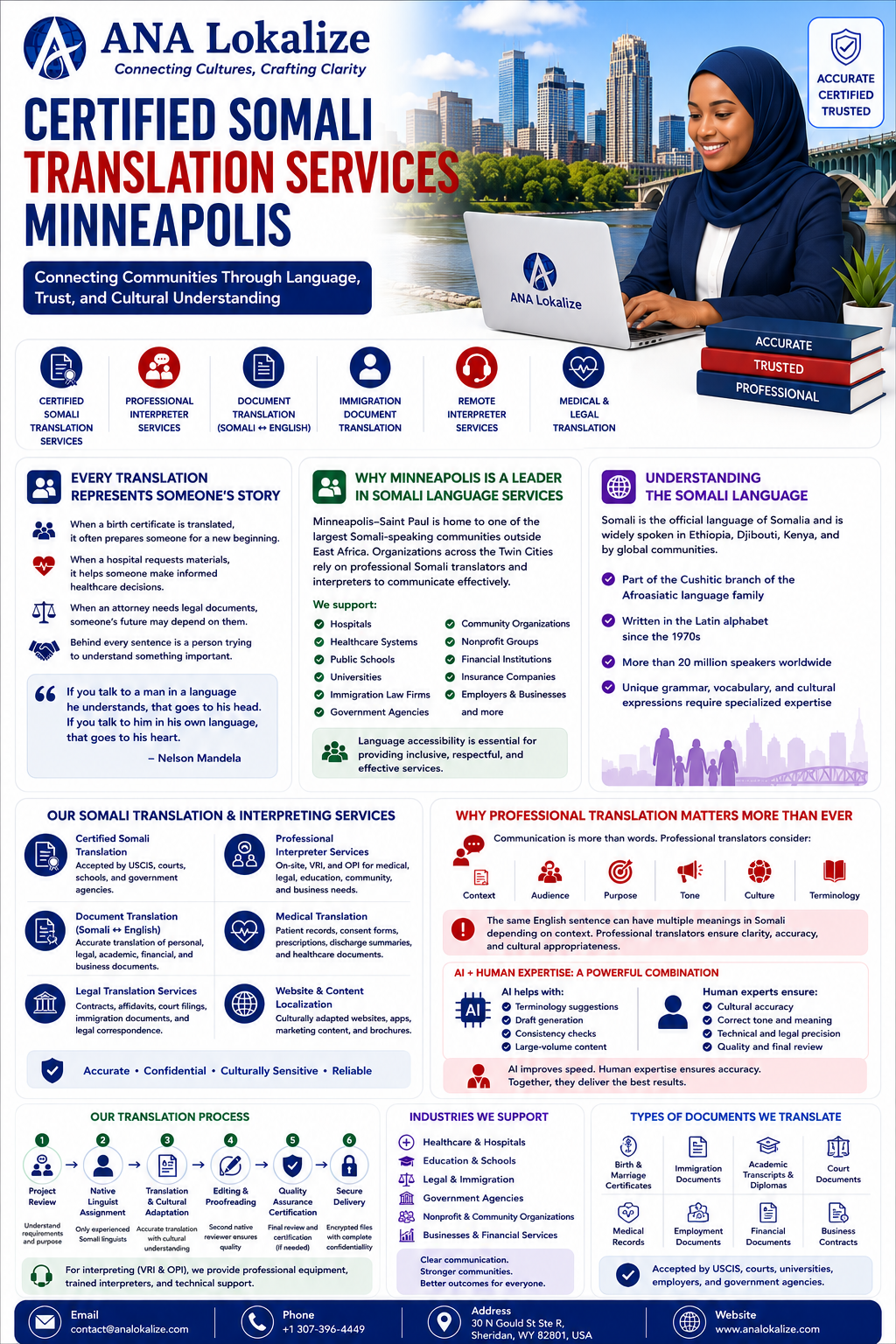
Every Translation Represents Someone's Story
One of the reasons I genuinely enjoy
working in the language industry is because every project reminds me that
language is deeply personal.
When someone sends us a birth certificate
for translation, they're often preparing for a major life event.
When a hospital requests patient education
materials, they're helping someone make informed healthcare decisions.
When an attorney needs translated legal
documents, someone's future may depend on those pages.
Translation isn't simply about documents.
It's about people.
Behind every sentence is a person trying to
understand something important.
That's why professional translation
deserves careful attention.
As Nelson Mandela famously said:
"If you talk to a man in a language
he understands, that goes to his head. If you talk to him in his own language,
that goes to his heart."
That quote has always resonated with me because it perfectly captures what professional language services should accomplish.
Why Minneapolis Has Become One of America's Most Important Cities for
Somali Language Services
Minneapolis–Saint Paul is home to one of
the largest Somali-speaking communities outside East Africa.
Over several decades, Minnesota has
welcomed Somali families through immigration, refugee resettlement, education,
employment opportunities, and family reunification.
Today, Somali entrepreneurs operate
successful businesses across the Twin Cities.
Somali healthcare professionals, educators,
community leaders, transportation workers, nonprofit organizations, and
students contribute significantly to the region's economy and cultural
diversity.
As this vibrant community continues to
grow, organizations increasingly recognize the importance of communicating
effectively with Somali-speaking individuals and families.
Professional language services now support
communication throughout:
- Hospitals
- Healthcare systems
- Public schools
- Universities
- Immigration law firms
- Government agencies
- Community organizations
- Nonprofit groups
- Financial institutions
- Insurance companies
- Employers
- Small businesses
- Corporate organizations
Language accessibility has become an
essential part of providing inclusive, respectful, and effective services.
Understanding the Somali Language
Somali is one of the most widely spoken
languages in the Horn of Africa and serves as the official language of Somalia.
It is also spoken extensively in
neighboring countries including Ethiopia, Djibouti, and Kenya, as well as by
large diaspora communities across North America, Europe, the Middle East, and
Australia.
Linguistically, Somali belongs to the Cushitic
branch of the Afroasiatic language family.
Modern Standard Somali has been written
using the Latin alphabet since the early 1970s, although regional dialects and
pronunciation variations continue to enrich the language across different
communities.
Globally, Somali is spoken by more than
20 million people, making it one of Africa's major languages.
Because Somali has unique grammar,
vocabulary, sentence structure, and cultural expressions, professional
translation requires specialized linguistic expertise rather than simple word
substitution.
Why Professional Translation Matters More Than Ever
Every year, translation technology becomes
more sophisticated.
Machine translation has improved
dramatically.
Artificial Intelligence has accelerated
multilingual communication.
Yet professional translation remains
indispensable.
Why?
Because communication involves much more
than vocabulary.
Professional translators constantly
consider:
- Context
- Audience
- Purpose
- Tone
- Cultural expectations
- Subject-matter terminology
The same English sentence may require
different Somali translations depending on whether it appears in:
- A legal agreement
- A medical report
- A patient brochure
- A government notice
- A school handbook
- A marketing campaign
Professional translation isn't simply
linguistic.
It's contextual.
That's what makes the difference.
Certified Somali Translation Services Minneapolis
Many clients ask me:
"What exactly makes a translation
certified?"
The answer is surprisingly simple.
A certified translation typically includes
both the translated document and a signed certification stating that the
translation is complete and accurate to the best of the translator's knowledge.
These translations are frequently requested
for official purposes such as:
- Birth certificates
- Marriage certificates
- Divorce decrees
- Academic transcripts
- Diplomas
- Employment records
- Immigration documentation
- Court records
- Police certificates
- Adoption paperwork
- Financial statements
- Government applications
Certified translations provide confidence
because every detail—from names and dates to official terminology—is reviewed
carefully before delivery.
Accuracy matters because official documents often support important life decisions.
Official Somali Document Translation Minneapolis
Not every translated document requires
certification.
However, every important document deserves
professional attention.
Professional Official Somali DocumentTranslation Minneapolis supports organizations and individuals by
translating written information clearly, naturally, and accurately.
Common document types include:
Personal Documentation
- Birth certificates
- Marriage certificates
- Identity documents
- Family records
- Personal correspondence
Academic Documentation
Educational institutions frequently require
translation for:
- Student records
- Academic transcripts
- Diplomas
- Certificates
- Enrollment documentation
Accurate translation helps institutions evaluate official records without ambiguity.
Government Documentation
Public agencies often require translation
for:
- Public notices
- Housing information
- Community programs
- Licensing documentation
- Emergency preparedness information
Accessible communication strengthens community engagement.
Business Documentation
Organizations regularly translate:
- Employee handbooks
- Workplace policies
- Financial reports
- Business proposals
- Internal communications
- Product documentation
Professional communication builds
professional relationships.
English to Somali Translation Services Minneapolis
Many organizations develop important
content in English that must later be shared with Somali-speaking audiences.
Professional English to Somali Translation Services Minneapolis ensure the translated content communicates
naturally while preserving the intended meaning.
Projects commonly include:
Healthcare Information
Healthcare providers frequently translate:
- Patient education materials
- Consent forms
- Medical instructions
- Appointment information
- Public health campaigns
Patients deserve to fully understand the information affecting their health.
Educational Resources
Schools and universities often require:
- Parent communication
- Student enrollment materials
- School policies
- Community announcements
- Educational resources
Language accessibility strengthens educational partnerships between schools and families.
Marketing Content
Professional translation helps businesses
adapt:
- Brochures
- Advertising campaigns
- Social media
- Product catalogs
- Email marketing
- Website content
Marketing should sound natural—not
translated.
Professional localization makes that
possible.
Website Localization
Businesses increasingly recognize that
simply translating a website isn't enough.
Localization considers:
- User experience
- Cultural expectations
- Regional language preferences
- Calls to action
- Navigation
- Customer communication
A localized website feels like it was
originally created for the people using it.
That builds trust.
Translation Is About Building Confidence
One thing I've learned throughout my career
is that clients rarely judge translation based on grammar alone.
Instead, they ask themselves one simple
question:
"Can I trust this?"
Trust comes from clarity.
Consistency.
Natural language.
Professional terminology.
And careful review.
Whether someone is reading medical
instructions, signing a contract, completing immigration paperwork, or
enrolling in school, they deserve information they can understand confidently.
That confidence begins with professional translation.
As organizations continue expanding
multilingual communication, another need naturally emerges.
Written documents are only one part of
communication.
People also need to ask questions, explain concerns, discuss options, and participate in conversations in real time—and those conversations require the same level of accuracy, cultural understanding, and professionalism that translated documents demand.
Somali to English Translation Services Minneapolis
Professional language services are never one-sided.
While many organizations require English
documents translated into Somali, there is an equally important need for Somalito English Translation Services Minneapolis. Individuals, businesses,
educational institutions, healthcare providers, attorneys, and government
agencies often receive official documents originally written in Somali that
must be translated into clear, professional English.
I've found that translating from Somali
into English is just as complex as translating in the opposite direction.
A professional translator doesn't simply
replace words.
They preserve:
- Meaning
- Context
- Official terminology
- Document structure
- Cultural references
- Reader intent
The final English translation should feel
as though it were originally written in English while remaining completely
faithful to the original document.
Projects frequently include:
Personal Documents
- Birth certificates
- Marriage certificates
- Family records
- Identification documents
- Community documentation
- Personal correspondence
Business Documentation
Organizations regularly translate:
- Employment records
- Financial reports
- Commercial contracts
- Business agreements
- Company policies
- Internal communications
Academic Documentation
Educational institutions often require:
- Academic transcripts
- Diplomas
- Certificates
- Enrollment records
- Educational evaluations
Accurate translation allows institutions to evaluate official records with confidence.
USCIS Certified Somali Translation Services Minneapolis
Immigration is one of the areas where
professional translation becomes especially important.
Behind every immigration document is a
person building a future.
Families invest months—sometimes
years—preparing applications, gathering documentation, and completing official
requirements.
Professional USCIS Certified Somali Translation Services Minneapolis help applicants present documents clearly
and accurately whenever certified translations are required.
Common immigration documents include:
- Birth certificates
- Marriage certificates
- Divorce decrees
- Police clearance certificates
- Academic transcripts
- Employment verification
- Financial records
- Identity documents
- Affidavits
- Adoption paperwork
Certified translations generally include a
signed certification confirming that the translated document accurately represents
the original.
Although translation providers can prepare
certified translations, applicants should always verify the current document
requirements with the receiving authority because submission requirements may
change over time.
Accuracy helps reduce unnecessary delays while giving applicants greater confidence during the immigration process.
Somali Medical Translation
Healthcare is one of the industries where
language accuracy has the greatest impact.
A patient who misunderstands medication
instructions.
A family uncertain about discharge
procedures.
A caregiver unable to explain symptoms
accurately.
These situations demonstrate why
professional Somali Medical Translation remains essential.
Medical translation commonly supports:
- Patient records
- Clinical reports
- Hospital discharge summaries
- Consent forms
- Vaccination documentation
- Prescription instructions
- Public health campaigns
- Medical research
- Healthcare brochures
- Telehealth resources
Medical language can be highly technical.
Professional translators ensure complex
medical terminology remains accurate while also being understandable for the
intended audience.
Healthcare providers benefit.
Patients benefit.
Most importantly, communication improves.
Somali Legal Translation Service
Legal communication requires exceptional
precision.
Unlike marketing or general business
communication, legal translation often leaves little room for interpretation.
Every sentence may carry legal
significance.
Professional Somali Legal Translation
Service supports:
Court Documentation
- Court filings
- Judgments
- Motions
- Legal notices
- Affidavits
Legal Agreements
- Contracts
- Employment agreements
- Partnership documents
- Business contracts
- Settlement agreements
Attorney Communication
Law firms frequently require translation
for:
- Client correspondence
- Consultation documents
- Immigration cases
- Legal evidence
- Witness statements
Professional legal translators focus on
preserving legal intent rather than producing literal word-for-word
translations.
That distinction helps ensure the translated
document accurately reflects the original legal meaning.
Professional Somali Language Services Minneapolis
Today's organizations rarely need only one
type of language service.
Most require ongoing multilingual
communication across many departments.
Professional Professional Somali
Language Services Minneapolis often include:
Document Translation
Professional translation for legal,
medical, educational, financial, technical, government, and business documents.
Website Localization
Adapting websites so they feel natural for
Somali-speaking visitors rather than simply translated.
Marketing Localization
Helping businesses communicate effectively
through culturally appropriate advertising, brochures, email campaigns, and
digital content.
Editing & Proofreading
Reviewing multilingual content for
consistency, readability, terminology, and quality.
Terminology Management
Maintaining consistent language across
long-term projects involving multiple translators, departments, or locations.
Language support becomes most effective
when every communication channel follows the same professional standards.
Why Native Somali Linguists Continue to Matter
One question clients often ask is:
"Does it really matter whether the
translator is a native Somali speaker?"
From my experience, absolutely.
Professional translators bring much more
than bilingual ability.
Native or highly fluent Somali linguists
naturally understand:
- Regional vocabulary
- Community preferences
- Cultural references
- Appropriate tone
- Everyday expressions
- Natural sentence rhythm
Those details often separate acceptable
translations from outstanding ones.
Readers may not consciously identify why
one translation feels more trustworthy than another.
They simply recognize when communication
sounds natural.
Artificial Intelligence Is Improving Translation Workflows
Artificial Intelligence has become one of
the most significant innovations in today's language industry.
At Ana Lokalize, we embrace AI because it
improves efficiency—not because it replaces professional translators.
Modern AI helps support:
- Translation memory
- Terminology consistency
- Workflow automation
- Initial draft generation
- Large multilingual projects
- Project organization
These technologies reduce repetitive work
while helping maintain consistency across thousands of translated words.
For organizations managing multilingual content at scale, AI offers valuable efficiency.
Why Human Expertise Remains Essential
Despite impressive advances in AI, language
continues to depend on human understanding.
Professional translators evaluate things
machines often struggle to interpret consistently.
They consider:
- Context
- Audience
- Culture
- Purpose
- Emotion
- Industry-specific terminology
Healthcare communication.
Legal documentation.
Immigration records.
Educational materials.
These projects require professional
judgment rather than automated prediction.
That's why our workflow combines the
strengths of both technology and experienced linguists.
Artificial Intelligence Provides
- Speed
- Consistency
- Productivity
- Translation memory
- Workflow optimization
Professional Linguists Provide
- Cultural understanding
- Subject expertise
- Contextual accuracy
- Critical thinking
- Natural communication
- Quality assurance
Technology accelerates the translation
process.
People ensure that every translated
document communicates naturally, accurately, and respectfully.
And while carefully translated documents
create the foundation for effective multilingual communication, many important
interactions don't begin with paperwork at all.
They begin with a conversation.
A physician discussing treatment options.
An attorney explaining legal rights.
A teacher meeting with parents.
A business owner speaking with a customer.
In those moments, people don't have the
luxury of waiting for written translations.
They need immediate understanding,
thoughtful communication, and professional interpretation that allows every
participant to engage confidently, regardless of the language they speak.
Professional Somali Interpreter Services Minneapolis: Making Every
Conversation Count
As important as professionally translated
documents are, many of life's most important moments don't happen on paper.
They happen in conversations.
A physician discussing a diagnosis with a
patient.
An attorney explaining legal options to a
client.
A teacher meeting with concerned parents.
A social worker helping a family understand
available resources.
A business owner welcoming a new customer.
In each of these situations, communication
happens in real time. People ask questions, express concerns, seek
clarification, and make important decisions together.
That's where Professional Somali
Interpreter Services Minneapolis become just as valuable as professional
translation.
Unlike written translation, interpretation
focuses on spoken communication, ensuring everyone involved understands one
another clearly, accurately, and respectfully.
Translation and Interpretation Work Together
Many people use the words translation
and interpretation interchangeably.
Although they both remove language
barriers, they solve different communication challenges.
Translation focuses on written communication
Examples include:
- Immigration documents
- Medical records
- Birth certificates
- Business contracts
- School records
- Government notices
- Websites
- Employee handbooks
Professional translators have time to
research terminology, verify context, edit their work, and carefully review
every sentence before delivery.
Interpretation focuses on spoken communication
Examples include:
- Doctor appointments
- Court hearings
- Parent-teacher conferences
- Business meetings
- Community events
- Government appointments
- Insurance discussions
- Customer support conversations
Professional interpreters work in real time
while maintaining the meaning, tone, and intent of every conversation.
Both services require exceptional language
skills, but interpretation also demands quick thinking, active listening,
excellent memory, and the ability to communicate naturally under pressure.
Why Professional Interpretation Matters
I've often noticed that people
underestimate how much can be lost when two individuals don't fully understand
one another.
Sometimes the misunderstanding seems small.
Sometimes it changes everything.
Imagine:
- A patient misunderstanding medication instructions.
- A parent missing important educational information.
- A client misunderstanding legal advice.
- An employee misunderstanding workplace safety procedures.
- A business negotiation ending because communication became
unclear.
Professional interpretation helps prevent
these situations by ensuring everyone participates equally in the conversation.
Language shouldn't determine who
understands important information.
Certified Somali Interpreter Services in Minneapolis
Certain conversations require an even
higher level of professionalism.
Healthcare providers.
Courts.
Law firms.
Government agencies.
Educational institutions.
These organizations often require
experienced interpreters who understand both language and professional ethics.
A Certified Somali Interpreter in Minneapolis
is expected to maintain:
- Accuracy
- Neutrality
- Confidentiality
- Professional ethics
- Cultural sensitivity
- Appropriate terminology
Professional interpreters don't summarize
conversations.
They don't leave out information.
They don't offer personal opinions.
Instead, they faithfully communicate
everything that is said while preserving the speaker's intent and tone.
That level of professionalism builds trust
for everyone involved.
Remote Somali Interpreter Services Minneapolis
Technology has transformed language access
over the past decade.
Organizations no longer need to delay
appointments while searching for an available local interpreter.
At Ana Lokalize, we primarily
provide Remote Somali Interpreter Services Minneapolis, allowing clients
to connect with experienced interpreters quickly and securely from virtually
anywhere.
Remote interpretation has become the
preferred solution for many organizations because it offers:
- Faster scheduling
- Improved interpreter availability
- Reduced travel expenses
- Flexible appointment times
- Secure online communication
- Consistent professional support
Whether you're serving one individual or
coordinating multilingual communication across multiple locations, remote
interpretation offers flexibility without compromising quality.
Video Somali Interpreter Services Minneapolis (VRI)
Some conversations benefit greatly from
visual communication.
People naturally understand one another
more effectively when they can observe:
- Facial expressions
- Body language
- Visual demonstrations
- Shared documents
- Non-verbal communication
That's why Video Somali Interpreter
Services Minneapolis continue to become increasingly popular.
Using secure video technology, professional
interpreters facilitate conversations while allowing everyone to remain visually
connected.
Video Remote Interpreting (VRI) is
particularly valuable for:
Healthcare
- Medical consultations
- Telehealth appointments
- Hospital admissions
- Mental health services
- Patient education
- Specialist referrals
Healthcare professionals can communicate
more naturally while interpreters observe important visual cues that may
support clearer understanding.
Education
Schools regularly use VRI for:
- Parent-teacher conferences
- Student evaluations
- Enrollment appointments
- Academic advising
- Individualized Education Program (IEP) meetings
Families participate more confidently when
language barriers are removed.
Legal Communication
Law firms often rely on VRI during:
- Client consultations
- Immigration meetings
- Case preparation
- Mediation
- Witness interviews
Complex legal discussions benefit from both
visual interaction and accurate interpretation.
Business Communication
Businesses increasingly use video
interpretation for:
- Employee interviews
- Human Resources meetings
- Customer consultations
- Staff training
- Vendor negotiations
- Internal communication
Video interpretation combines professional
language support with the flexibility of remote collaboration.
Virtual Somali Interpreter Minneapolis
As workplaces, healthcare providers,
educational institutions, and government agencies continue embracing digital
communication, virtual interpretation has become an essential part of everyday
operations.
A Virtual Somali Interpreter Minneapolis
allows organizations to provide language support regardless of physical
location.
Clients appreciate virtual interpretation
because it offers:
- Convenient scheduling
- Reliable communication
- Reduced travel requirements
- Greater flexibility
- Faster access to interpreters
Technology has expanded access to
professional language services without sacrificing quality.
Over-the-Phone Interpreting (OPI)
Not every conversation requires video.
Sometimes organizations simply need
immediate language assistance during a telephone conversation.
That's where Over-the-Phone Interpreting
(OPI) becomes an ideal solution.
OPI allows organizations to connect quickly
with professional Somali interpreters for conversations involving:
- Appointment scheduling
- Customer service
- Insurance providers
- Healthcare facilities
- Financial institutions
- Utility companies
- Government agencies
- Emergency situations
Because interpreters can often join calls
quickly, OPI remains one of the fastest methods for overcoming language
barriers.
Affordable Somali Interpreter Services Minneapolis
One question we hear frequently is:
"Can professional interpretation
also be affordable?"
Absolutely.
Affordable interpretation shouldn't mean
compromising on professionalism or accuracy.
Instead, affordability comes from:
- Efficient scheduling
- Modern communication technology
- Remote interpretation platforms
- Experienced project coordination
- Flexible service delivery
By leveraging secure virtual platforms and
streamlined workflows, organizations can often receive high-quality language
support while managing costs effectively.
Language accessibility should be practical
as well as professional.
Interpretation Creates More Than Communication
One thing I've learned throughout my career
is that interpretation doesn't simply help people exchange information.
It helps people build relationships.
Patients trust their healthcare providers.
Parents trust their children's schools.
Clients trust their attorneys.
Businesses build stronger customer
relationships.
Communities become more inclusive.
Every interpreted conversation creates an
opportunity for understanding.
And as organizations continue investing in
multilingual communication, another important question naturally follows.
How do you choose the right language
partner—one that combines experienced linguists, secure technology,
professional quality standards, and a genuine commitment to helping people
communicate with confidence?
Choosing the Right Somali Language Partner
By the time organizations begin searching
for professional language services, they usually have an immediate need.
A hospital has a patient arriving tomorrow.
An attorney has a hearing scheduled next
week.
A university needs translated enrollment
documents.
A business is preparing to expand into a
new market.
An individual is submitting immigration
paperwork.
At that point, the most important question
becomes:
Who can we trust with our communication?
Throughout my experience in the language
industry, I've found that choosing a translation company should involve much
more than comparing prices.
You're choosing a partner who will represent
your message, protect your confidential information, and help build trust
between people who speak different languages.
A professional language partner should
offer:
- Experienced Somali linguists
- Certified translation services
- Professional interpretation services
- Medical and legal language expertise
- Secure document handling
- AI-assisted quality workflows
- Consistent terminology management
- Responsive customer support
- Reliable turnaround times
The goal isn't simply to receive a
translated document.
The goal is to communicate accurately and
confidently.
Why Quality Is a Process, Not an Accident
People often see only the finished
translation.
What they don't see is the careful process
behind it.
Every successful language project begins
with understanding the purpose of the communication before the first sentence
is translated.
Professional translation typically includes
several stages.
Understanding the Project
Before work begins, we identify:
- Target audience
- Industry
- Document purpose
- Required certification
- Delivery timeline
- Preferred terminology
Understanding these details allows
translators to make informed linguistic decisions from the very beginning.
Selecting the Right Linguist
Not every translator specializes in every
subject.
Medical translation requires healthcare
terminology.
Legal translation requires legal expertise.
Business translation requires commercial
understanding.
Matching each project with the right
linguist improves both quality and consistency.
Translation
During translation, every sentence is
evaluated for:
- Meaning
- Context
- Tone
- Accuracy
- Readability
- Cultural appropriateness
Literal translation is rarely the goal.
Natural communication is.
Editing and Proofreading
Professional review remains one of the most
important parts of the workflow.
Editing helps improve:
- Grammar
- Consistency
- Terminology
- Sentence flow
- Formatting
- Overall readability
A second set of experienced eyes often
identifies opportunities to improve clarity before the document reaches the
client.
Final Quality Assurance
Before delivery, every project undergoes a
final quality review.
This final check helps ensure that names,
dates, formatting, terminology, and document completeness have been carefully
verified.
Quality isn't created by a single step.
It's the result of a thoughtful process.
Protecting Confidential Information
Many of the documents entrusted to
professional translators contain highly sensitive information.
Healthcare providers share medical records.
Attorneys share legal documentation.
Businesses share financial reports.
Individuals submit immigration paperwork
and personal records.
Protecting confidentiality isn't simply a
professional expectation.
It's an essential responsibility.
Organizations should feel confident that
their information is handled securely throughout every stage of the project.
Trust is built not only through accurate
translation but also through responsible document management.
The Future of Somali Language Services
The language industry is changing rapidly.
Artificial Intelligence continues
advancing.
Speech recognition becomes more accurate.
Translation memory systems become more
sophisticated.
Secure cloud collaboration makes
multilingual projects easier to manage.
Remote communication continues expanding
worldwide.
These innovations are making professional
language services faster and more accessible than ever before.
At the same time, one important truth
remains unchanged.
Language is fundamentally human.
Every conversation reflects culture.
Every document carries context.
Every community has its own communication
style.
Technology helps us work more efficiently.
Professional linguists help us communicate
more meaningfully.
The future isn't about replacing people
with technology.
It's about combining the strengths of both.
Why Human Expertise Continues to Matter
One question I hear frequently is:
"Will Artificial Intelligence
eventually replace translators and interpreters?"
From what I've seen, AI will continue
becoming a valuable tool.
But communication involves much more than
predicting the next word.
Professional linguists understand:
- Cultural expectations
- Regional language variation
- Context
- Emotional nuance
- Industry terminology
- Reader intent
These are areas where human judgment
continues to make an enormous difference.
At Ana Lokalize, we embrace AI because it
improves efficiency.
We rely on experienced human linguists
because they ensure quality.
Together, they create language solutions
that are faster, more consistent, and more reliable than either could achieve
independently.
Language Accessibility Creates Stronger Communities
One of the most rewarding aspects of
professional translation is seeing how it improves everyday life.
Hospitals communicate more clearly with
patients.
Schools strengthen relationships with
families.
Businesses build trust with new customers.
Government agencies make public information
more accessible.
Legal professionals ensure clients fully
understand their rights.
Community organizations reach people who
might otherwise feel excluded.
Language accessibility isn't simply a
service.
It's an investment in inclusion.
The stronger communication becomes, the
stronger communities become.
Final Thoughts
Whenever I reflect on why translation and
interpretation matter, I always return to one simple idea:
Every person deserves to be understood.
Whether someone is reading a medical
report, preparing immigration documents, attending a legal consultation,
enrolling a child in school, or asking questions during an important
appointment, language should never become an obstacle.
Professional Certified Somali
Translation Services Minneapolis, Somali Document Translation Services
Minneapolis, English to Somali Translation Services Minneapolis, Somali
to English Translation Services Minneapolis, Official Somali Document
Translation Minneapolis, USCIS Certified Somali Translation Services
Minneapolis, Somali Medical Translation, Somali Legal Translation
Service, Professional Somali Language Services Minneapolis, Remote
Somali Interpreter Services Minneapolis, Video Somali Interpreter
Services Minneapolis, and Virtual Somali Interpreter Minneapolis all
serve the same purpose:
Helping people communicate with confidence,
accuracy, and cultural respect.
As Maya Angelou wisely said:
"Words mean more than what is set
down on paper. It takes the human voice to infuse them with deeper
meaning."
Translation gives those words clarity.
Interpretation gives them a voice.
Together, they create understanding.
Frequently Asked Questions
What are Certified Somali Translation Services Minneapolis?
Certified Somali translation services
provide professionally translated documents accompanied by a signed
certification stating that the translation is complete and accurate to the best
of the translator's knowledge. These are commonly used for immigration, legal,
educational, employment, and government purposes.
Do you provide Somali document translation services in Minneapolis?
Yes. We translate personal, legal, medical,
educational, financial, technical, business, and government documents between
Somali and English with careful quality assurance.
Do you offer English to Somali and Somali to English translation?
Absolutely. We provide both English to
Somali Translation Services Minneapolis and Somali to English Translation
Services Minneapolis for organizations and individuals across a wide range
of industries.
What is Official Somali Document Translation Minneapolis?
Official document translation refers to
professionally translated documents prepared for formal or institutional use,
such as applications, records, contracts, certificates, and government
paperwork. Some organizations may also require certified translations.
Do you provide USCIS certified Somali translation services?
Yes. We provide certified translations
suitable for many immigration-related purposes. Applicants should always verify
current documentation requirements with the receiving authority before
submission.
Do you provide Somali Medical Translation?
Yes. We translate medical records, consent
forms, patient education materials, discharge summaries, healthcare brochures,
public health information, and many other healthcare-related documents.
Do you provide Somali Legal Translation Service?
Yes. Our legal language services include
contracts, court documents, affidavits, legal correspondence, immigration
paperwork, compliance documentation, and other legal materials requiring
precise terminology.
What interpretation services do you provide?
Our primary focus is Remote
Interpretation, including:
- Video Remote Interpreting (VRI)
- Over-the-Phone Interpreting (OPI)
We also support on-site interpretation
requests when appropriate for specific client needs.
What is a Virtual Somali Interpreter Minneapolis?
A virtual interpreter provides professional
language interpretation through secure online platforms, allowing participants
to communicate effectively from different locations without sacrificing
communication quality.
Are your Somali interpreter services affordable?
Yes. We strive to provide cost-effective
interpretation solutions by combining experienced linguists, efficient
scheduling, and secure remote communication technologies.
Can I request a Somali interpreter quote online?
Yes. You can easily contact Ana Lokalize to
discuss your translation or interpretation requirements and request a
customized quote based on your project's language pair, subject matter,
timeline, and service type.
How do you ensure translation quality?
Every project follows a structured workflow
that includes project assessment, professional translation, editing,
proofreading, terminology verification, and final quality assurance before
delivery.
Ready to Communicate Without Language Barriers?
At Ana Lokalize, we believe
communication should create opportunities—not obstacles. Whether you need
certified document translation, medical or legal translation, website
localization, or professional Remote Somali Interpreter Services Minneapolis
through Video Remote Interpreting (VRI) or Over-the-Phone
Interpreting (OPI), our experienced linguists are ready to help.
By combining expert human translators and
interpreters with carefully managed AI-assisted workflows, we deliver language
solutions that are accurate, culturally appropriate, secure, and tailored to
your needs.
Contact Ana Lokalize Today
Request a free quote today and discover how
our professional Somali translation and interpretation services can help your
organization improve communication, strengthen relationships, and confidently
connect with Minneapolis's vibrant Somali-speaking community.
