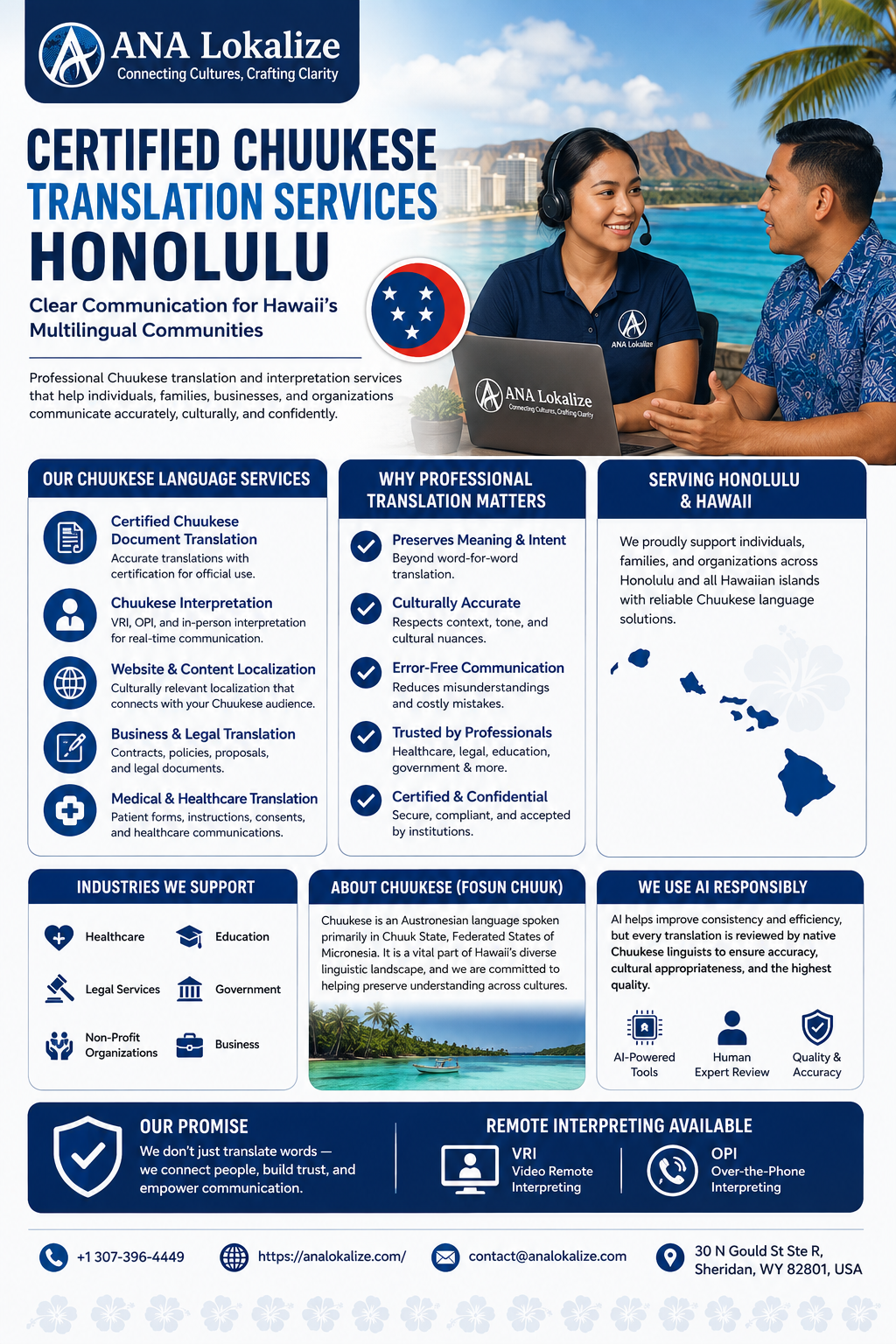
If you’re searching for Certified Chuukese translation services Honolulu, Professional Chuukese interpreter services Honolulu, English to Chuukese document translation Honolulu, or reliable Remote Chuukese interpreter services in Honolulu, chances are the communication in front of you matters. It may involve immigration paperwork, healthcare information, an official certificate, a school document, a legal matter, or a conversation where someone needs to be understood immediately. In this guide, I want to go beyond simply describing translation services. We’ll explore what professional Chuukese translation actually involves, why language access has particular relevance in Hawaii, when certified translation is appropriate, how Chuukese-to-English and English-to-Chuukese projects should be handled, when VRI and OPI interpretation make sense, and how we can use AI responsibly without allowing technology to replace the cultural knowledge and judgment of experienced linguists.
At ANA
Lokalize, we see translation as something much bigger than exchanging words
between two languages.
A good
translation should preserve information.
A great
translation should preserve understanding.
And when the
document affects someone’s health, education, immigration journey, legal
situation, employment, or access to essential services, that distinction
becomes extremely important.
In Honolulu, Language Access Is About
Real People
Honolulu is one
of those places where multilingual communication isn’t an abstract business
concept.
It’s part of
everyday life.
Hawaii’s
connections across the Pacific have created communities with remarkably diverse
linguistic backgrounds. Chuukese is significant enough in the state’s
language-access environment that the Hawaiʻi Office of Language Access
maintains dedicated Chuukese resources, including a Chuukese-language
interpreter request form and information explaining how people can request language
assistance. The state’s language-access encounter form also explicitly lists
Chuukese among the languages for which agencies may record requests for
assistance.
That tells us
something important.
Chuukese
language access in Hawaii is not simply an SEO phrase or a hypothetical service
need.
It is part of
real communication between people and institutions.
A
Chuukese-speaking resident may need to understand healthcare information.
A family may
need to communicate with a school.
Someone may have
an official document that needs to be presented in English.
A community
organization may need to make information accessible.
An attorney may
need to communicate with a client.
A business may
have employees or customers who are more comfortable communicating in Chuukese.
The language is
the same, but the solution isn’t always the same.
Sometimes people
need translation.
Sometimes they
need certified translation.
Sometimes they
need localization.
And sometimes
there is no document at all—they need an interpreter who can help two people
communicate in real time.
Understanding
those differences is the foundation of meaningful language access.
What Is Chuukese?
Chuukese, often
referred to as Fosun Chuuk, is an Austronesian language associated
primarily with Chuuk State in the Federated States of Micronesia.
For
organizations in Honolulu, understanding this background matters because
professional translation isn’t performed in a cultural vacuum.
Languages
develop through communities.
They reflect
relationships, history, conventions, and ways of communicating that cannot
always be understood through vocabulary alone.
That is why I’m
cautious whenever someone describes translation as simply “changing the words.”
Words are only
one part of meaning.
A professional
translator also has to think about:
- Context
- Audience
- Purpose
- Tone
- Terminology
- Cultural appropriateness
- Readability
A government
notice, medical instruction, business advertisement, legal document, and school
communication may all be written in English, but they shouldn’t necessarily be
translated using the same style.
Professional
translation begins by understanding what the content is supposed to accomplish.
Why Professional Chuukese Translation
Matters
Machine
translation has changed enormously.
We can type a
sentence into an application and receive another-language version almost
instantly.
That convenience
is genuinely useful in certain circumstances.
But instant
translation can also create the impression that professional translation is
simply a slower version of the same process.
It isn’t.
Professional
translators make decisions.
They ask:
Who will read
this?
What does the
author actually mean?
Does this
term have a specialized meaning here?
Is this
wording natural in the target language?
Could a
literal translation create confusion?
Does this
document require certification?
Are names,
numbers and dates consistent?
Those questions
become especially important with less digitally resourced languages, where
automated systems may have fewer high-quality examples available than they do
for globally dominant languages.
Fluent-looking
machine output is not proof that the meaning is correct.
That is one
reason human review remains so important.
Certified Chuukese Translation
Services Honolulu
When clients ask
us about Certified Chuukese translation services Honolulu, the first
thing we need to understand is how the translated document will be used.
Certified
translation is commonly associated with official or administrative purposes.
Depending on the
receiving organization, documents may include:
- Birth certificates
- Marriage certificates
- Divorce records
- Academic transcripts
- Diplomas and certificates
- Immigration documents
- Employment records
- Government records
- Court-related documentation
- Personal identification records
- Adoption documents
- Financial records
A certified
translation typically includes a certification attesting to the completeness
and accuracy of the translation.
But there is an
important point that sometimes gets lost in marketing language:
“Certified”
does not mean every receiving institution follows identical requirements.
The organization
receiving the document determines what it will accept.
So before
beginning a project, we encourage clients to check the specific requirements of
the agency, school, court, employer, attorney, or other organization requesting
the translation.
That is more
useful than making broad promises that every document will automatically be
accepted everywhere.
Accuracy in an Official Document Is
About the Small Details
Official
documents often aren't particularly long.
But they can be
some of the most demanding documents to translate properly.
Think about a
birth certificate.
It might contain
relatively little text, yet nearly every piece of information matters:
- Names
- Dates
- Places
- Registration numbers
- Government offices
- Signatures
- Stamps
- Titles
- Annotations
If a source
contains unclear or illegible information, a professional translator should not
quietly invent what they think it says.
If spelling
differs across documents, the discrepancy shouldn't simply be “corrected”
without consideration.
Transparency
matters.
Completeness
matters.
Consistency
matters.
This is why
professional document translation should be evaluated on more than how quickly
someone can produce a target-language file.
English to Chuukese Document
Translation Honolulu
Organizations
throughout Hawaii may create information in English but need to make that
information understandable to Chuukese-speaking audiences.
Professional English to Chuukese document translation Honolulu can support materials across
healthcare, education, government, business, nonprofit work, community
services, and other areas.
Common projects
can include:
Healthcare Materials
- Patient education
- Appointment information
- Discharge instructions
- Healthcare forms
- Preventive-care materials
- Public-health communication
Educational Content
- Parent notices
- Enrolment materials
- School policies
- Student information
- Community announcements
- Educational resources
Government and Community Information
- Public notices
- Program information
- Application guidance
- Community resources
- Service instructions
- Outreach materials
Workplace Documents
- Employee handbooks
- HR communication
- Training materials
- Safety information
- Internal notices
- Workplace policies
Business Communication
- Customer information
- Product materials
- Marketing content
- Presentations
- Service information
- Website content
Although all
these projects involve English and Chuukese, they do not require identical
writing.
A medical
instruction should prioritize precision and comprehension.
A government
notice should be clear and authoritative.
An employee
handbook should be consistent.
Marketing
content should sound engaging and natural.
Good translation
adapts to purpose without changing the underlying message.
Translating Meaning Instead of
Chasing Words
One of the
easiest ways to create an unnatural translation is to become obsessed with
matching every word individually.
Languages don't work
that way.
Meaning often
exists at the sentence, paragraph, and situational level.
Imagine an
English public-service message containing an expression that sounds perfectly
natural to an American English reader.
A literal
Chuukese rendering might preserve each dictionary definition while producing a
phrase that feels awkward or unclear to the intended audience.
The translator
has to preserve the meaning and function of the message.
That doesn't
mean taking creative liberties with official information.
It means
recognizing that linguistic equivalence is more sophisticated than word
replacement.
This principle
is particularly important in healthcare, legal, immigration, and educational
materials, where misunderstandings can have consequences beyond poor writing.
Affordable Chuukese Document
Translation Services in Honolulu Should Still Be Professional
Cost
understandably matters.
Individuals may
have several personal documents requiring translation.
Community
organizations may operate within limited budgets.
Businesses and
institutions may need large volumes of recurring content.
So it makes
sense that people search for Affordable Chuukese document translation services in Honolulu.
But
affordability shouldn't mean removing the steps that protect quality.
A more
sustainable approach is to improve the workflow.
Technology can
help with repetitive tasks.
Translation
memory can support consistency.
Terminology
resources can reduce repeated research.
Digital project
management can simplify document handling.
Recurring
projects can benefit from established linguistic preferences.
These
efficiencies can make professional services more practical without treating
quality control as an optional extra.
The question
shouldn't be:
“How cheaply
can these words be translated?”
A better
question is:
“What is the
most efficient way to produce a translation we can actually trust?”
Cultural Understanding Is Part of
Translation Quality
I've always
believed that one of the most valuable things a professional linguist
contributes is knowing when a technically possible translation is culturally
wrong for the situation.
Language carries
assumptions about:
- Formality
- Respect
- Relationships
- Authority
- Community
- Familiarity
- Social context
Those
considerations influence how people receive information.
The best
translation isn't necessarily the version that demonstrates the translator's
vocabulary.
It's the version
the intended reader understands naturally.
That
human-centered approach also aligns with the Google guidance you referenced for
this article. Google says its systems are designed to prioritize helpful,
reliable information created to benefit people rather than content created
primarily to manipulate rankings. Its guidance also encourages publishers to
consider who created content, how it was produced, and why it exists.
The same
philosophy is useful here.
We're naturally
using phrases such as Certified Chuukese translation services Honolulu
because they describe what people are looking for.
But we're not
going to repeat that phrase every few paragraphs simply to increase its
frequency.
The reader comes
first.
Language Access Is Already Part of
Hawaii’s Public-Service Landscape
There is another
reason professional Chuukese communication deserves serious attention in Honolulu.
Hawaii has
formal language-access infrastructure.
The state's
Office of Language Access says it provides oversight and coordination to state
agencies and technical assistance in implementing language-access plans. Its
public resources include Chuukese alongside languages such as Ilocano,
Japanese, Korean, Marshallese, Samoan, Tagalog, and others.
The Office of
Language Access also provides a dedicated Chuukese “I Speak” card and Chuukese
information for requesting interpreter assistance.
For businesses
and organizations, this provides a useful reminder:
Language
accessibility isn't simply about translating a brochure once.
People interact
with organizations across multiple channels.
They read.
They complete
forms.
They visit
websites.
They call.
They attend
appointments.
They ask
questions.
They participate
in meetings.
A complete
language-access strategy has to consider those different moments.
Translation and Localization Are Not
Always the Same Thing
This distinction
becomes particularly important online.
A client may
tell us:
“I want my
website translated into Chuukese.”
What they may
actually need is localization.
Translation
focuses primarily on transferring written meaning between languages.
Localization
looks at how that translated content works within the broader experience.
For a website,
that might mean considering:
- Navigation
- Calls to action
- Forms
- Help information
- Service descriptions
- User instructions
- Terminology
- Layout
- Customer-support content
A visitor should
be able to use the information, not merely recognize that the words have been
translated.
The same
principle applies to digital forms, healthcare portals, educational resources,
and customer-support materials.
Technology Can Help, but It Needs a
Defined Role
AI will be an
important thread throughout this guide because it is already changing how
multilingual projects are managed.
But I don't want
to describe AI as magic.
Its value
depends on what we're asking it to do.
Depending on the
content, privacy requirements, and workflow, technology may assist with areas
such as:
- Terminology management
- Translation memory
- Repetitive-content identification
- Workflow automation
- Project organization
- Quality-control assistance
That can save
professional linguists time and help improve consistency.
What technology
should not do is encourage us to stop asking whether the final communication is
accurate.
Google's current
guidance makes a comparable distinction for web content: the focus is on
whether material is useful, reliable, and created primarily to help people,
while extensive automation used mainly to manipulate rankings is a warning
sign.
For translation,
our principle is similarly practical:
Use
technology to strengthen the process—not to avoid professional responsibility for
the result.
A Document Often Represents Something
Much Bigger
When someone
emails us a certificate or record, we see a file.
But for the
client, that file might represent a much bigger journey.
It could support
an immigration process.
It could
establish a family relationship.
It could
document education.
It could verify
employment.
It could provide
evidence for an administrative or legal matter.
That's why
official translation deserves care even when the source contains only a small
amount of text.
And it brings us
naturally to one of the most important areas of Chuukese document services in
Honolulu: immigration-related translation.
A Professional Chuukese translator for immigration documents Honolulu needs to think not
only about the language on the page but also about names, dates, stamps,
document structure, completeness, certification, and consistency across
supporting records. At the same time, many Honolulu clients need the opposite
language direction—turning records originally written in Chuukese into clear
English for organizations that need to understand them.
That is where Chuukese
to English translation services Honolulu USA become especially important,
and where the difference between an ordinary translation and a carefully
prepared official document becomes much easier to see.
Chuukese to English Translation
Services Honolulu USA
When a document
begins in Chuukese and needs to be presented in English, the direction of
translation changes—but the responsibility for accuracy does not.
Professional Chuukese to English translation services Honolulu USA may be needed by individuals,
attorneys, healthcare organizations, educational institutions, employers,
community organizations, and other agencies that receive documents originally
prepared in Chuukese.
These may
include:
- Birth and marriage records
- Family documents
- Academic transcripts
- School records
- Medical records
- Employment documentation
- Legal correspondence
- Financial records
- Personal statements
- Government-related documents
- Community records
A good English
translation should allow the receiving reader to understand what the original
document actually says without adding explanations, assumptions, or
interpretations that weren't present in the source.
That sounds
simple.
In practice,
official records often make it surprisingly complicated.
Why Small Details Become Big Details
in Official Translation
Names are a good
example.
Someone's name
may appear with slightly different spelling across several records. Dates may
use an unfamiliar format. A stamp may be partially legible. A handwritten
annotation may be difficult to read.
A translator
should not silently "fix" uncertain information simply because one
version appears more logical.
Our
responsibility is to represent the source faithfully.
If something
cannot be read reliably, that uncertainty needs to be handled transparently
rather than guessed.
The same
principle applies to:
- Registration numbers
- Titles
- Government offices
- Signatures
- Dates
- Addresses
- Seals and stamps
- Handwritten notes
Professional
translation isn't valuable because a translator can make every ambiguity
disappear.
Sometimes
professionalism means recognizing that an ambiguity exists.
Professional Chuukese Translator for
Immigration Documents Honolulu
Immigration-related
documents make this level of care particularly important.
Someone
searching for a Professional Chuukese translator for immigration documents
Honolulu may be preparing documents connected with a major transition in
their life.
The paperwork
could include:
- Birth certificates
- Marriage certificates
- Divorce records
- Police or government records
- Academic transcripts
- Employment documentation
- Financial records
- Family records
- Affidavits or supporting statements
- Other identity or civil documents
In these
situations, names, dates, places, and document relationships should be handled
consistently.
A professional
translator should also understand the boundary between translation and
immigration advice.
We translate
what the source says.
We don't decide
whether a government agency will approve an application, and professional
translation itself does not guarantee acceptance of a document.
Requirements
should always be checked with the receiving authority or a qualified
immigration professional where appropriate.
That distinction
makes the content more useful because clients know exactly what a translation
provider can—and cannot—do for them.
Certified Translation Is About
Accuracy, Not Marketing Language
The word
"certified" appears frequently in translation searches, but it
shouldn't become a vague quality label.
A certified
translation typically involves a statement attesting to the completeness and
accuracy of the translation.
It doesn't mean
the translator gets to rewrite a source document into what they believe it
should say.
It doesn't mean
the translation provider can guarantee the decision of an immigration
authority, university, court, or government agency.
And it doesn't
mean every receiving organization has identical submission requirements.
Professional Certified
Chuukese translation services Honolulu should therefore begin with a
practical question:
What does the
organization receiving your document require?
Once that is
clear, the translation can be prepared accordingly.
Immigration Documents Often Need More
Than Linguistic Fluency
Immigration-related
translation illustrates why professional expertise matters.
A translator may
need to preserve:
- Personal names
- Geographic information
- Family relationships
- Dates and timelines
- Official titles
- Institutional names
- Document identifiers
Consistency
across multiple documents is especially important.
Imagine that the
same person's name appears on a birth record, marriage certificate, academic
document, and employment record.
A professional
workflow should recognize those connections rather than treating each file as
an unrelated collection of words.
That attention
to context is difficult to achieve when documents are simply pushed through an
automated translation tool one at a time.
Healthcare Creates a Different Kind
of Responsibility
Official records
require documentary precision.
Healthcare
communication introduces another challenge: the reader may need to use the
information to understand something affecting their health.
Chuukese
language services in Honolulu may support healthcare organizations with written
materials such as:
- Patient education documents
- Appointment instructions
- Medical histories
- Consent-related information
- Discharge materials
- Preventive-health resources
- Public-health communication
- Insurance information
- Clinical documentation
- Follow-up instructions
The translator
needs to preserve medical meaning while respecting the communication level of
the original material.
A clinical
document written for healthcare professionals shouldn't suddenly become an
oversimplified patient brochure.
Likewise, a
plain-language patient instruction shouldn't become unnecessarily technical
simply because the translator knows sophisticated medical vocabulary.
The audience
matters.
Medical Translation Is Not Medical
Advice
This distinction
is worth making explicitly.
Professional
medical translators communicate the information contained in the source.
They don't
diagnose patients.
They don't
independently modify treatment instructions.
They don't
decide whether a medication recommendation is appropriate.
Their
responsibility is linguistic accuracy.
Healthcare
decisions remain with qualified healthcare professionals and patients.
This boundary is
particularly important when translation and interpretation services become
integrated into clinical communication.
Written Healthcare Translation and
Live Interpretation Work Together
Imagine a
Chuukese-speaking patient attending an appointment in Honolulu.
Before the
visit, translated materials might explain how to prepare.
During the
appointment, an interpreter may help the patient and healthcare professional
communicate in real time.
Afterward,
translated instructions may provide information the patient can refer to at
home.
If questions arise
later, telephone interpretation may help facilitate a follow-up call.
These aren't
competing services.
They're
different components of the same language-access experience.
Written
translation supports information that needs to remain available.
Interpretation
supports conversations that need to happen now.
That distinction
becomes increasingly important when organizations design language-access
programs instead of ordering isolated translations.
Legal Translation Demands Precision
and Restraint
Legal
communication creates another specialized environment.
Chuukese-English
language support may be required for:
- Contracts
- Affidavits
- Legal correspondence
- Court-related records
- Witness statements
- Immigration-related legal
documentation
- Employment agreements
- Settlement documents
- Compliance materials
- Powers of attorney
- Business agreements
Legal
translators need to understand what the terminology means in context before
deciding how it should be communicated in another language.
But they also
need restraint.
A translator
shouldn't "improve" an argument.
They shouldn't
make someone's statement sound more persuasive.
They shouldn't
independently explain the legal consequences of the document.
The role is to
preserve the source faithfully.
Legal advice
belongs to qualified legal professionals.
Educational Translation Supports
Families as Well as Institutions
Language access
also plays an important role in education.
Schools,
universities, training organizations, and families may require translation for:
- Enrolment information
- Academic records
- Parent communication
- Student policies
- School notices
- Program information
- Educational resources
- Certificates and transcripts
The
communication goal can vary significantly.
An academic
transcript requires documentary precision.
A letter to
parents needs clarity.
An informational
guide may need accessible language.
Once again, the
subject isn't simply "Chuukese translation."
It's
communication designed for a particular purpose.
Business Translation Needs to Sound
Like the Business
Businesses
serving multilingual communities face a different challenge.
Their
communication often needs to be accurate and persuasive, welcoming,
instructional, or brand-consistent.
Possible
projects include:
- Employee handbooks
- HR communication
- Workplace training
- Safety instructions
- Customer support resources
- Product information
- Service descriptions
- Websites
- Marketing materials
- Internal communication
A business
shouldn't sound like a government agency simply because its content was
translated.
Tone matters.
If the original
message is friendly, the translation should preserve that quality where
linguistically appropriate.
If the source is
formal, the target should respect that formality.
Translation
should preserve the organization's voice without forcing English-language
structures unnaturally into Chuukese.
Get Professional Chuukese Translation
Services Online
Technology has
made this kind of specialized work easier to access.
Today, clients
can Get professional Chuukese translation services online without
limiting themselves to whoever happens to be physically available within a few
miles of Honolulu.
A typical
digital workflow may allow clients to:
- Submit documents electronically.
- Explain the intended use.
- Identify certification or formatting
requirements.
- Receive a project estimate.
- Have the work assigned to an
appropriate linguist.
- Complete translation and quality
review.
- Receive the finished document
electronically.
This matters
particularly when subject expertise is required.
The best
translator for a healthcare project may not be the best linguist for legal
content.
Remote workflows
allow providers to prioritize expertise instead of geography alone.
Remote Translation Does Not Mean
Automated Translation
This distinction
is important.
"Remote"
describes how the service is delivered.
It doesn't mean
the translation is automatically generated by software.
Professional
remote translation can still involve experienced human linguists, editors,
project managers, and quality-control processes.
Technology
simply makes it possible for those professionals to collaborate efficiently.
That flexibility
can be especially valuable for Affordable Chuukese document translation
services in Honolulu, because digital workflows can reduce unnecessary
administrative and geographic limitations without requiring quality to be
sacrificed.
Where AI Actually Helps
Artificial
intelligence can support this process, but I prefer to describe its role
specifically rather than saying that we "use AI" as though that alone
were a benefit.
Depending on the
project, security requirements, and suitability of the content, technology can
assist professional workflows through:
Terminology Support
Recurring
clients may use the same institutional, healthcare, educational, or business
terminology repeatedly.
Terminology
tools can help professional linguists maintain consistency.
Translation Memory
Previously
approved translations can sometimes help identify recurring or similar content,
reducing unnecessary repetitive work.
Quality-Assurance Assistance
Technology can
help flag potential inconsistencies involving numbers, repeated terminology,
formatting, or other elements for human review.
Workflow Automation
Project
assignment, file organization, status management, and other administrative
processes can be made more efficient.
Repetitive Content Identification
Large documents
may contain sections that repeat. Technology can help identify those patterns.
These
applications solve specific problems.
That's a much
more responsible approach than assuming an AI-generated translation is
automatically ready for use simply because it sounds fluent.
Fluency Can Be Misleading
One of the most
important things organizations should understand about modern generative AI is
that incorrect output can sound extremely confident.
That's
particularly dangerous in translation.
A sentence may:
- Read smoothly
- Follow correct grammar
- Sound professional
…and still
misrepresent the source.
Human reviewers
therefore need to ask a different question from ordinary proofreading.
Not:
"Does
this sound good?"
But:
"Does
this accurately communicate what the source actually says?"
For official,
immigration, healthcare, legal, or otherwise consequential content, that
distinction can be critical.
Human Expertise Provides What
Automation Cannot Reliably Guarantee
Professional
linguists contribute several things that are difficult to reduce to an
algorithm:
- Cultural understanding
- Contextual judgment
- Subject-matter awareness
- Audience awareness
- Recognition of ambiguity
- Natural language instincts
- Professional accountability
AI can be
extremely useful when its role is clearly defined.
The strongest
model is therefore not:
Human or AI?
It's:
Which tasks
can technology improve, and which decisions require professional human
judgment?
That is how we
approach responsible integration.
The Same Principle Applies to Online
Language Access
Remote
technology has changed more than document translation.
It has also
changed how people communicate live.
A few years ago,
someone who needed an interpreter might assume the only solution was finding a
bilingual person who could physically travel to the appointment.
Today,
professional interpretation can happen in several ways.
An interpreter
may be present in the room.
They may join
through video.
They may
participate by telephone.
Each option has
strengths.
And the right
choice depends on what is actually happening in the conversation.
A legal
consultation may have different requirements from an appointment-scheduling
call.
A medical visit
may benefit from visual communication.
A short
customer-service conversation may work perfectly well by telephone.
This is why our
primary remote interpretation models—Video Remote Interpreting (VRI) and
Over-the-Phone Interpreting (OPI)—are such an important part of modern
language access.
Translation
gives people information they can read and return to.
Interpretation
allows them to participate while the conversation is happening.
And when someone
in Honolulu needs to speak with a healthcare provider, attorney, school
representative, business, public agency, or service organization right now, the
question is no longer how to translate a document. It becomes how to connect
that person with the right Professional Chuukese interpreter services
Honolulu in the right format—whether through a Certified Chuukese
interpreter in Honolulu, an appropriate on-site arrangement, or flexible
remote interpretation through video and phone.
Professional Chuukese Interpreter Services
Honolulu: When Understanding Cannot Wait
That distinction
becomes much more important once communication moves from a document to a live
conversation.
A translator
working with written content can research terminology, compare the source and
target text, revise a sentence, and complete quality checks before the
translation reaches its reader.
An interpreter
works differently.
The conversation
is already happening.
A patient asks a
question. A physician responds. A parent wants clarification from a school. An
attorney explains something important to a client. A community member needs
help understanding a public service.
The interpreter
has to listen, understand, process, and communicate the meaning in another
language while allowing the conversation to continue naturally.
That's why
organizations searching for Professional Chuukese interpreter services Honolulu should look beyond bilingual ability alone.
Professional
interpretation requires:
- Strong command of both languages
- Active listening
- Rapid language processing
- Cultural awareness
- Appropriate terminology
- Confidentiality
- Impartiality
- Professional boundaries
- The ability to communicate
accurately under pressure
The interpreter
isn't there to become the conversation.
The interpreter
is there to make the conversation possible.
Translation and Interpretation Solve
Different Communication Problems
This distinction
is worth understanding because organizations sometimes request a
"translator" when what they actually need is an interpreter.
Translation deals primarily with written content.
Interpretation deals primarily with spoken or signed communication happening in
real time.
For example, a
hospital might translate discharge instructions into Chuukese but use an
interpreter during the conversation in which a physician explains those
instructions.
A school might
translate a parent handbook but arrange interpretation for a parent-teacher
meeting.
An attorney
might have a Chuukese document professionally translated into English and then
use an interpreter while discussing that document with the client.
Neither service
replaces the other.
They work
together.
Certified Chuukese Interpreter in
Honolulu
The phrase Certified
Chuukese interpreter in Honolulu may appear straightforward, but
organizations should be careful about what "certified" means in a
particular setting.
Certification
requirements can vary according to the profession, organization, jurisdiction,
and type of interaction.
Healthcare
systems may have their own interpreter qualification requirements.
Courts may have
separate credentialing or qualification procedures.
Government
agencies may follow their own language-access policies.
For that reason,
clients should explain the setting and any required credentials when requesting
an interpreter rather than assuming one generic certification applies
everywhere.
What should
remain consistent is the expectation of professionalism.
A qualified
interpreter should strive to preserve:
- Accuracy
- Completeness
- Neutrality
- Confidentiality
- Appropriate register
- Speaker intent
An interpreter
shouldn't decide which sentences are important enough to interpret.
They shouldn't
independently answer a question intended for the physician, attorney, teacher,
or other participant.
And they
shouldn't turn interpretation into personal advice.
The people in
the conversation should remain in control of the conversation.
On-Site Chuukese Interpreter Services
in Honolulu
There are
situations where On-site Chuukese interpreter services in Honolulu may
be appropriate.
An interpreter
physically present in the room can see the full environment and follow
interactions among participants directly.
Organizations
may consider on-site interpretation for circumstances involving:
- Complex multi-person meetings
- Lengthy appointments
- Formal proceedings
- Community events
- Situations involving extensive
physical demonstrations
- Certain sensitive conversations
- Meetings where in-person interaction
is operationally preferred
Face-to-face
interpretation can feel natural because everyone shares the same physical
environment.
But it also
requires logistics.
The right
interpreter needs to be available.
Travel has to be
coordinated.
The interpreter
has to arrive at the correct location and time.
Last-minute
changes may create scheduling difficulties.
And for
languages where specialized interpreters aren't available everywhere at all
times, physical proximity can unnecessarily restrict access to expertise.
This is where
remote interpretation becomes particularly valuable.
Remote Chuukese Interpreter Services
in Honolulu
At ANA Lokalize,
our interpretation services are primarily focused on remote delivery, including
Video Remote Interpreting (VRI) and Over-the-Phone Interpreting (OPI).
Professional Remote Chuukese interpreter services in Honolulu can allow organizations to
connect with language professionals without requiring everyone to be physically
present in the same location.
Remote
interpretation may support:
- Healthcare appointments
- Telehealth
- School meetings
- Legal consultations
- Government interactions
- Social services
- Business meetings
- Employee communication
- Customer support
- Insurance conversations
- Community services
The benefit
isn't simply convenience.
Remote access
can expand the pool of interpreters an organization can potentially work with.
Instead of
asking:
"Which
interpreter can physically get here?"
The organization
can focus more directly on:
"Which
interpreter is appropriate for this conversation?"
That is a
meaningful difference.
Video Remote Interpreting: When Seeing
the Conversation Helps
Video Remote
Interpreting (VRI) allows the interpreter to join
through a video connection.
Participants can
see the interpreter, and the interpreter can observe relevant visual
information during the interaction.
That visual component
can be valuable because human communication involves much more than sound.
We communicate
through:
- Facial expressions
- Gestures
- Body language
- Visual demonstrations
- Physical objects
- Shared materials
Consider a
healthcare provider demonstrating how a patient should use a medical device.
Or a teacher
showing a parent a student's work.
Or a
social-service professional pointing to sections of a form.
An audio-only
interpreter can hear what is said.
A video
interpreter may also be able to see what the speakers are referring to.
That additional
context can make VRI a useful option for many situations.
VRI for Healthcare Communication
Healthcare is
one of the clearest examples.
A remote
Chuukese video interpreter may support communication during:
- Primary-care appointments
- Specialist consultations
- Hospital interactions
- Telehealth visits
- Patient education
- Follow-up consultations
- Rehabilitation discussions
- Medication-related conversations
- Discharge discussions
The healthcare
professional remains responsible for clinical communication.
The patient
remains the person asking questions and making decisions about their care.
The interpreter
facilitates understanding between them.
That
professional boundary is essential.
An interpreter
shouldn't independently explain a diagnosis or tell a patient what treatment
they should choose.
Their
responsibility is to interpret the communication accurately.
VRI Can Also Support Education and
Community Services
Healthcare isn't
the only environment where visual interaction matters.
Schools may use
video interpretation for:
- Parent-teacher conferences
- Enrollment discussions
- Student support meetings
- Academic advising
- Family communication
Community
organizations may use it during:
- Service consultations
- Program enrolment
- Outreach meetings
- Resource discussions
Businesses may
use it for:
- HR meetings
- Employee onboarding
- Customer consultations
- Training discussions
In each case,
the interpreter can participate remotely while allowing the primary relationship
to remain between the people who actually need to communicate.
Over-the-Phone Interpreting: When
Simplicity Matters
Not every
conversation requires video.
Sometimes the
fastest and most practical solution is simply to bring a professional
interpreter onto a phone call.
That's where Over-the-Phone
Interpreting (OPI) becomes useful.
OPI may be
appropriate for:
- Appointment scheduling
- Customer service
- Insurance calls
- Information lines
- Follow-up conversations
- Utility services
- Routine business communication
- Basic intake
- Telephone-based support
The main
advantage is simplicity.
Participants
don't necessarily need cameras or a video-conferencing environment.
If the
communication is primarily verbal and visual context isn't important, telephone
interpretation can be an efficient option.
VRI vs. OPI: Which Is Better?
Clients
sometimes ask us which remote interpretation method is "better."
I don't think
there is one universal answer.
The better
option is the one that fits the conversation.
Consider VRI when:
- Visual cues are useful.
- Someone needs to demonstrate
something.
- Participants may refer to physical
objects or documents.
- Face-to-face interaction would
improve the experience.
- The conversation is complex and
visual engagement is beneficial.
Consider OPI when:
- The interaction is already taking
place by telephone.
- Visual information isn't necessary.
- Participants need a relatively
simple connection.
- Video equipment isn't practical.
- The conversation is primarily
verbal.
The goal isn't
to use the most sophisticated technology available.
It's to use the
communication method that works.
Hawaii Already Recognizes Multiple
Forms of Language Assistance
This isn't
merely a private-sector trend.
Hawaiʻi's Office
of Language Access provides information explaining how people can request an
interpreter and distinguishes between telephone and in-person encounters in its
language-access materials. It also provides Chuukese-language resources for
people seeking interpreter assistance.
That local
context matters because language access is most effective when it becomes part
of an organization's normal service process rather than something staff have to
improvise whenever a communication barrier appears.
Interpretation in Healthcare Requires
More Than Knowing Medical Words
Healthcare
conversations can move quickly.
A physician may
ask about symptoms.
The patient may
describe when they began.
The conversation
may shift to medical history.
Then medication.
Then allergies.
Then testing.
Then treatment
options.
A Chuukese
medical interpreter supporting that conversation needs to follow the
context while preserving what each participant actually says.
They may
encounter terminology related to:
- Anatomy
- Symptoms
- Procedures
- Medication
- Diagnoses
- Treatment
- Follow-up care
- Insurance
- Consent
But terminology
alone isn't enough.
The interpreter
also has to manage turn-taking and maintain professional neutrality while
helping the speakers communicate directly with one another.
A Complete Patient Experience May Use
Translation, VRI, and OPI
Think again
about the patient journey we discussed earlier.
A healthcare
organization might send translated appointment instructions before the visit.
During the
appointment, VRI may provide live communication between the patient and
healthcare professional.
After the
appointment, translated written instructions can give the patient something to
reference at home.
If the patient
later calls with a question, OPI may support the telephone conversation.
Translation.
Video interpretation.
Telephone
interpretation.
Each solves a
different communication need.
Together, they
can create a much more complete language-access experience.
Legal Interpretation Requires Clear
Professional Boundaries
The same is true
in legal communication.
An attorney may
already have a client's Chuukese documents professionally translated into
English.
But
understanding the documents doesn't eliminate the need to communicate with the
client.
Interpretation
may be useful for:
- Attorney-client consultations
- Immigration discussions
- Case preparation
- Document review
- Mediation
- Business legal meetings
- Other legal conversations
Here, neutrality
becomes especially important.
An interpreter
isn't the client's lawyer.
They shouldn't
provide legal advice.
They shouldn't
change a statement because they think another version would sound stronger.
They shouldn't
answer a question addressed to the attorney.
Their role is to
facilitate communication faithfully.
Interpretation Can Support Businesses
Too
Businesses sometimes
associate interpreters only with hospitals and courts.
But real-time
language access can also support everyday commercial operations.
Organizations
may use professional Chuukese interpretation during:
- Employee onboarding
- HR conversations
- Workplace training
- Customer support
- Benefits discussions
- Business meetings
- Service consultations
- Vendor conversations
For
organizations employing or serving Chuukese-speaking people in Honolulu,
interpretation can complement translated workplace and customer materials.
Again, the
strongest strategy isn't necessarily choosing one service.
It's
understanding where each service belongs.
Confidentiality Matters Whether the
Interpreter Is in the Room or Online
The format
changes.
The
responsibility does not.
A healthcare
conversation may contain private medical information.
A legal
consultation may contain confidential case details.
An HR meeting
may involve sensitive employment information.
A government
interaction may involve personal records.
A business discussion
may contain commercially sensitive information.
Organizations
considering Remote Chuukese interpreter services in Honolulu should
therefore think about professional conduct, confidentiality, and the technology
being used—not merely whether someone can join the call quickly.
Convenience is
valuable.
Trust is
essential.
Why Using a Family Member Can Create
Problems
When a
professional interpreter isn't immediately available, people may be tempted to
ask a bilingual relative, friend, employee, or even a child to interpret.
It may feel
easier.
But important
conversations can become complicated quickly.
An untrained
person may:
- Summarize instead of interpreting
fully
- Leave out uncomfortable information
- Add their own explanation
- Misunderstand specialized terminology
- Change the speaker's tone
- Feel emotionally involved in the
situation
Children, in
particular, should not be placed in the position of interpreting sensitive
adult conversations simply because they happen to speak both languages.
Professional
interpretation creates clearer roles.
Each participant
speaks for themselves.
The interpreter
facilitates communication.
AI-Powered Speech Tools Are
Improving, but Conversation Is Messy
AI is also
entering live multilingual communication through technologies such as:
- Speech recognition
- Automated transcription
- Real-time captions
- Machine translation
- Voice synthesis
- Terminology assistance
The progress is
impressive.
But real
conversations are rarely clean datasets.
People interrupt
one another.
They speak
quickly.
They change
their sentences halfway through.
They use names,
slang, abbreviations, and local expressions.
Background noise
interferes.
Accents vary.
Someone points
and says, "It hurts here."
Another person
responds, "Since when?"
Meaning depends
on context unfolding second by second.
Automated tools
can be useful, but consequential conversations still benefit significantly from
professional human judgment.
An Interpreter Understands More Than
the Audio Signal
A professional
interpreter isn't merely converting sound into another language.
They're
following a human interaction.
They understand
who asked the question.
They recognize
when a sentence refers to something said moments earlier.
They can notice
when terminology changes because the subject changes.
They understand
that tone may affect how a statement should be communicated.
That contextual
continuity is one reason human interpreters remain particularly valuable in
healthcare, legal, government, educational, and other high-stakes settings.
Remote Doesn't Have to Mean
Impersonal
I sometimes hear
people assume that remote interpretation automatically creates a colder
experience than having someone physically present.
Technology
certainly changes the interaction.
But what makes
communication human isn't simply where the interpreter is sitting.
It's whether the
people involved can understand each other.
A well-managed
VRI session can allow participants to see one another and communicate
naturally.
A well-managed
OPI call can give someone the ability to ask a question they otherwise could
not ask.
Technology is
the channel.
Understanding is
the purpose.
Language Access Works Best When It Is
Planned Before It Is Needed
This is perhaps
the most practical lesson for organizations serving multilingual communities.
Don't wait until
someone arrives before deciding how language access will work.
Know:
- Which documents are commonly
requested
- Which materials should already be
translated
- When certified translation may be
necessary
- How staff request an interpreter
- When VRI should be considered
- When OPI may be sufficient
- How sensitive information should be
handled
- Who coordinates language-service
requests
Planning removes
unnecessary friction.
It also changes
language access from an emergency response into an ordinary part of good
service.
And once an
organization reaches that point, the final challenge is no longer simply
finding someone who speaks Chuukese. It is choosing a language partner that can
bring all of these pieces together—Certified Chuukese translation services
Honolulu, online document translation, appropriate on-site support, VRI,
OPI, specialized linguistic expertise, responsible AI-assisted workflows,
confidentiality, and quality assurance—without making the process unnecessarily
complicated or expensive.
Choosing a Language Partner That Can
Bring Everything Together
That is where
the quality of the language provider becomes just as important as the
individual service being ordered.
When I speak
with organizations about language access, I encourage them not to evaluate
providers solely by asking, “How much does translation cost?” or “How quickly
can you find an interpreter?”
Those questions
matter, but they are only part of the picture.
A better set of
questions includes:
- Do you work with experienced
Chuukese linguists?
- Can you support both
Chuukese-to-English and English-to-Chuukese communication?
- Can you prepare certified
translations when required?
- Do you understand medical, legal,
immigration, educational, and business terminology?
- Do you primarily offer VRI and OPI
for remote interpretation?
- How do you protect confidential
information?
- What quality-control procedures do
you follow?
- How do you maintain terminology
across recurring projects?
- Where does AI fit into your
workflow?
- What happens when the source
document is unclear?
- Can the same provider support both
written and spoken communication?
Those answers
reveal far more about a language company than a price-per-word figure ever
could.
Get Professional Chuukese Translation
Services Online Without Sacrificing Human Expertise
One of the
greatest advantages of modern language services is accessibility.
Clients can now Get professional Chuukese translation services online without visiting an
office or limiting their project to whoever happens to be geographically
closest.
A typical online
workflow may begin with securely submitting the documents and explaining what
the translation will be used for.
From there, the
provider can determine:
- Source and target languages
- Subject matter
- Certification requirements
- Formatting needs
- Desired turnaround
- Relevant terminology
- Appropriate linguistic expertise
The project can
then move through translation, review, quality assurance, and electronic
delivery.
For clients in
Honolulu, this means professional language support can remain locally relevant
without being geographically restrictive.
That's
especially valuable when a project requires specialized knowledge.
The right
linguist for an immigration document may not be the same person best suited to
a complex healthcare document.
Digital
workflows make it easier to prioritize expertise.
Affordable Chuukese Document
Translation Services in Honolulu: What Should “Affordable” Really Mean?
Cost is
understandably important.
Individuals may
need several certificates translated at once.
Nonprofits and
community organizations may operate with limited budgets.
Businesses may
have recurring translation requirements.
Healthcare
organizations may manage large volumes of multilingual communication.
So when people
search for Affordable Chuukese document translation services in Honolulu,
they're asking a legitimate question.
But affordable
should not mean careless.
The objective
should be efficiency.
A well-designed
workflow can reduce unnecessary costs through:
- Digital project management
- Translation-memory technology where
appropriate
- Terminology management
- Reuse of previously approved
recurring content
- Efficient file preparation
- Consistent client preferences
- Remote collaboration
- Appropriate automation
Those
efficiencies can help professional linguists spend more time on the decisions
that genuinely require linguistic judgment.
The lowest quote
is not automatically the best value.
A translation
that has to be corrected, resubmitted, or explained later may ultimately cost
more.
Quality Assurance Should Reflect What
Is at Stake
Not every piece
of content carries the same risk.
A minor
stylistic issue in an informal internal announcement is different from an error
involving:
- A patient's medication information
- Someone's date of birth
- A legal obligation
- An immigration record
- A workplace safety instruction
- An official certificate
Quality
assurance should therefore reflect the nature of the project.
A professional
process may involve several stages.
Source Review
Before
translation begins, the source should be checked for obvious problems such as
unreadable text, missing pages, inconsistent information, or unusual
formatting.
Appropriate Linguist Selection
Projects should
be matched with professionals based not only on language pair but also on
subject matter whenever specialized knowledge is important.
Translation
The linguist
transfers the meaning into the target language while considering context,
terminology, audience, and purpose.
Editing and Review
Where the
project requires it, another review stage can help identify omissions,
inconsistencies, terminology issues, or passages requiring further attention.
Formatting and Completeness Checks
Names, numbers,
dates, headings, tables, stamps, and other important document elements should
be checked appropriately.
Final Quality Assurance
Before delivery,
the project should be reviewed against the agreed requirements.
Quality isn't a
single button someone presses at the end.
It's a process.
Confidentiality Should Never Be an
Afterthought
Language-service
providers regularly encounter sensitive information.
Consider what
might appear in:
- Medical records
- Immigration documents
- Legal files
- Employment documentation
- Academic records
- Financial documents
- Identity records
- Internal business materials
The information
may be deeply personal or commercially sensitive.
Organizations
should therefore consider how documents are handled and how confidential
conversations are supported.
The same
expectation applies to interpretation.
Whether an
interpreter is physically present, connected through VRI, or participating
through OPI, professional conduct and appropriate confidentiality practices
remain important.
Convenience
should strengthen language access—not weaken trust.
A Complete Language Strategy Can Be
More Efficient Than Ordering One Service at a Time
Organizations
sometimes approach multilingual communication reactively.
A document
appears, so they order a translation.
A patient
arrives, so they search for an interpreter.
A customer
calls, so someone tries to find a bilingual employee.
A website needs
updating, so another provider is hired.
Each problem is
solved separately.
Over time, that
can create inconsistent terminology, duplicated work, fragmented workflows, and
unnecessary administrative effort.
A more
coordinated strategy might combine:
- Certified document translation
- General document translation
- Website localization
- Healthcare translation
- Legal translation
- Immigration-document translation
- VRI
- OPI
- Appropriate on-site interpretation
- Terminology management
- Quality assurance
Not every client
needs all of these.
But knowing how
the pieces fit together makes it easier to select the right service when a need
arises.
AI Is Most Useful When Humans Decide
Where It Belongs
Artificial
intelligence will continue changing translation and interpretation.
That's
unavoidable—and, in many ways, exciting.
AI-supported
tools can help language professionals with:
- Terminology retrieval
- Translation-memory workflows
- Repetitive-content analysis
- Quality checks
- Speech recognition
- Transcription
- Scheduling
- Project administration
But I think the
most responsible question remains:
What problem are we using AI to
solve?
Using AI simply
because it sounds innovative isn't a strategy.
For a
repetitive, low-risk workflow, automation may provide substantial efficiency.
For a sensitive
medical, legal, immigration, or certified document, the risk profile is
different.
The appropriate balance
should depend on:
- Content type
- Accuracy requirements
- Confidentiality
- Audience
- Consequences of error
- Client requirements
That is why
human accountability remains so important.
AI can assist.
Qualified
professionals should remain responsible for decisions where linguistic judgment
matters.
The Future Is Human Expertise
Supported by Better Technology
I don't believe
the future of language services is a contest between humans and machines.
The more useful
future is collaborative.
Technology can
become better at:
- Recognizing speech
- Organizing terminology
- Finding repeated content
- Supporting translators
- Connecting interpreters remotely
- Managing multilingual workflows
Human
professionals remain particularly valuable for:
- Understanding context
- Recognizing ambiguity
- Applying cultural knowledge
- Handling specialized terminology
- Interpreting intent
- Exercising judgment
- Taking responsibility for quality
The combination
can make language services more accessible without pretending that communication
has stopped being human.
Why Chuukese Language Access Matters
in Honolulu
After discussing
technology, workflows, certifications, and terminology, it's worth returning to
the people at the center of all of this.
Hawaiʻi's public
language-access infrastructure includes Chuukese resources for a reason. The
state's Office of Language Access provides Chuukese materials for people
seeking interpreter assistance, reflecting the practical need for communication
across languages in Hawaiʻi.
But statistics
and administrative resources tell only part of the story.
Language access
becomes meaningful in individual moments.
A patient
understands what their healthcare provider is saying.
A parent can
participate in a school meeting.
Someone
understands the document they're being asked to sign.
An individual
can present translated records to an organization.
An employee
understands important workplace information.
A customer can
ask a question.
A community
member can access a service.
Those moments
are the real purpose of professional translation and interpretation.
Frequently Asked Questions About
Chuukese Translation and Interpretation in Honolulu
What are Certified Chuukese
translation services Honolulu?
Certified
Chuukese translation generally involves translating a document between Chuukese
and English and providing a certification attesting to the completeness and
accuracy of the translation. Certified translations may be requested for
immigration, academic, legal, government, employment, and other official
purposes.
The receiving
organization determines its own requirements, so confirm those requirements
before ordering.
Do you provide English to Chuukese
document translation Honolulu?
Yes.
Professional English to Chuukese document translation Honolulu can
support healthcare materials, educational content, workplace documents, public
information, business communication, legal materials, websites, and other
written content.
The translation
approach should reflect the document's audience and purpose rather than
applying the same style to every project.
Can you translate Chuukese documents
into English?
Yes. Chuukese
to English translation services Honolulu USA can support personal records,
certificates, academic documents, medical information, legal materials,
employment documentation, and other content originally written in Chuukese.
Do you translate immigration
documents?
Yes. A Professional
Chuukese translator for immigration documents Honolulu can translate
relevant civil, personal, academic, employment, and supporting documents.
Clients should
verify current certification, formatting, and submission requirements with the
organization receiving the documents.
Can you guarantee that an immigration
agency will accept my translation?
A professional
translation provider can prepare the translation according to the agreed
requirements, but the receiving agency determines whether a document satisfies
its submission rules.
Translation
services should not be confused with immigration or legal advice.
Do you provide affordable Chuukese
document translation services in Honolulu?
Yes. Project
pricing depends on factors such as document length, complexity, language
direction, subject matter, certification requirements, formatting, and
turnaround.
Our goal is to
use efficient professional workflows to provide good value without treating
quality as optional.
Can I get professional Chuukese
translation services online?
Yes. Clients can
Get professional Chuukese translation services online by submitting
their project electronically and coordinating requirements remotely.
Online service
allows projects to be assigned based on linguistic and subject expertise rather
than geographic proximity alone.
What is the difference between
translation and interpretation?
Translation
primarily deals with written content.
Interpretation
facilitates spoken communication in real time.
For example, a
hospital might translate written discharge instructions while using an
interpreter during the patient's appointment.
Do you provide Professional Chuukese
interpreter services Honolulu?
Yes. ANA
Lokalize provides professional interpretation support, with a primary focus on
remote interpreting through Video Remote Interpreting (VRI) and Over-the-Phone
Interpreting (OPI).
Service
availability may depend on scheduling, subject matter, required qualifications,
and other project-specific factors.
Can I request a Certified Chuukese
interpreter in Honolulu?
You can discuss
interpreter qualification requirements when requesting service. The meaning and
requirements of interpreter certification can vary according to the setting,
organization, jurisdiction, and professional context.
Tell us where
the interpreter will be used and whether the organization has specific
credential requirements so the request can be evaluated appropriately.
Do you provide On-site Chuukese
interpreter services in Honolulu?
On-site
interpretation may be considered depending on location, scheduling, interpreter
availability, required qualifications, and the nature of the assignment.
Because ANA
Lokalize primarily provides remote interpretation, VRI and OPI are generally
our most flexible options for clients requiring Chuukese language support.
What are Remote Chuukese interpreter
services in Honolulu?
Remote
interpretation connects participants with a professional interpreter through
technology rather than requiring the interpreter to travel to the same
location.
Our primary
remote options include VRI and OPI.
What is Video Remote Interpreting?
Video Remote
Interpreting (VRI) connects the interpreter and
participants through video.
It can be useful
when visual context—including gestures, facial expressions, demonstrations, or
physical materials—contributes to the conversation.
What is Over-the-Phone Interpreting?
Over-the-Phone
Interpreting (OPI) provides live interpretation
through an audio connection.
It may be useful
for appointment scheduling, customer service, follow-up calls, insurance
communication, business conversations, information lines, and other
interactions where video isn't necessary.
Should I choose VRI or OPI?
Choose according
to the conversation.
VRI may be
preferable when visual communication is valuable.
OPI may be more
practical when the interaction is primarily verbal or already taking place over
the telephone.
For healthcare,
legal, government, or other specialized settings, organizations should also
consider applicable professional and institutional requirements.
Can translation and interpretation be
used together?
Absolutely.
In fact,
combining them often creates stronger language access.
A patient may
receive translated written information and use VRI during an appointment.
An attorney may
have documents translated and then arrange interpretation for a consultation.
A business may
translate employee policies while using OPI for live HR conversations.
Each service
addresses a different communication need.
Can AI translate Chuukese?
AI-assisted
tools may support parts of a translation workflow, but automated output should
not automatically be assumed to have the same reliability as professionally
reviewed translation.
Human review
becomes particularly important when documents are certified, medical, legal,
immigration-related, official, culturally sensitive, or otherwise
consequential.
Does ANA Lokalize use AI?
We believe AI
and language technology can support professional workflows where
appropriate—for example, through terminology management, translation memory,
workflow efficiency, and certain quality-assurance tasks.
Our focus
remains on using technology to support professional linguistic expertise rather
than treating automation as a substitute for human judgment.
How should I prepare my documents for
translation?
Whenever
possible, provide clear and complete copies.
Also tell the
language provider:
- The language direction
- How the document will be used
- Whether certification is required
- The desired deadline
- Any formatting requirements
- Any preferred terminology
- Whether related documents should be
handled consistently
Providing
context at the beginning can prevent unnecessary questions later.
How do I request a Chuukese
interpreter?
Provide as much
information as possible about the interaction, including:
- Date and time
- Expected duration
- Type of appointment
- Preferred VRI, OPI, or on-site
format
- Subject matter
- Required qualifications, if any
- Number of participants
This helps
determine the appropriate interpretation arrangement.
Clear Communication Should Feel Like
Access, Not an Obstacle
After looking at
Certified Chuukese translation services Honolulu, immigration
documentation, English to Chuukese document translation Honolulu, Chuukese
to English translation services Honolulu USA, online translation,
healthcare and legal communication, Professional Chuukese interpreter
services Honolulu, on-site interpreting, VRI, OPI, AI, confidentiality, and
quality assurance, everything comes back to one idea:
People
deserve the opportunity to understand and be understood.
Language
services aren't valuable because they produce more words.
They're valuable
because they remove barriers.
At ANA Lokalize, that's how we approach professional Chuukese communication. We
combine experienced human language professionals with practical technology to
support written translation and real-time interpretation while keeping
accuracy, cultural respect, and the needs of the person receiving the
communication at the center of the process.
Technology will
continue changing.
AI will continue
improving.
Remote
communication will become even easier.
But the purpose
of language services will remain remarkably simple:
Helping one
person understand another.
Need Chuukese Translation or
Interpretation in Honolulu?
Whether you're
an individual preparing important documents or an organization serving
Chuukese-speaking patients, clients, students, employees, customers, or
community members, ANA Lokalize can help you identify the language service that
fits your situation.
You may need Affordable
Chuukese document translation services in Honolulu.
You may need a
professional translation prepared online.
You may need an
immigration-related document translated carefully.
Or you may need Remote
Chuukese interpreter services in Honolulu through Video Remote
Interpreting (VRI) or Over-the-Phone Interpreting (OPI) so an
important conversation can happen without unnecessary delay.
Contact ANA
Lokalize today to request a quote for professional Chuukese translation or
interpretation services in Honolulu and tell us what you need to communicate.