A letter arrives in the mail. It contains
instructions, a deadline, and several details that need attention. The
recipient understands that the information is important but may not feel
completely comfortable reading it in English. A few days later, there is an
appointment to attend, a form to complete, or a conversation with an
organization that requires clear communication.
These situations are common in everyday life.
They also show why language access is about much more than translating words.
People need to understand what information means, what action may be required,
and how to communicate their questions or concerns.
For Somali-speaking individuals and families
in Minneapolis, language support can make interactions with institutions,
service providers, educational organizations, and legal professionals easier to
navigate. Written documents and spoken conversations each present different
challenges. A document may require careful translation, while an appointment
may require an interpreter who can help participants communicate in real time.
Professional language services can help bridge
these communication gaps. From Certified Somali translation services Minneapolis to remote and video interpreting, the right solution depends on
the purpose of the communication, the intended audience, and any requirements
set by the receiving organization.
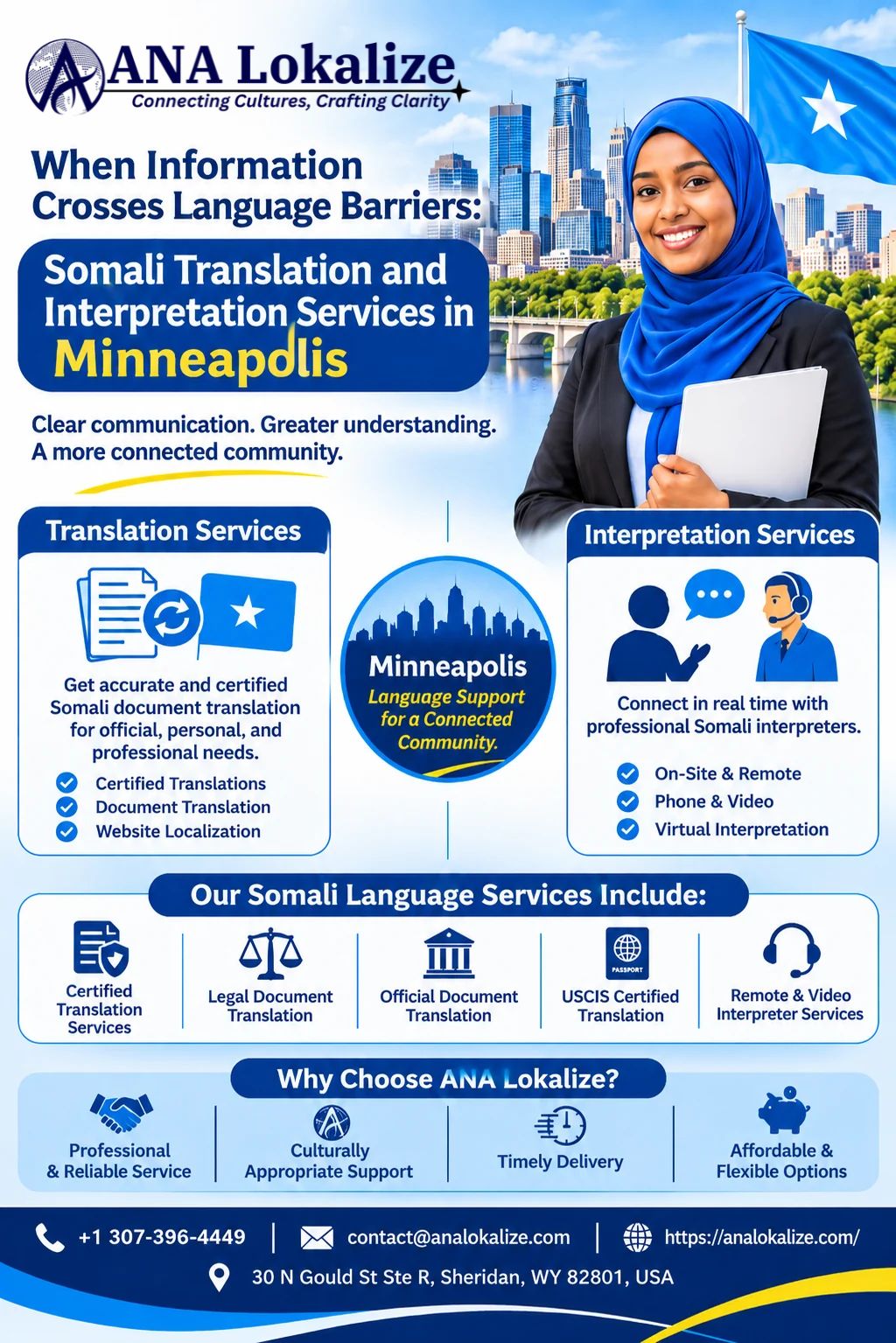
ANA Lokalize provides translation and
interpretation solutions for individuals and organizations seeking professional
language support. This article explores how Somali language services can help
people navigate important information, manage documentation, communicate with
institutions, and choose appropriate translation or interpreting arrangements
in Minneapolis.
1. Understanding the Information
Before Taking the Next Step
Many important processes begin with
information that someone needs to read, understand, or respond to. It could be
a school notice, a healthcare instruction, a legal letter, an immigration
document, or a message from a government office.
The difficulty is not always the amount of
information. Sometimes the challenge is understanding how different pieces of
information relate to one another.
Consider a document that contains:
- A
description of a particular process.
- A list of
required supporting documents.
- A date by
which information must be submitted.
- Instructions
about where to send a response.
- Contact
details for additional questions.
A person may understand some of these elements
but remain uncertain about the complete process. If the information is
translated inaccurately, important instructions may become even harder to
follow.
This is where professional translation becomes
useful. A well-prepared translation should communicate the meaning of the
original material clearly, preserve relevant details, and maintain the purpose
of the document.
Spoken communication presents a different
challenge. During an appointment, participants may need to explain
circumstances, ask follow-up questions, and understand responses immediately.
In such situations, interpretation may be more suitable than document
translation.
The first step is therefore to identify the
communication task:
- Is the
information written or spoken?
- Does it need
to be translated into Somali or English?
- Will the
material be submitted to an official organization?
- Does the
receiving organization require certification?
- Is the
conversation expected to involve specialized terminology?
- Is the
service needed in person, by phone, or through video?
Answering these questions helps individuals
select language support that matches the actual situation.
2. Certified Somali Translation
Services Minneapolis: Why Document Requirements Matter
Documents often carry information that must
remain consistent and accurate when transferred between languages. A translated
document may be used for personal reference, an administrative process, an
application, or communication with an institution.
Certified Somali translation services Minneapolis
may be relevant when an individual or organization needs a translated document
accompanied by a certification statement.
However, certification requirements are not
identical everywhere. Some institutions request a translator's certification of
accuracy, while others may specify particular procedures, formats, or
additional documentation. The receiving organization should always be consulted
before a translation is ordered.
What Does Certified Translation
Usually Involve?
A certified translation generally includes the
translated document and a signed statement from the translator or translation
provider confirming the completeness and accuracy of the translation to the
best of their knowledge.
The exact wording and format may depend on the
recipient's instructions.
It is important to distinguish between
translation certification and government approval. A certification statement
does not automatically mean that an institution has approved the document or
that it will accept it for every purpose.
Documents That May Require Certified
Translation
Depending on the receiving organization's
requirements, people may request certified translations for:
- Birth
certificates.
- Marriage
certificates.
- Divorce
records.
- Educational
certificates.
- Academic
transcripts.
- Personal
declarations.
- Identity-related
records.
- Official
correspondence.
- Supporting
documents for applications.
- Other civil
or administrative records.
Before submitting a document, check whether
the recipient requires the original, a copy, a certified translation, or a
particular submission format.
Why Preparation Makes a Difference
A translation project is easier to assess when
the provider receives complete and readable documents.
Before submitting a request, individuals
should check that:
- All pages
are included.
- Names and
dates are visible.
- Stamps and
seals can be identified where possible.
- The document
is not cut off or blurred.
- Any
handwritten sections are readable.
- The intended
use is clearly explained.
If a document contains unclear handwriting or
incomplete information, it is better to identify the issue before translation
begins. A translator should not guess at information that cannot be read.
3. Somali Document Translation
Services Minneapolis: Giving Written Records a Clear Purpose
A document is not simply a collection of
sentences. It has a purpose, an audience, and sometimes a specific role within
a larger process.
Somali document translation services Minneapolis
can help individuals and organizations communicate written information between
Somali and English.
The type of translation needed depends on who
will read the document and what they need to understand.
For example, a personal letter may require
natural language that preserves the writer's tone. A school notice may need
clear and accessible wording. An official record may require close attention to
names, dates, headings, and formal terminology.
Common Types of Documents
Somali document translation may be useful for:
Personal records: Birth records, marriage documents,
family correspondence, and personal statements.
Educational materials: School notices, academic records,
enrollment information, certificates, and transcripts.
Legal paperwork: Agreements, declarations, notices,
and other documents that may need translation for review by a qualified legal
professional.
Administrative documents: Applications, instructions, forms,
and correspondence with institutions.
Business materials: Company correspondence, informational
documents, internal communication, and customer-facing content.
Community information: Public notices, event announcements,
informational brochures, and outreach materials.
The Importance of Document Structure
A translation should preserve the organization
of the original document wherever appropriate.
Headings, numbered sections, tables, dates,
and references may all help the reader understand the information. Removing or
rearranging these elements without a good reason can make a translated document
harder to compare with the source.
A professional translation process should
consider both language accuracy and document usability.
For multi-page projects, consistency is also
important. The same names, terms, and phrases should be handled consistently
throughout the material.
4. English to Somali Translation
Services Minneapolis: Communicating With Somali-Speaking Audiences
Organizations frequently prepare information
in English and need to make it accessible to Somali-speaking individuals.
English to Somali translation services Minneapolis
can support communication across educational, healthcare, administrative, business,
and community settings.
The purpose of the translation may be to
explain a process, share instructions, provide information, or help readers
understand their available options.
Translating for the Intended Reader
A translation that works well for one audience
may not be appropriate for another.
For example, a technical document may use
formal terminology, while a community information sheet may need more
straightforward language. A public announcement may need to be brief and
accessible, while a formal notice may require a more structured tone.
The translator should consider:
- The age and
general needs of the intended audience.
- The purpose
of the material.
- The level of
formality.
- The
terminology used in the original.
- Whether the
information is intended for one person or a wider community.
- Whether a
particular Somali language preference or writing style should be followed.
Somali is used by people with different
experiences and language preferences. It is therefore useful to confirm the
intended audience and any relevant terminology preferences before beginning a
large translation project.
Maintaining the Original Message
Translation should make the information
accessible without changing what the source document communicates.
For example, if an English document contains a
deadline, condition, or warning, the Somali translation should preserve that
information. It should not make the instruction less strict or add a promise
that does not appear in the original.
This is particularly important for healthcare
information, legal materials, financial documents, and administrative
instructions.
5. Somali to English Translation
Services Minneapolis: Making Original Information Understandable
Translation also works in the opposite
direction. Somali-speaking individuals may have written records or personal
documents that need to be understood by English-speaking institutions and
professionals.
Somali to English translation services
Minneapolis
can support communication when the original information is written in Somali
and the intended recipient uses English.
This may involve:
- Personal
letters.
- Civil and
family records.
- Educational
documents.
- Written
statements.
- Supporting
documentation.
- Community
records.
- Administrative
correspondence.
- Other
personal or professional materials.
Preserving the Meaning of the Original
The translator's responsibility is to
communicate what the source document says, not to rewrite it into a different
message.
This requires attention to the context of each
sentence, particularly when a phrase has more than one possible meaning.
A direct word-for-word translation may not
always communicate the intended meaning naturally. At the same time, a
translator should not add explanations or assumptions that are not supported by
the original.
When the source document is unclear, the
appropriate response is to seek clarification where possible or identify the
uncertainty rather than invent missing information.
Names, Dates, and Supporting Details
Personal documents often contain information
that must match other records.
For example, a name may appear in several
documents, or a date may be referenced in a supporting statement. These details
should be handled carefully and consistently.
If spelling differences already exist across
original records, they should not be silently corrected during translation. The
customer should be informed so that the appropriate institution or qualified
professional can advise on the next step.
A clear translation helps the recipient
understand the original information while preserving the integrity of the
document.
6. Official Somali Document
Translation Minneapolis: Preparing Documents for Institutional Use
Official documents often have specific
requirements that differ from ordinary personal or business translation.
People searching for Official Somali document translation Minneapolis may need assistance preparing written
records for an institution, government office, educational organization, legal
professional, or another recipient.
The word “official” can refer to different
requirements depending on the organization. It is therefore important to
establish exactly what the recipient expects.
Questions to Ask Before Ordering
Before requesting an official document
translation, confirm:
- Does the
organization require a certified translation?
- Must the
certification statement follow a particular format?
- Does the
recipient require a complete translation of every page?
- Are stamps,
seals, and handwritten notes required to be translated?
- Must the
source document be submitted with the translation?
- Is
notarization requested in addition to translation?
- Are there
specific file or delivery requirements?
Notarization and translation certification are
different processes. A notarized document does not automatically establish that
the translation meets every institutional requirement.
Similarly, a translated document does not
automatically satisfy every legal or administrative condition.
Why the Receiving Organization Has the
Final Requirements
Different organizations may follow different procedures.
An educational institution may have requirements that differ from those of an
immigration authority or legal office.
The safest approach is to obtain the
instructions directly from the recipient before requesting the translation.
This reduces the possibility of paying for a
format or service that does not match the actual submission requirements.
7. USCIS Certified Somali Translation
Services Minneapolis: Understanding Immigration Translation Needs
Immigration-related applications can involve several
documents, personal details, and instructions. Individuals may need to
translate records originally issued in Somali so that they can be reviewed by
an English-speaking authority.
USCIS certified Somali translation services Minneapolis
may be relevant to individuals preparing Somali-language documents for a
USCIS-related application.
USCIS has specific requirements for
translations of foreign-language documents. In general, a foreign-language
document submitted to USCIS must be accompanied by a full English translation,
and the translator must certify that the translation is complete and accurate
and that they are competent to translate from the foreign language into
English.
Applicants should always review the latest
official USCIS instructions and the requirements that apply to their particular
filing.
Documents That May Be Involved
Depending on the application,
immigration-related translation requests may include:
- Birth
certificates.
- Marriage
certificates.
- Divorce
records.
- Educational
records.
- Family-related
documents.
- Personal
statements.
- Civil
records.
- Other
supporting documentation.
The documents required vary according to the
type of application and the individual's circumstances.
Accuracy Is Essential
Immigration paperwork can contain information
that appears in multiple places. Names, dates, places of birth, family
relationships, and other details should be translated consistently.
If the original document contains an unclear
entry, the translator should not guess. The issue should be identified and
clarified where possible.
It is also important to understand the limits
of translation services. A translator can translate a document and provide the
appropriate certification statement, but cannot guarantee that USCIS will
approve an application or determine whether a person qualifies for an
immigration benefit.
For questions about eligibility, application
strategy, or legal rights, individuals should consult a qualified immigration
attorney or accredited representative.
8. Somali Legal Document Translation
Minneapolis: Precision for Sensitive Written Information
Legal documents often contain formal language,
defined terms, obligations, conditions, and statements that may have specific
consequences.
Somali legal document translation Minneapolis can help individuals and
organizations communicate legal information between Somali and English.
The type of legal material may vary. It could
be an agreement, a personal declaration, a notice, a supporting statement, or
correspondence intended for review by a legal professional.
Why Legal Translation Requires Care
Legal language is often different from
everyday conversation. A word that appears simple in ordinary language may have
a more specific meaning in a legal document.
A translation should therefore preserve:
- Defined
terms.
- Names of
parties.
- Dates and
deadlines.
- Rights and
responsibilities described in the source.
- Conditions
and exceptions.
- Numbered
clauses and references.
- Formal
statements and declarations.
Changing the meaning of a condition or leaving
out a qualification may affect how the document is understood.
Translation Is Not Legal Advice
A translator's role is to communicate the
source material accurately in another language. It does not include deciding
whether a contract is enforceable, advising someone to sign a document, or
interpreting the legal consequences of a particular clause.
When legal meaning or strategy is in question,
the document should be reviewed by a qualified legal professional.
Confidentiality and Document Handling
Legal documents may contain sensitive
personal, family, financial, or business information.
Before sharing these materials, individuals
should understand how documents will be submitted, accessed, stored, and
handled. Secure file transfer and appropriate confidentiality practices are
important considerations.
A professional translation request should
include only the information necessary to assess and complete the work.
9. Professional Somali Language
Services Minneapolis: Supporting More Than One Communication Need
Language requirements can extend beyond a
single document or appointment. An individual may need written translation for
one stage of a process and interpretation for another.
Organizations may also need to communicate
with Somali-speaking customers, families, employees, or community members
across multiple channels.
Professional Somali language services Minneapolis
can help address these different communication needs through suitable
translation and interpretation arrangements.
Translation for Written Communication
Written translation can help organizations
prepare:
- Informational
brochures.
- Public
notices.
- School
communications.
- Appointment
instructions.
- Customer
information.
- Administrative
documents.
- Business
correspondence.
- Community
outreach materials.
The wording should be appropriate for the
intended audience and should preserve the meaning of the original.
Interpretation for Live Communication
Interpretation can support conversations where
participants need to communicate directly.
This may include appointments, meetings,
consultations, interviews, and discussions involving different languages.
Consistency Across Multiple Projects
When an organization produces several
Somali-language materials, consistent terminology can improve the overall communication
experience.
For example, an organization may use the same
terms across a website, a brochure, an appointment notice, and a follow-up
letter.
A coordinated approach helps prevent confusing
differences between materials that discuss the same subject.
10. Request a Somali Interpreter Quote
Minneapolis: What Information Helps?
Before arranging an interpreter, it is useful
to understand the nature of the conversation and the practical requirements of
the session.
People who Request a Somali interpreter quote Minneapolis should provide enough information for the service
provider to assess the request.
A quote may depend on the session format,
date, duration, subject matter, location, and interpreter requirements.
Details to Include in a Quote Request
1. Date and time
Provide the proposed appointment date and
start time. If the timing is flexible, mention the available options.
2. Session duration
Estimate how long the conversation may take.
If the duration is uncertain, explain that when submitting the request.
3. Type of appointment
Identify whether the session concerns
healthcare, education, legal matters, business, administration, or a general
conversation.
4. Interpreting format
Specify whether you need in-person, phone, or
video interpretation.
5. Location
For an on-site appointment, provide the
location in Minneapolis and any relevant arrival instructions.
6. Language direction
Confirm that the participants need
Somali-English interpretation and explain whether any particular language
preference should be considered.
7. Special requirements
Mention any required credentials, subject-area
experience, confidentiality procedures, or organizational instructions.
Why Complete Details Matter
A quote based on incomplete information may
not reflect the actual requirements of the session.
For example, an appointment involving several
participants may need different arrangements from a short one-to-one
conversation. A specialized discussion may also require additional preparation.
Providing accurate details makes it easier to
assess the request and discuss availability, service format, and expected
costs.
11. Remote Somali Interpreter Services
Minneapolis: Language Support Without Travel
Not every conversation needs to happen in the
same physical location. People may be at home, at work, or in different
facilities when a discussion takes place.
Remote Somali interpreter services Minneapolis can support suitable conversations
through telephone or video-based arrangements.
Remote interpretation may be useful when:
- Participants
are located in different places.
- An
appointment needs to take place without interpreter travel.
- A
short conversation requires language support.
- A
follow-up discussion is scheduled.
- An
organization needs to coordinate communication across locations.
- An
in-person arrangement is not practical.
What Should Be Considered?
Remote interpreting is not automatically the
right choice for every conversation.
The organization should consider the
sensitivity of the discussion, the number of participants, the need to share
documents, and whether visual communication is important.
A remote session also depends on reliable
technology. Poor audio quality or an unstable connection can interrupt
communication and make important details difficult to understand.
Preparing for a Remote Session
Before the scheduled conversation:
- Confirm
the session time and joining instructions.
- Check
the device and internet connection.
- Use
a quiet location.
- Make
sure participants can hear clearly.
- Keep
relevant documents available.
- Confirm
the platform being used.
- Review
any privacy requirements.
Remote interpreting should be arranged
according to the needs of the conversation and the policies of the organization
involved.
12. Affordable Somali Interpreter
Services Minneapolis: Planning the Right Budget
Cost is an important part of arranging
interpretation. Individuals and organizations may need to compare service
options while making sure that the selected arrangement is appropriate.
Affordable Somali interpreter services Minneapolis should be considered in terms of
overall value, not price alone.
Interpreting costs may depend on:
- The session
duration.
- The
interpreting format.
- The
appointment location.
- The date and
time.
- The subject
matter.
- Interpreter
qualifications or required credentials.
- Minimum
booking periods.
- Travel or
other applicable arrangements.
Comparing Quotes Carefully
When reviewing quotes, compare the same
service requirements.
For example, a quote for a short remote
appointment should not be compared directly with an on-site booking that
includes travel and a longer session.
Ask whether the quotation includes the
expected duration, any minimum booking period, and additional charges that may
apply.
It is also helpful to confirm what happens if
the appointment is delayed, extended, or rescheduled.
Avoiding Last-Minute Confusion
When possible, request interpretation before
the appointment date. This gives the service provider time to assess
availability and identify the appropriate arrangement.
For urgent requests, share the details
immediately and ask what options may be available. Availability should be
confirmed rather than assumed.
A clear booking request helps everyone
understand the expected service and costs before the session begins.
13. Video Somali Interpreter Services
Minneapolis: When Visual Communication Helps
Some conversations are easier to follow when
participants can see one another.
Video Somali interpreter services Minneapolis may be suitable for appointments and
discussions where visual communication is useful and the technology supports a
clear conversation.
Video interpreting can be considered for:
- Healthcare
consultations.
- Educational
meetings.
- Remote
administrative appointments.
- Professional
discussions.
- Family-related
meetings.
- Selected
community and service-provider interactions.
Why Video May Be Useful
Video allows participants to see the people
involved in the discussion. This can help with turn-taking, identifying who is
speaking, and coordinating communication during a meeting.
When documents or visual references are
involved, video may also provide a practical way for participants to
communicate about shared information, depending on the platform and session
arrangement.
However, video does not guarantee better
communication in every situation. A poor camera setup, unstable internet
connection, or noisy environment may make the session less effective.
Planning a Video Session
Before the session, confirm:
- Which video
platform will be used.
- Whether
participants can access it.
- Whether the
device has a working camera and microphone.
- Whether the
internet connection is stable.
- Whether the
meeting is private.
- Whether
participants need to share documents.
- Whether the
interpreter has received relevant background information.
If video is not practical, phone
interpretation may be an alternative for suitable conversations.
14. Virtual Somali Interpreter
Minneapolis: Choosing Flexible Communication Arrangements
A Virtual Somali interpreter Minneapolis
request may involve a remote interpreting session arranged through a digital
platform.
Virtual interpretation can be helpful for
individuals and organizations that need to coordinate conversations without
bringing all participants together in one location.
It can support communication when people have
different schedules, work from separate offices, or need language assistance
for a remote appointment.
Virtual Interpretation Is Still a
Professional Service
The fact that a conversation takes place
online does not reduce the importance of interpreter preparation and
communication quality.
The interpreter still needs to communicate the
participants' messages accurately and maintain the intended meaning.
Participants should speak directly to one
another, use clear language, and allow the interpreter time to communicate each
message.
They should also avoid speaking over one
another. If a statement is unclear, participants should pause and request
clarification rather than allowing confusion to continue.
Privacy in Virtual Settings
Remote conversations may involve personal or
confidential information.
Participants should use a private environment
and follow the relevant organization's privacy procedures. They should also
understand whether the platform is approved for the type of information being
discussed.
For sensitive healthcare, legal, or
administrative appointments, the organization arranging the session should
confirm that the interpreting arrangement meets its applicable requirements.
15. Phone, Video, or In-Person:
Selecting the Appropriate Format
The most suitable interpreting format depends
on the conversation rather than on convenience alone.
|
Format |
May
be suitable when |
Important
consideration |
|
On-site |
Participants
need to meet in person or review physical materials |
Location,
travel, and scheduling |
|
Phone |
The
conversation is primarily verbal |
Clear
audio and turn-taking |
|
Video |
Visual
communication may be helpful |
Internet,
camera, and privacy |
|
Virtual
platform |
Participants
are in separate locations |
Platform
access and technical preparation |
Before choosing a format, consider the
following:
Complexity: A discussion involving specialized
terminology may require additional preparation.
Number of participants: Larger meetings may need more
coordination than a one-to-one appointment.
Sensitivity: Confidential conversations require suitable
privacy arrangements.
Technology: Remote services depend on equipment and
connectivity.
Institutional requirements: Some organizations may specify which
interpreting formats they permit.
A suitable format should help participants
communicate effectively while meeting the requirements of the setting.
16. Somali Language Access in
Healthcare, Education, Legal, and Community Settings
Different institutions communicate in different
ways. Understanding these differences can help individuals request the right
language service.
Healthcare Communication
Healthcare settings may involve appointment
information, medical forms, treatment discussions, and follow-up instructions.
Written Somali translation may help make
informational materials accessible. Spoken interpretation may support
communication between patients and healthcare professionals.
Medical discussions can involve specialized
terminology and sensitive personal information. Healthcare providers should
determine the appropriate interpreting arrangement and follow their applicable
language-access and privacy requirements.
Education and Family Communication
Schools communicate with parents and families
through enrollment forms, notices, academic information, meetings, and
administrative updates.
Somali translation can help families
understand written information, while interpretation can support conversations
with educators and school staff.
Clear communication helps families ask
questions and participate in discussions about education.
Legal and Administrative Settings
Legal and administrative communication may
involve formal notices, declarations, applications, and discussions about
procedures.
Document translation can help communicate
written information, while interpretation can assist with spoken conversations.
The translation or interpreting service should
not be confused with legal advice. Individuals who need help understanding
legal rights or deciding how to respond should consult an appropriately
qualified professional.
Community Organizations
Community groups may share information about
local programs, events, resources, and public services.
Translated materials can help make information
accessible to Somali-speaking audiences. Interpretation may support meetings
and discussions.
Organizations should consider the language
preferences of the people they serve rather than assuming that one approach
will suit everyone.
17. Cultural and Linguistic
Considerations in Somali Translation
Language is closely connected to context. The
same idea may be expressed differently depending on the audience, subject, and
purpose of the communication.
Professional Somali translation should
therefore consider more than vocabulary and grammar.
Tone and Audience
A public information notice may need simple,
direct language. A legal document may require a formal structure. A personal
letter may need to preserve the writer's tone and intention.
The translator should understand the intended
audience before selecting wording and style.
Consistent Terminology
When a document uses a particular term
repeatedly, the translation should maintain consistency unless the context
requires a different expression.
This is especially important in educational,
administrative, healthcare, and legal materials.
Avoiding Cultural Assumptions
Somali-speaking audiences are not a single
uniform group. People may have different preferences, experiences, and levels
of familiarity with particular terminology.
Translators and interpreters should avoid
making assumptions about individuals based only on their language.
When a project is intended for a broad
community, it may be useful to review important terminology with appropriate
language professionals or representatives of the intended audience.
The purpose of cultural awareness is to
improve understanding while preserving the original message.
18. How to Prepare for a Somali
Translation or Interpretation Request
A well-organized request can help reduce
delays and make it easier to identify the correct service.
For Written Translation
Prepare the following:
- A
complete copy of the source document.
- The
source and target languages.
- The
intended use of the translation.
- The
recipient's certification requirements.
- Any
formatting instructions.
- The
expected deadline.
- Any
terminology or spelling preferences.
For Interpretation
Provide:
- The date and
time of the appointment.
- The
estimated duration.
- The location
or virtual meeting details.
- The subject
of the discussion.
- The languages
required.
- The number
of participants.
- Any required
interpreter credentials.
- Any relevant
privacy or organizational requirements.
For a Combined Project
If you need both document translation and
interpretation, explain how the two services relate to one another.
For example, you may need a document
translated before a meeting where participants will discuss its contents.
Sharing this information can help the provider understand the complete
communication requirement.
19. How ANA Lokalize Helps With Somali
Language Requirements in Minneapolis
Every language request has a different
purpose. Some customers need one personal document translated, while others
need ongoing support for written and spoken communication.
ANA Lokalize offers language-service solutions
for individuals and organizations seeking Somali translation and interpretation
support.
Depending on the project requirements,
requests may include:
- Certified
Somali translation services Minneapolis for documents requiring an
appropriate certification statement.
- Somali
document translation services Minneapolis for
personal, educational, administrative, and professional records.
- English
to Somali translation services Minneapolis for written
information intended for Somali-speaking audiences.
- Somali
to English translation services Minneapolis for
documents originally prepared in Somali.
- Official
Somali document translation Minneapolis for institutional submissions
where recipient requirements have been confirmed.
- USCIS
certified Somali translation services Minneapolis for
immigration-related document translation requests that require a
translator's certification.
- Somali
legal document translation Minneapolis for legal materials requiring
careful and consistent language handling.
- Professional
Somali language services Minneapolis for different written and spoken
communication needs.
- Remote
Somali interpreter services Minneapolis for suitable phone-based or
virtual sessions.
- Affordable
Somali interpreter services Minneapolis for customers seeking a suitable
interpreting arrangement within their budget.
- Video
Somali interpreter services Minneapolis for appointments where video
communication is appropriate.
- Virtual
Somali interpreter Minneapolis requests for remote communication needs.
Service suitability, interpreter availability,
delivery timelines, and certification requirements should be confirmed
according to each individual project.
ANA Lokalize encourages customers to share the
purpose of their request and any instructions from the receiving organization
before the work begins.
20. Frequently Asked Questions About
Somali Translation and Interpretation in Minneapolis
What is the difference between Somali
translation and Somali interpretation?
Translation deals with written content, such
as certificates, letters, forms, and reports. Interpretation supports spoken
communication during appointments, meetings, and conversations.
Can I request a certified Somali
translation for an immigration document?
You can request a translation with the certification
statement required for the intended purpose. For USCIS submissions, review the
current USCIS requirements to confirm the translation and certification
conditions.
Do I need a certified translation for
every official document?
Not necessarily. Requirements vary by
organization and document type. Confirm the requirements with the recipient
before placing an order.
Can I arrange a Somali interpreter
remotely?
Remote interpreting may be available through
phone or video arrangements, depending on the appointment, interpreter
availability, and service requirements.
Is video interpreting different from
phone interpreting?
Yes. Video interpreting allows participants to
see one another, while phone interpreting is audio-based. The appropriate
option depends on the conversation and technical requirements.
What affects the cost of a Somali
interpreter?
Cost may depend on session duration, format,
location, date, subject matter, qualifications, and any minimum booking
requirements. A detailed request helps establish the expected cost.
What should I provide when requesting
a translation quote?
Share a readable copy of the document,
language direction, intended use, deadline, and any certification or formatting
instructions from the recipient.
Can Somali documents be translated
into English?
Yes. Somali-to-English translation can help
communicate written information to English-speaking institutions,
professionals, and organizations.
Conclusion: Clear Communication Starts
With the Right Language Support
Important information should be understandable
to the people who need it. Whether someone is reviewing an official record,
preparing immigration paperwork, attending a healthcare appointment, speaking
with a school, or communicating with a legal professional, language barriers
can make the process more difficult.
Professional translation and interpretation
address different parts of this challenge. Translation helps preserve written
information across languages, while interpretation supports direct
communication between people.
For Somali-speaking individuals and
organizations in Minneapolis, choosing the right service means looking beyond
the name of the service. The document's purpose, recipient requirements,
language direction, appointment format, and privacy considerations all matter.
ANA Lokalize supports these communication
needs through Somali document translation, immigration-related translation
assistance, legal document translation requests, and remote or video
interpreting options.
If you need language support, begin by
identifying what information needs to be communicated and how it will be used.
A clear request makes it easier to discuss the appropriate service, project
requirements, and next steps.
Connect With ANA Lokalize
ANA Lokalize – Connecting Cultures, Crafting
Clarity
For Somali translation and interpretation
inquiries in Minneapolis:
- Phone: +1
307-396-4449
- Email: contact@analokalize.com
- Website: https://analokalize.com/
- Address: 30 N Gould
St Ste R, Sheridan, WY 82801, USA
Contact ANA Lokalize to discuss your Somali
translation or interpretation requirements and request information about a
suitable language-service solution.