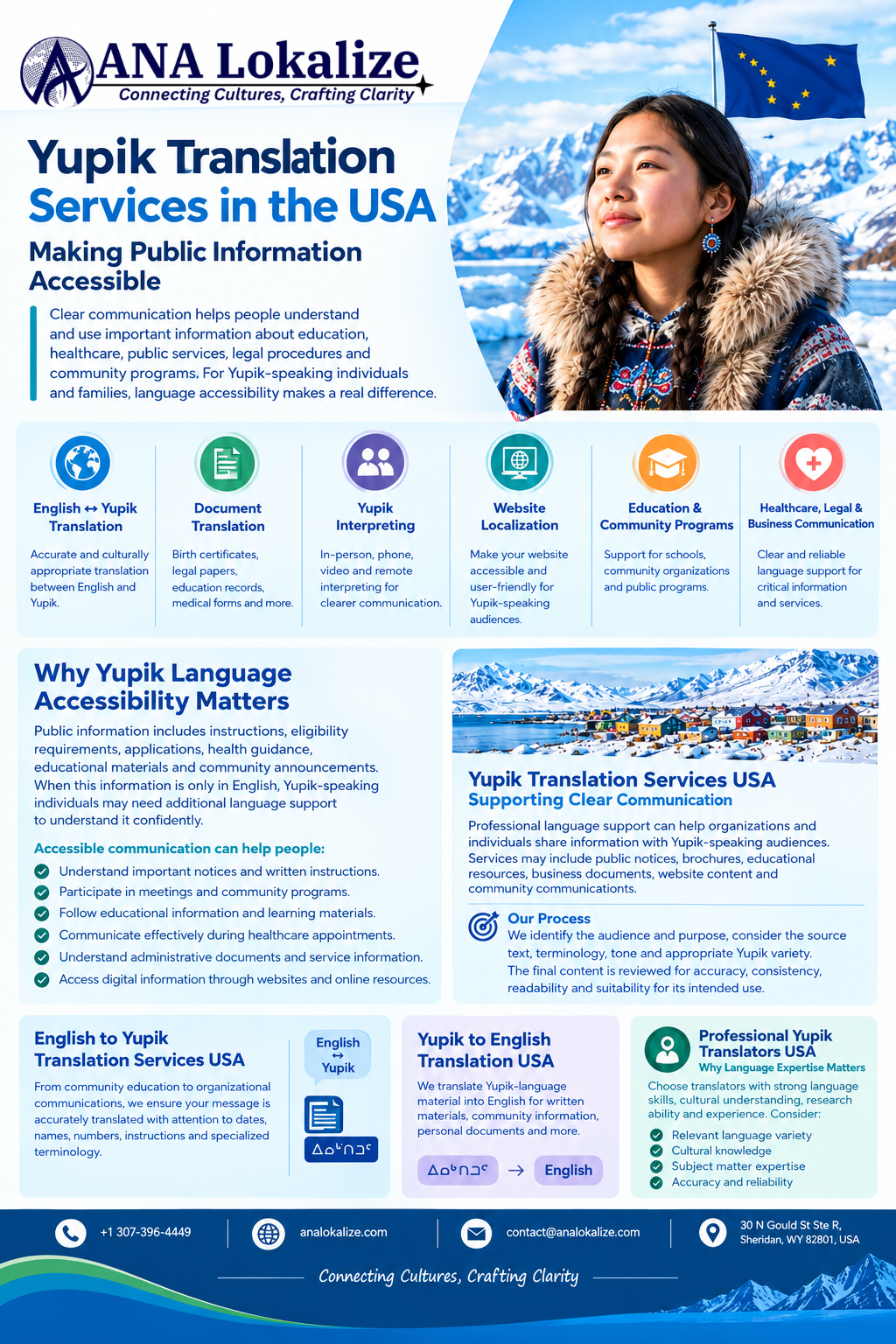
Clear communication is essential when people need to understand important information about education, healthcare, public services, legal procedures, or community programs. For Yupik-speaking individuals and families in the United States, language accessibility can help make information easier to understand and use in everyday life.
Yupik languages are part of the
linguistic heritage of Indigenous communities, particularly in Alaska.
Translating information for Yupik-speaking audiences requires more than
replacing English words with their equivalents. It calls for careful attention
to language variety, cultural context, intended meaning, and the needs of the
people who will read or hear the message.
ANA Lokalize provides Yupik language solutions for organizations and individuals seeking clear, culturally
appropriate communication. Through
translation, interpreting, document support, and website localization, language
services can help bridge communication gaps and make information more
accessible.
Why
Yupik Language Accessibility Matters
Public information often includes
instructions, eligibility requirements, application procedures, health
guidance, educational materials, and community announcements. When this
information is available only in English, some Yupik-speaking individuals may
need additional language support to understand the details confidently.
Accessible communication can help
people:
- Understand important notices and written instructions.
- Participate more comfortably in meetings and community
programs.
- Follow educational information and learning materials.
- Communicate more effectively during healthcare
appointments.
- Understand relevant administrative documents and
service information.
- Access digital information through websites and online
resources.
The objective is not simply to
translate a document. It is to communicate its meaning in a way that suits the
audience, purpose, and context.
Yupik
Translation Services USA: Supporting Clear Communication
Professional language support can
help organizations share information with Yupik-speaking audiences while
preserving the original message. Yupik translation services USA may be
relevant to public agencies, educational institutions, healthcare providers,
nonprofit organizations, businesses, and individuals who need language
assistance.
Depending on the project,
translation requirements may include public notices, informational brochures,
educational resources, business documents, website content, and community
communications.
A well-managed translation project
begins by identifying the audience and purpose. Translators then consider the
source text, terminology, tone, and appropriate Yupik language variety before preparing
the translated material.
The final content should be reviewed
for accuracy, consistency, readability, and suitability for its intended use.
For sensitive or high-impact information, additional review may be appropriate
to reduce ambiguity and help preserve important details.
English
to Yupik Translation Services USA
Organizations often create their
original materials in English and then need to communicate the same information
to Yupik-speaking audiences. English to Yupik translation services USA can
support projects involving community education, public information,
organizational communications, and selected personal or professional documents.
The translation process should begin
with a clear understanding of the English source. Dates, names, numbers,
instructions, warnings, and specialized terminology require particular
attention because even a small change can affect how a message is understood.
For example, an English-language
community announcement might explain the date of a meeting, the documents
attendees should bring, and the steps required to register. A suitable
translation must preserve each of these details rather than focusing only on
the general meaning.
Yupik includes distinct language
varieties, so the intended audience should be identified before work begins.
Confirming the appropriate variety and reviewing unfamiliar terminology can
help ensure that the translation is suitable for the people expected to use it.
Yupik
to English Translation USA
Communication can also require translating
Yupik-language material into English. Yupik to English translation USA
may be useful when individuals or organizations need to understand written
materials, community information, personal documents, or other
language-specific content.
A translator working from Yupik into
English must consider the meaning of the original message rather than relying
on a literal word-for-word approach. Cultural references, expressions, context,
and differences in sentence structure can influence how a message should be
conveyed.
The intended use of the English
translation also matters. A document for general understanding may require a
different presentation from material intended for an institution, professional
review, or formal submission.
When a document is needed for an
official purpose, the receiving organization should be consulted about its
translation, certification, formatting, and submission requirements before the
work begins.
Professional
Yupik Translators USA: Why Language Expertise Matters
Choosing a translator involves more
than checking whether someone recognizes a language. Effective translation
requires strong language skills, an understanding of context, careful research,
and the ability to communicate the source message accurately.
When selecting professional Yupik translators USA, organizations should consider several factors:
- Language variety:
Confirm that the translator can work with the Yupik variety relevant to
the intended audience.
- Subject knowledge:
Specialized documents may require familiarity with legal, medical,
educational, administrative, or technical terminology.
- Cultural context:
Expressions and references should be handled in a way that preserves their
intended meaning.
- Quality review:
The project should include suitable checks for omissions, terminology,
spelling, and consistency.
- Confidentiality:
Personal and organizational documents should be handled according to
agreed privacy and security procedures.
- Intended use:
The translator should understand whether the material is informational,
commercial, educational, or intended for formal submission.
These considerations can help
organizations choose an appropriate language service for their specific
communication needs.
Certified
Yupik Document Translation Services USA
Some projects require more than a
general translation. Individuals may need translated documents for
administrative processes, educational matters, legal procedures, employment, or
other formal purposes.
Certified Yupik document translation services USA may be relevant when a receiving
institution requires a certification statement or other documentation
accompanying a translation.
Requirements vary by institution and
document type. Certification does not automatically mean that every agency will
accept the translation, and the term can refer to different requirements
depending on the recipient.
Before placing an order, clients
should confirm:
- Which documents must be translated.
- Whether the institution accepts translations from the
relevant Yupik variety.
- Whether a signed certification statement is required.
- Whether the original document, a copy, or a particular
format must be submitted.
- Whether additional notarization or other formalities
are necessary.
Common documents that may require
translation include personal records, educational materials, letters,
statements, and supporting paperwork. The exact service should be determined by
the document and the receiving organization's requirements.
ANA Lokalize can discuss document
translation needs and help clients identify the project details that should be
confirmed before work begins.
Yupik
Interpreting Services USA for Spoken Communication
Written translation is only one part
of language accessibility. In situations where people need to communicate
directly, interpreting can help speakers understand one another during a
conversation.
Yupik interpreting services USA may support communication in appropriate healthcare,
educational, community, organizational, and service-related settings, depending
on interpreter availability and the language variety required.
Interpreting differs from
translation because the message is communicated orally or through another
spoken-language interaction in real time. The interpreter must listen
carefully, understand the message, and convey its meaning without unnecessarily
changing or omitting important information.
Potential interpreting situations
include:
- Meetings between service providers and community
members.
- Educational discussions involving families and staff.
- Appointments where a person needs help understanding
spoken information.
- Community outreach sessions and informational meetings.
- Selected business or administrative conversations.
Before arranging an interpreter,
organizations should clarify the language variety, meeting purpose, subject
matter, date, duration, location, and any confidentiality or accessibility
requirements.
For medical, legal, or other
high-impact situations, it is especially important to select an appropriately
qualified interpreter for the setting.
Yupik
Website Localization USA: Creating More Accessible Digital Content
Websites are often the first place
people look for information about services, organizations, applications, and
community resources. However, translating website text alone may not make the
entire digital experience easy to use.
Yupik website localization USA focuses on adapting digital content for a particular
audience while maintaining the purpose and usability of the original website.
Depending on the project,
localization may involve:
- Translating relevant website pages and informational
content.
- Adapting headings, instructions, and calls to action.
- Reviewing terminology for consistency across pages.
- Checking navigation labels and form instructions.
- Considering how text appears on desktop and mobile
screens.
- Reviewing translated content for readability and cultural
relevance.
- Identifying content that may require clarification for
the intended audience.
For example, a public-service
website may contain application instructions, contact information, frequently
asked questions, and eligibility details. If these sections are translated
inconsistently, visitors may struggle to follow the process.
A structured localization workflow
can help maintain consistency and make digital information easier to navigate.
Website owners should also plan for updates so that translated pages remain
aligned with changes to the English content.
Yupik
Language Translation Services USA for Education and Community Programs
Educational institutions and
community organizations often communicate information that people need to act
on. This may include program schedules, enrollment instructions, event notices,
learning resources, participation guidelines, and family communications.
Yupik language translation services USA can help organizations evaluate
which materials would benefit from translation and how those materials should
be prepared for their audiences.
A useful starting point is to
identify the information that people need most frequently. Organizations might
prioritize essential instructions, recurring notices, safety information, and
details about accessing services.
The language needs of each community
should be considered individually. A translated resource should not be treated
as a substitute for direct feedback from its intended audience. Where
appropriate, organizations can seek review from qualified language
professionals and community representatives to identify unclear wording or
culturally unsuitable references.
This approach can make communication
more purposeful and help organizations use their translation budgets responsibly.
Translation
for Healthcare, Legal, and Business Communication
Different industries have different
language requirements. The same translation approach may not be appropriate for
a medical information sheet, a legal document, and a business website.
Healthcare
communication
Healthcare materials may include
appointment instructions, patient information, wellness resources, and
explanations of services. Accuracy and clarity are essential, especially when
the information may affect a person's decisions or understanding of care.
Translated materials should be
reviewed carefully, and interpreting needs should be assessed separately when
live communication is required.
Legal
and administrative documents
Legal and administrative content may
contain defined terms, formal statements, deadlines, and procedural
instructions. These details must be preserved carefully. Clients should confirm
whether the relevant institution has specific requirements for translation,
certification, or supporting documents.
Business
and organizational communication
Businesses and nonprofit
organizations may need translated presentations, informational materials,
customer communications, internal resources, or digital content. Consistent
terminology and an appropriate tone can help maintain a clear organizational
message.
In every sector, the translation
process should be matched to the purpose, complexity, and potential impact of
the content.
How
ANA Lokalize Approaches Yupik Language Projects
A clear process helps clients
explain their needs and understand what is required before a translation or
interpreting project begins.
1. Define the requirement
Identify the source language, target
language variety, type of content, intended audience, and purpose of the
project.
2. Review the materials
Examine the source documents or
digital content to understand the scope, formatting, terminology, and any
specialized requirements.
3. Confirm the service
Determine whether the project
requires written translation, document translation, interpreting, website
localization, or a combination of services.
4. Establish quality and privacy
expectations
Agree on the appropriate review
process, terminology requirements, confidentiality arrangements, and any
relevant institutional standards.
5. Review the completed work
Check the final material for
completeness, accuracy, consistency, and suitability for its intended use
before delivery or publication.
The exact workflow depends on the
project. Turnaround time, language variety, certification requirements, and
service availability should be confirmed before a timeline is promised.
Common
Challenges in Yupik Translation
Yupik translation projects can
require careful planning because language and context influence how information
should be expressed.
Identifying
the appropriate language variety
The term Yupik covers distinct
language varieties. Identifying the intended audience and the variety used by
that audience is an important first step.
Handling
specialized terminology
Medical, legal, technical, and
administrative terms may not have straightforward equivalents in every context.
Translators may need to research terminology and consult appropriate references
or qualified reviewers.
Preserving
cultural meaning
Expressions, examples, and
references that make sense in one cultural context may not communicate the same
meaning in another. Translation should preserve the intended message while
avoiding unnecessary assumptions about the audience.
Maintaining
consistency
Repeated terms should be handled
consistently across documents, website pages, and related materials. A
terminology list and a structured review process can help support consistency.
Planning
for updates
Public information and websites
change over time. Organizations should plan how translated content will be
reviewed when the source material is updated.
Recognizing these challenges early
can help clients define realistic project requirements and improve the quality
of the final result.
Frequently
Asked Questions About Yupik Language Services
1.
What do Yupik translation services in the USA include?
Depending on the project and
availability, services may include English-to-Yupik translation,
Yupik-to-English translation, document translation, website localization, and
interpreting for spoken communication.
2.
How do I choose the right Yupik language variety?
Start by identifying the community
or audience that will use the translated material. Share this information with
the language service provider so the appropriate variety and qualified language
resources can be confirmed.
3.
Can I request English to Yupik translation services for public information?
Yes, you can discuss projects such
as community announcements, educational resources, service information, and
other public-facing materials. The appropriate language variety, content scope,
and availability should be confirmed before the project begins.
4.
When might I need Yupik to English translation?
You may need it when you want to
understand Yupik-language written materials or communicate their meaning to an
English-speaking audience. The requirements depend on the document's purpose
and intended recipient.
5.
Are certified Yupik document translations accepted by every institution?
No. Acceptance depends on the
institution and its rules. Always confirm whether a certification statement,
notarization, particular format, or additional documentation is required before
ordering a translation.
6.
What is the difference between translation and interpreting?
Translation generally deals with
written content, while interpreting conveys spoken communication in real time.
Some projects may require both services.
7.
Does Yupik website localization involve more than translating words?
Yes. It can also involve adapting
navigation, headings, instructions, forms, terminology, and other digital
elements so the website is suitable for its intended audience.
8.
How can I request Yupik language services from ANA Lokalize?
Contact ANA Lokalize with details
about the language variety, service required, document or content type,
intended use, and preferred timeline. The team can discuss the project
requirements and confirm availability.
Connect
with ANA Lokalize for Yupik Language Support
Accessible communication begins with
understanding the people who need the information. Whether an organization is
preparing public resources, translating documents, localizing a website, or
arranging spoken-language support, a carefully planned language project can
help preserve meaning and improve understanding.
ANA Lokalize supports translation
and language-access projects for clients seeking professional communication
across languages. Each project should be evaluated according to its language
variety, subject matter, intended audience, and specific requirements.
If you are looking for Professional Yupik translation services USA, English-to-Yupik translation,
Yupik-to-English translation, document translation, interpreting, or website
localization, contact ANA Lokalize to discuss your needs.
ANA Lokalize — Connecting Cultures,
Crafting Clarity
- Website:
https://analokalize.com/
- Email:
contact@analokalize.com
- Phone:
+1 307-396-4449
- Address:
30 N Gould St Ste R, Sheridan, WY 82801, USA
Contact the team to discuss your Yupik language project and confirm the services available for your requirements.