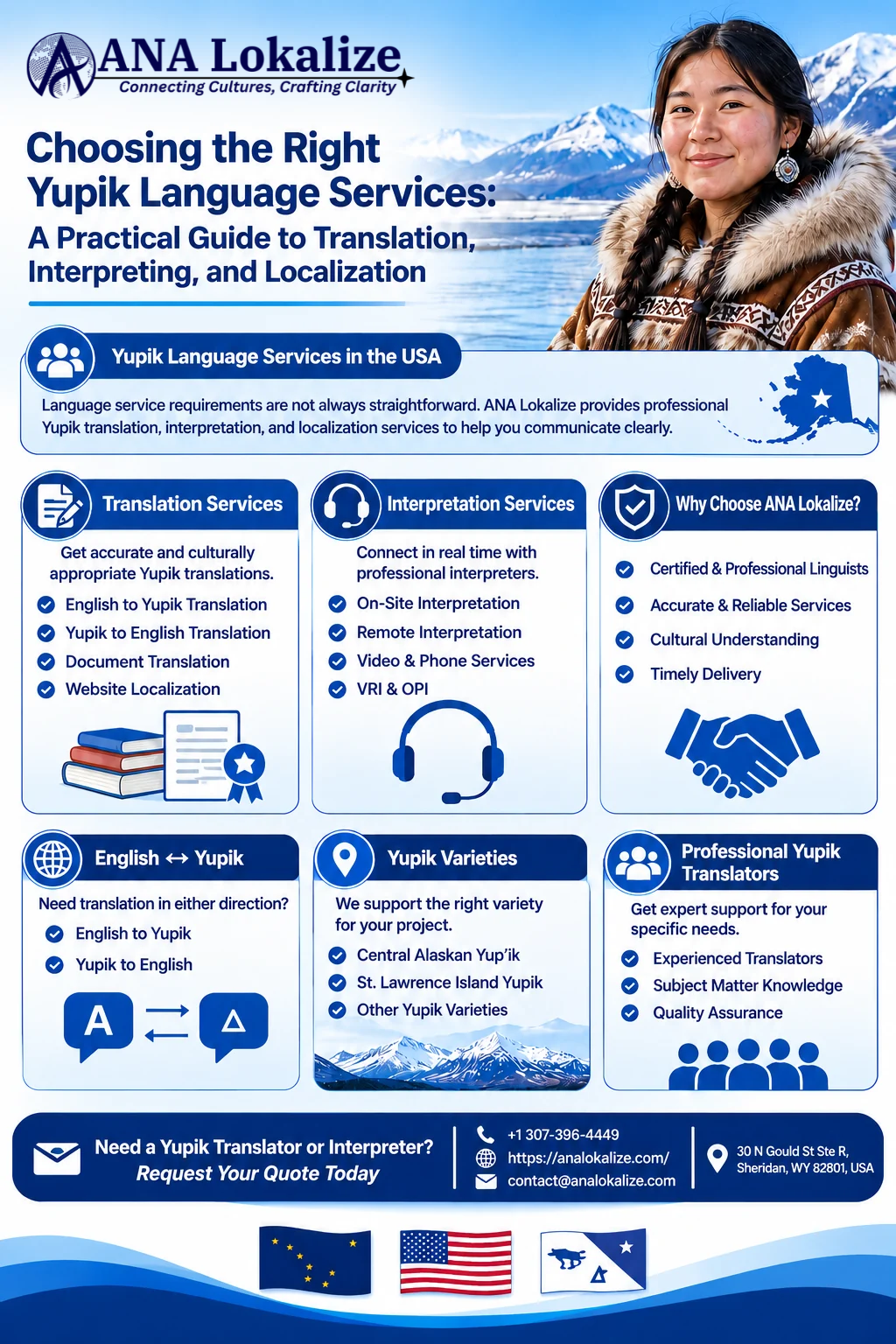
Language service requirements are not always straightforward. A person may need a document translated for an application, a business may want to communicate with a multilingual audience, or an organization may need interpreting support for a scheduled meeting. Each situation involves a different communication goal, and choosing the right service can make the process more effective.
For individuals and organizations
seeking Yupik language support in the United States, understanding the
available services is an important first step. Translation, interpreting,
document certification, and website localization serve different purposes.
Knowing which one is appropriate can help clients prepare their materials,
communicate their expectations, and avoid unnecessary delays.
ANA Lokalize provides language
service solutions for clients who need professional communication support
across languages. This guide explains how Yupik language services can fit
different project requirements and what to consider before requesting a
service.
Yupik
Translation Services USA: Finding the Right Solution for Your Project
When searching for Yupik translation services USA, clients may have different goals. Some need a
written document translated. Others need information adapted for a website or
support during a live conversation.
The first step is to identify the
purpose of the communication.
For example, someone preparing a
document for an institution may need a written translation. A business sharing
information with a Yupik-speaking audience may need translated marketing or
informational materials. An organization arranging a meeting may require an
interpreter.
These projects should not be treated
as interchangeable. The service selected should match the format of the
communication, its intended audience, and the importance of the information
being shared.
Yupik is not a single uniform
language variety. Central Alaskan Yup’ik, St. Lawrence Island Yupik, and other
Yupik varieties have linguistic differences. Central Alaskan Yup’ik itself
includes several dialects, such as General Central Yup’ik, Norton Sound, Hooper
Bay-Chevak, Nunivak, and Egegik. Therefore, identifying the appropriate
language variety is an important part of planning a translation or interpreting
project.
Before starting, clients should be
ready to explain:
- What information needs to be translated or communicated.
- Who will read or hear the message.
- Which language variety is required.
- Whether the project involves written content or spoken
communication.
- Whether there are specific deadlines or institutional
requirements.
This information helps establish the
scope of the project and identify the service that best matches the client's
needs.
English
to Yupik Translation Services USA
Organizations often prepare their
original materials in English and then need to communicate the same information
to Yupik-speaking audiences.
English to Yupik translation services USA can support suitable written
content such as informational materials, announcements, educational resources,
business communications, and selected personal documents.
The translation process should
preserve the original message while making it understandable in the target
language. This requires attention to terminology, context, sentence structure,
and the intended audience.
Consider a document that explains
how to register for a program. It may include eligibility criteria, deadlines,
contact information, and instructions. If any of these details are translated
incorrectly or omitted, readers may misunderstand the process.
A carefully planned translation
project should therefore include:
- Review of the original document.
- Confirmation of the target language variety.
- Identification of specialized terminology.
- Translation with attention to meaning and context.
- Quality checks for completeness and consistency.
The source material should be clear
and readable. If the English document contains confusing instructions or
inconsistent terminology, clients should consider resolving those issues before
translation begins.
Yupik
to English Translation USA
Translation may also be needed in
the opposite direction. A person or organization may have a document written in
Yupik and need to communicate its meaning to an English-speaking audience.
Yupik to English translation USA can be relevant for written materials intended for personal
understanding, organizational communication, professional review, or other
purposes.
A translator working from Yupik into
English must consider the context of the original message. A literal
word-for-word approach may not always communicate the intended meaning clearly.
For example, a document may include
expressions, references, or culturally specific wording. These elements should
be understood in context rather than translated mechanically.
The intended use of the English
translation is also important. A translation prepared for general understanding
may have different requirements from one intended for formal submission.
Clients should explain how the
translated material will be used so the appropriate requirements can be
discussed before the project begins.
Professional
Yupik Translators USA: What Should Clients Consider?
Choosing a translator involves more
than confirming that the person knows the language.
When searching for professional Yupik translators USA, clients should consider language proficiency,
experience with the relevant variety, subject knowledge, and the ability to
communicate meaning accurately.
Native-language familiarity can be
valuable, but it should be considered alongside professional translation
skills. A translator may have strong language knowledge while still needing
specialized experience for particular document types.
For example, educational content,
business materials, and legal documents may contain different terminology and
communication expectations.
Clients can ask about:
- Experience with the required language variety.
- Familiarity with the subject matter.
- Quality review procedures.
- Handling of names, dates, and specialized terms.
- Confidentiality and document security.
- Project scope and availability.
A clear discussion before work
begins can help establish realistic expectations and ensure that the
translation is appropriate for its intended purpose.
Certified
Yupik Document Translation Services USA
Some clients require a translation
that includes a certification statement. This may be relevant when a document
is being submitted to an institution or used for a formal process.
Certified Yupik document translation services USA may be appropriate when the
receiving organization requires a certified translation of a document.
However, certification requirements
vary. A certification statement does not automatically mean that every
institution will accept the translation.
Before ordering, clients should
check:
- Whether the receiving organization requires
certification.
- Whether it specifies a particular certification format.
- Whether the translation must be accompanied by the
original document.
- Whether notarization or other procedures are required.
- Whether additional formatting or supporting information
is necessary.
Documents that may require
translation include personal records, educational materials, correspondence,
and selected administrative paperwork.
The most useful approach is to
confirm the recipient's requirements first and share them with the language
service provider. This can help avoid unnecessary revisions or additional steps
later.
Yupik
Interpreting Services USA: When a Conversation Needs Language Support
Translation is designed for written
content. Interpreting supports communication between people during a live
conversation.
Yupik interpreting services USA may be relevant when participants need help communicating
in meetings, appointments, consultations, or other spoken interactions, subject
to language variety and interpreter availability.
Interpreting can support
communication in situations such as:
- Business or organizational meetings.
- Educational discussions.
- Community information sessions.
- Service-related conversations.
- Selected appointments and consultations.
The interpreter listens to one
participant and conveys the message to another participant in the appropriate
language. This requires careful listening, accuracy, and attention to context.
Before arranging interpreting,
clients should confirm the meeting's purpose, subject matter, duration, format,
and required language variety.
For specialized settings, including
medical or legal communication, clients should establish the relevant
interpreter qualifications and requirements in advance.
Yupik
Website Localization USA: More Than Translating a Website
A website can contain many different
types of information: service descriptions, instructions, navigation menus,
contact details, online forms, and frequently asked questions.
Yupik website localization USA can help organizations adapt relevant website content for a
Yupik-speaking audience.
Localization may involve translating
selected pages and reviewing how visitors interact with the content. The
objective is to make information understandable while maintaining the website's
original purpose.
A website localization project may
include:
- Translating page content and service descriptions.
- Adapting navigation labels and headings.
- Reviewing form instructions.
- Maintaining consistent terminology.
- Checking readability on mobile devices.
- Identifying content that may need clarification.
- Planning for future website updates.
For example, a website may explain
how to contact an organization or request a service. If translated instructions
are inconsistent across pages, visitors may have difficulty completing the
process.
A structured localization workflow
can help make the digital experience more consistent and easier to navigate.
Yupik
Language Translation Services USA for Different Industries
The right language service depends
on the content and its purpose. Different industries may have different
requirements for accuracy, terminology, privacy, and review.
Education
Educational organizations may need
to translate informational materials, program descriptions, family
communications, and learning resources.
The content should be appropriate
for its intended readers and reviewed for clarity. If materials are intended
for a particular Yupik-speaking community, the relevant language variety should
be confirmed.
Healthcare
Healthcare communication may include
appointment information, patient resources, service descriptions, and other
informational materials.
Accuracy is particularly important
when information may influence a person's understanding of care or services.
Organizations should establish appropriate language-access arrangements for
both written materials and live conversations.
Business
and organizations
Businesses and organizations may
need translated correspondence, presentations, service information, and digital
content.
Consistent terminology and a clear
tone can help preserve the original message and support effective
communication.
Administrative
and legal settings
Administrative or legal materials
may contain specific terms, conditions, and instructions. Clients should
confirm the recipient's requirements and consider appropriate professional
review where the document has significant implications.
How
to Prepare for a Yupik Translation Project
A little preparation can help make a
language project easier to manage.
Step
1: Identify the purpose
Explain what the translated material
needs to accomplish. Is it intended to inform, support an application,
communicate a business message, or help people participate in a conversation?
Step
2: Confirm the language variety
Share details about the intended
audience and the Yupik variety required. This is particularly important because
Yupik language varieties are not all identical.
Step
3: Prepare the source materials
Provide readable documents and
identify any specialized terms, abbreviations, or formatting requirements.
Step
4: Explain the intended use
Tell the provider whether the
content is for personal use, publication, an institution, a website, or a live
meeting.
Step
5: Confirm requirements and availability
Discuss the scope, review process,
certification needs, timeline, and service availability before the project
begins.
This preparation can help clients
and providers establish clear expectations and identify potential issues early.
Professional
Yupik Translation Services USA from ANA Lokalize
Language services should be selected
according to the communication requirement, not simply the language name.
A document may require written
translation. A formal submission may require certification. A website may need
localization. A meeting may require interpreting.
ANA Lokalize helps clients discuss
these different requirements and explore appropriate language service
solutions.
If you are seeking Professional Yupik translation services USA, share the project details so the service,
language variety, and requirements can be evaluated.
Frequently
Asked Questions
What
do Yupik translation services USA include?
Depending on the project and
availability, services may include English-to-Yupik translation,
Yupik-to-English translation, document translation, website localization, and
interpreting.
What
is the difference between translation and interpreting?
Translation generally involves
written content, while interpreting conveys spoken communication during a live
interaction.
Do
I need certified Yupik document translation services?
That depends on the institution or
recipient. Confirm whether certification, notarization, or a specific format is
required before ordering.
Why
should I confirm the Yupik language variety?
Yupik includes distinct varieties
and dialects. Identifying the intended audience helps establish which language variety
is appropriate for the project. <Cite
refs={["turn654844search1","turn654844search5"]}/>
Can
Yupik website localization include forms and navigation?
Yes. A localization project may
include website pages, headings, navigation labels, instructions, forms, and
other relevant digital content.
How
can I request Yupik language services from ANA Lokalize?
Contact ANA Lokalize with the
service required, language variety, document or content type, intended use, and
preferred timeline. The team can discuss project details and confirm
availability.
Contact
ANA Lokalize
Clear communication starts with
understanding the audience and selecting the right language service. Whether
you need translation, interpreting, document support, or website localization,
planning the project carefully can help preserve meaning and improve
understanding.
ANA Lokalize — Connecting Cultures,
Crafting Clarity
- Website:
https://analokalize.com/
- Email:
contact@analokalize.com
- Phone:
+1 307-396-4449
- Address:
30 N Gould St Ste R, Sheridan, WY 82801, USA
Contact ANA Lokalize to discuss your
Yupik language project and confirm service availability.