Communication is often treated as something that happens naturally. A person receives a letter, attends an appointment, completes a form, speaks with an organization, or asks a question. But when people involved in these interactions do not share the same language, even a simple exchange can become difficult. Important details may be misunderstood, questions may remain unanswered, and decisions may be made without everyone having the information they need.
For Chuukese-speaking individuals
and families in Portland, access to clear language support can make a
meaningful difference in these situations. Whether someone is reviewing
official paperwork, communicating with a school, attending a healthcare
appointment, managing an immigration-related process, or handling a personal
document, accurate communication helps create a more informed experience.
Professional language services are
not simply about replacing words from one language with another. They involve
understanding the purpose of a message, preserving its meaning, considering its
context, and communicating it in a way that the intended audience can understand.
ANA Lokalize supports communication
through professional translation and interpretation solutions. From Certified Chuukese translation services Portland to professional interpreting
options, the goal is to help individuals and organizations manage language-related
communication needs with greater clarity.
This guide explores how Chuukese
translation and interpretation can support different communication situations
in Portland, what to consider before requesting a service, and how to choose an
approach that fits the purpose of a particular interaction.
1.
Communication Is More Than Understanding Individual Words
A message can contain familiar words
and still be difficult to understand. This often happens when the message
includes technical terminology, formal instructions, unfamiliar procedures, or
information that depends on cultural and situational context.
For example, a document may contain
a deadline, a request for additional information, or a specific instruction.
Understanding the general subject is not always enough. The reader may also
need to understand what action is required, which details are important, and
whether a response is necessary.
The same issue can arise during a
conversation. A person may understand the general topic of a discussion but
miss an important qualification, clarification, or follow-up instruction.
This is why language support should
focus on the complete message rather than individual words.
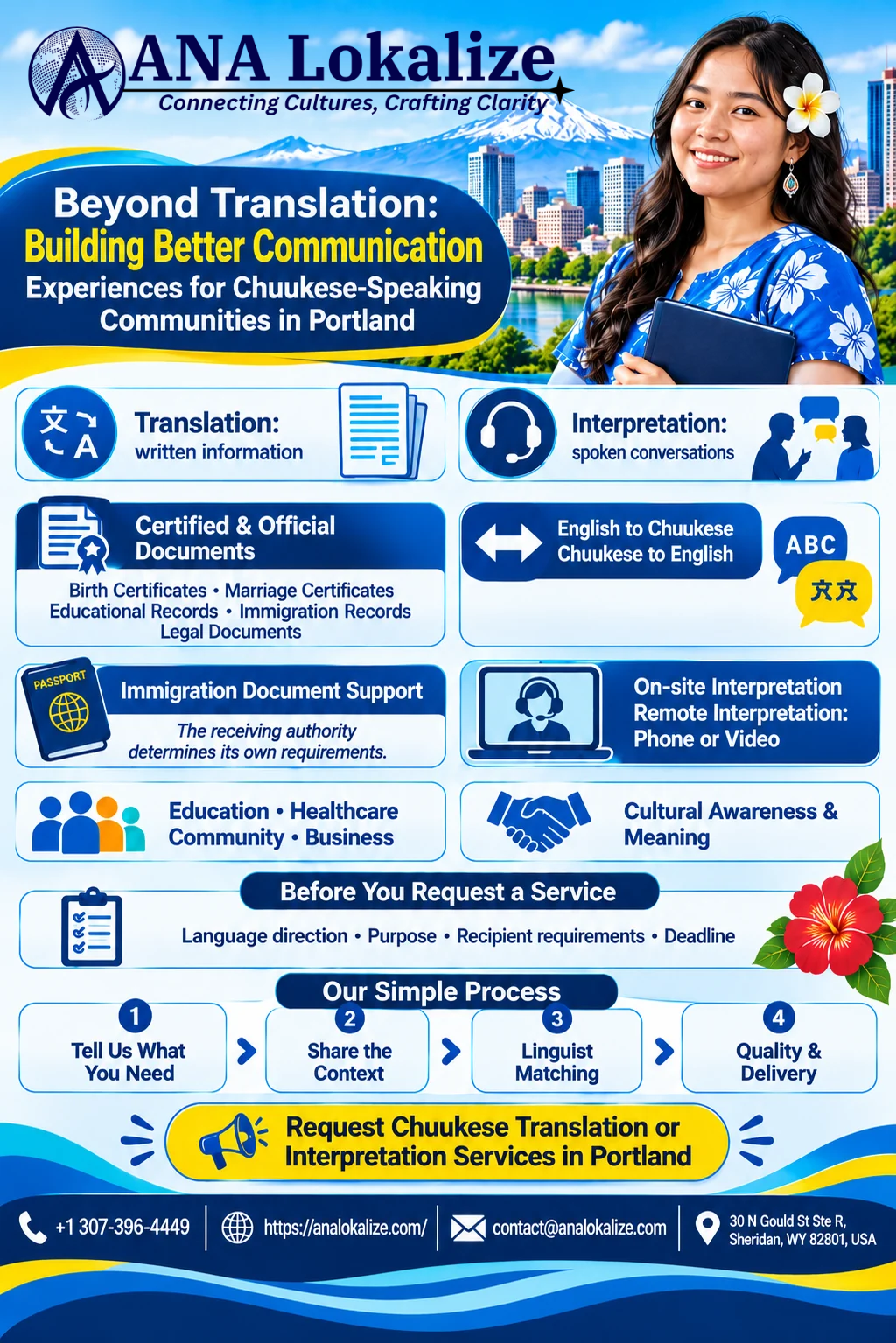
Professional translation and
interpretation help address different parts of this communication process:
- Translation
transfers written information from one language into another while
preserving its meaning and relevant details.
- Interpretation
communicates spoken or signed messages between participants during
conversations.
- Document review and preparation help identify the purpose, intended audience,
terminology, and specific requirements before language work begins.
- Language coordination
helps clarify which language variety, format, and delivery method are
appropriate for the intended audience.
For Chuukese-speaking communities in
Portland, selecting the right service begins with understanding what needs to
be communicated and how the information will be used.
2.
Why Professional Chuukese Translation Services Matter in Portland
Written information can influence
important personal, professional, educational, and administrative decisions. A
translated document should therefore communicate the original information
accurately without introducing unsupported details or leaving out relevant content.
Certified Chuukese translation services Portland may be relevant when individuals
need translated documents for official, institutional, or personal purposes.
The specific requirements depend on the organization receiving the translation.
Some institutions request a certification statement, while others may have
additional formatting, submission, or translator qualification requirements.
Before ordering a translation, it is
useful to identify:
- The document's intended purpose.
- The organization or person who will receive it.
- The source and target languages.
- Whether a certification statement is required.
- Whether the original document must be submitted with
the translation.
- Whether the recipient has specific formatting
instructions.
- The deadline for submission.
These details help establish the
scope of the project and reduce the possibility of preparing a translation that
does not meet the recipient's expectations.
Professional translation can be
useful for a variety of materials, including personal records, educational
documents, administrative correspondence, business information, and
immigration-related paperwork.
The objective is not simply to
create a readable version. It is to preserve the information in a form that
serves the document's intended purpose.
3.
English to Chuukese Document Translation Portland: Making Written Information
Accessible
People may receive important
information in English even when they are more comfortable reading or
discussing it in Chuukese. In these circumstances, translation can help make
the content more accessible.
English to Chuukese document translation Portland can support individuals and
families who need written information translated for personal understanding,
communication with relatives, community activities, or other purposes.
Depending on the project, documents
may include:
- Personal letters and correspondence.
- Educational notices and school communications.
- General administrative documents.
- Community information and announcements.
- Business correspondence.
- Informational brochures and guides.
- Personal statements and supporting materials.
- Selected forms and written instructions.
Every document has a different
communication purpose. A personal letter may require a natural and
conversational tone, while an administrative notice may need more formal
language. Educational material may require clear explanations, while business
communication may need consistent terminology.
A professional translator should
consider these differences before beginning the work.
Preserving
Meaning Across Languages
A common challenge in document
translation is that sentences cannot always be transferred directly from one
language into another. Grammar, sentence structure, expressions, and word
choices may differ.
A literal translation can sometimes
sound unnatural or fail to communicate the intended message. A professional
approach considers the meaning of the complete sentence and selects language
that communicates that meaning appropriately.
The translator should also pay
attention to:
- Names and personal details.
- Dates and numerical information.
- Addresses and identification details.
- Headings and section labels.
- Instructions and conditions.
- References to institutions or procedures.
- Terminology that appears repeatedly.
Consistency is especially important
when several documents belong to the same application, project, or
communication process.
Confirming
the Chuukese Language Variety
Chuukese is used across different
communities, and language preferences may vary by speaker, family, and
location. Before beginning a translation, it is helpful to confirm the intended
audience and the preferred language variety.
This is particularly important when
the translated material will be distributed to a community rather than provided
to one individual. The purpose is to create content that feels understandable
and appropriate to the people who will read it.
4.
Immigration Documents Require Particular Attention to Detail
Immigration-related paperwork often
includes personal information, official instructions, supporting records, and
details that must remain consistent across multiple documents.
A missing date, an incorrectly
written name, or an unclear translation can create confusion when documents are
being reviewed. This makes careful document preparation especially important.
A Professional Chuukese translator for immigration documents Portland can help individuals who need
written information translated between English and Chuukese for
immigration-related purposes.
Depending on the individual's
circumstances, translation requests may involve:
- Birth certificates.
- Marriage certificates.
- Educational records.
- Personal statements.
- Family-related documents.
- Supporting letters.
- Civil records.
- Other relevant personal documentation.
The exact documents required depend
on the particular application and the instructions provided by the relevant
authority.
Translation
and Immigration Requirements Are Not the Same Thing
It is important to understand that
translation services and immigration advice are separate. A translator can help
communicate the contents of a document in another language, but translation
does not determine eligibility, provide legal representation, or guarantee an
immigration outcome.
Applicants should follow the
instructions issued by the relevant immigration authority and consult a
qualified immigration professional or attorney when they need legal guidance.
Why
Consistency Matters
Immigration-related documents may
contain the same personal details in multiple places. Names, dates, locations,
and other identifying information should be handled carefully.
When requesting translation,
individuals should provide clear copies of the documents and explain whether
the recipient has specific requirements. If a name appears differently across
records, that difference should be brought to the attention of the appropriate
professional rather than silently changed.
A careful process helps reduce
avoidable confusion and supports a more organized submission.
5.
Chuukese to English Translation Services Portland USA: Helping Information
Travel in the Other Direction
Language support is not limited to
translating English documents into Chuukese. Many individuals also need
information originally written in Chuukese to be understood by English-speaking
organizations, institutions, or professionals.
Chuukese to English translation services Portland USA can help communicate the contents
of personal records, letters, statements, and other written materials to an
English-speaking audience.
This direction of translation may be
useful when someone needs to share information with:
- Educational institutions.
- Healthcare providers.
- Government offices.
- Employers and business organizations.
- Legal professionals.
- Community organizations.
- Other institutions that require English-language
documentation.
Accuracy
Should Come Before Simplification
A translation should not introduce
information that does not appear in the original document. Equally, it should
not leave out details simply because they appear repetitive or unfamiliar.
For example, a personal statement
may include specific descriptions, dates, or explanations that are important to
the writer. A translator should preserve the intended meaning and relevant
details rather than rewriting the statement to express a different idea.
Where the original document contains
unclear handwriting, incomplete information, or ambiguous expressions, those
issues should be identified and clarified when possible.
Maintaining
the Original Document's Purpose
A translated letter should still
function as a letter. A personal statement should retain its personal nature.
An official record should preserve its relevant structure and information.
This attention to purpose helps the
translated material remain useful to the person or institution receiving it.
6.
Spoken Communication Needs a Different Kind of Language Support
Documents are only one part of
everyday communication. Many important interactions happen through
conversations, where people need to ask questions, explain circumstances, receive
instructions, and respond in real time.
A written translation cannot replace
an interpreter when two or more people need to communicate directly during a
conversation.
Professional Chuukese interpreter services Portland can support communication in situations
where participants use different languages and need assistance understanding
one another.
Interpretation may be relevant
during:
- Healthcare appointments.
- School meetings.
- Parent-teacher discussions.
- Community meetings.
- Administrative conversations.
- Professional consultations.
- Business discussions.
- Personal appointments.
The appropriate interpreting
arrangement depends on the setting, the participants, the sensitivity of the
discussion, and whether everyone can attend the same location.
What
Makes an Interpreted Conversation Effective?
An effective interpreted
conversation requires preparation and cooperation from everyone involved.
Participants should speak clearly,
use manageable sentences, and allow time for the interpreter to communicate
each message. They should address one another directly rather than treating the
interpreter as the person responsible for the conversation.
It is also useful to explain the
purpose of the meeting before it begins. This allows the interpreter to understand
the subject and prepare for any specialized terminology that may arise.
Interpreting should communicate the
meaning of what participants say without adding personal opinions or changing
the substance of the message.
7.
Choosing a Certified Chuukese Interpreter in Portland
When a conversation involves
important information, selecting an appropriate interpreter is an important
consideration.
A Certified Chuukese interpreterin Portland may be requested when an organization or situation specifies a
particular credential or qualification. However, the term “certified” should
not be assumed to mean the same thing in every setting.
Different institutions and
professional environments may have different credentialing, qualification, or
language-access requirements. Some may request a particular certification,
while others may assess language proficiency, relevant experience, or other
qualifications.
Before arranging an interpreter,
confirm:
- Whether the receiving organization requires a specific
credential.
- Whether the interpreter must have experience in a
particular subject area.
- Whether the conversation involves technical or
specialized terminology.
- Whether the appointment is in person or remote.
- How long the session is expected to last.
- Whether confidentiality or additional procedures apply.
These questions help establish
whether the requested interpreter arrangement is suitable.
Subject
Knowledge and Communication Skills
An interpreter may need to work with
terminology related to healthcare, education, administration, business, or
another specialized subject.
Language proficiency is important,
but the setting also matters. A conversation involving technical information
may require preparation that differs from a general appointment.
For sensitive or high-stakes
situations, organizations should confirm that the interpreter's qualifications
and experience meet their requirements.
8.
On-site Chuukese Interpreter Services in Portland: When Being Present Matters
Some conversations are easier to
manage when all participants are in the same physical location. In-person
communication can be useful when a meeting involves several people, physical
documents, or a setting where remote participation is not practical.
On-site Chuukese interpreter services in Portland may be appropriate for
appointments, meetings, and other situations where an interpreter needs to be
physically present.
Possible settings include:
- In-person healthcare appointments.
- School and educational meetings.
- Community gatherings.
- Administrative appointments.
- Workplace discussions.
- Professional consultations.
- Scheduled meetings involving multiple participants.
Benefits
of In-person Interpretation
An on-site arrangement allows
participants to communicate in the same environment. They can refer to physical
documents, ask questions, and follow the conversation without coordinating
through a separate device.
This format may also be useful when
several people need to participate in the same discussion.
However, on-site interpreting
requires practical planning. The location, appointment time, expected duration,
subject matter, and interpreter availability should be confirmed in advance.
Preparing
for an On-site Session
A few simple steps can help an
in-person session run more smoothly:
Share the purpose of the meeting: Explain whether the discussion concerns healthcare,
education, administration, business, or another topic.
Confirm the location: Provide the complete address and any relevant arrival
instructions.
Estimate the duration: Let the service provider know how long the appointment is
expected to last.
Identify the participants: Confirm how many people will take part and which languages
they use.
Prepare relevant materials: If appropriate, share an agenda or terminology in advance,
while following applicable privacy and confidentiality procedures.
Good preparation helps reduce
unnecessary delays and gives participants a clearer understanding of the
communication process.
9.
Remote Chuukese Interpreter Services in Portland: Connecting People Across
Locations
Not every appointment requires an
interpreter to travel to a physical location. Sometimes participants are in
different places, schedules are difficult to coordinate, or an in-person
arrangement is not practical.
Remote Chuukese interpreter services in Portland can help connect participants
through supported phone or video interpreting arrangements, depending on
availability and the requirements of the session.
Remote interpretation may be useful
for:
- Phone appointments.
- Video consultations.
- Follow-up discussions.
- Short administrative conversations.
- Meetings involving participants in different locations.
- Situations where travel creates practical difficulties.
Phone
or Video: Which Format Is More Appropriate?
The choice depends on the nature of
the conversation.
Phone interpreting may be suitable
when participants primarily need to communicate verbally and do not need to
share visual information.
Video interpreting may be more
appropriate when seeing the participants, observing visual references, or sharing
information on screen is helpful.
Neither format is automatically
suitable for every situation. Organizations should consider privacy,
technology, participant comfort, and the complexity of the conversation before
selecting a method.
Making
Remote Interpretation Work Smoothly
Remote sessions depend on reliable
communication technology and a suitable environment.
Before the appointment:
- Test the phone, computer, or video platform.
- Check the internet connection where applicable.
- Choose a quiet and private location.
- Confirm that participants can hear one another clearly.
- Keep relevant documents available.
- Share the session details with everyone involved.
For confidential conversations,
participants should also confirm that the selected platform and communication
arrangement meet the applicable privacy and organizational requirements.
Remote interpretation can make
language support more accessible, but the format should always be chosen
according to the needs of the actual conversation.
10.
Get Professional Chuukese Translation Services Online: A More Convenient
Starting Point
Finding language support does not
always need to begin with an in-person visit. Many translation projects can
start through an online request, allowing individuals and organizations to
share project details and documents electronically.
When people want to Get professional Chuukese translation services online, they can begin by
identifying the document, language direction, intended purpose, and expected
deadline.
An online request process can be
useful for people who:
- Live outside central Portland.
- Have limited time for in-person appointments.
- Need to submit documents from another location.
- Want to request a translation estimate.
- Need to coordinate a project for multiple documents.
- Prefer digital communication during the initial
inquiry.
What
Information Should You Provide?
A clear request helps the service
provider understand the work involved.
Include the following details when
possible:
Document type: Identify whether the material is a certificate, letter,
statement, form, educational record, or another document.
Language direction: Specify whether the translation is English to Chuukese or
Chuukese to English.
Purpose: Explain whether the translation is for personal use, an
institution, an application, or another purpose.
Recipient requirements: Share any instructions about certification, formatting, or
submission.
Deadline: Mention when the completed translation is needed.
Document quality: Provide a clear and complete copy so the text can be
reviewed.
For documents containing sensitive
personal information, use an appropriate secure submission method and avoid
sharing unnecessary information.
Online
Requests Still Need Human Attention
An online process may make project
coordination easier, but the quality of the translation remains central.
The source material should be
reviewed carefully, terminology should be handled consistently, and the final
translation should be checked before delivery.
Technology can support communication
and workflow management, but it should not replace the professional judgment
required to understand context and preserve meaning.
11.
Understanding Affordable Chuukese Document Translation Services in Portland
Cost is a practical consideration
for individuals and organizations arranging language services. However, the
lowest quoted price is not necessarily the most suitable choice for every
project.
People looking for Affordable Chuukese document translation services in Portland should consider both the
price and the requirements of the document.
Translation costs may depend on
several factors:
- The number of words or pages.
- The complexity of the source material.
- The language direction.
- The document formatting.
- The need for certification or a certification statement.
- The quality and readability of the source file.
- The requested completion time.
- Any additional review or project requirements.
A short document containing
specialized terminology may require a different level of attention from a
longer, straightforward letter. Similarly, a project involving several related
documents may need consistency checks across the complete set.
How
to Plan a Translation Budget
A few practical steps can help
individuals manage translation costs.
Submit complete documents: Sending all relevant pages together can help the provider
understand the full scope of the project.
Explain the purpose: The intended use helps identify whether additional
requirements may apply.
Confirm the language direction: Clearly state whether the document needs to be translated
into Chuukese or English.
Ask about the complete price: Confirm what is included in the quotation and whether
additional services may involve separate charges.
Discuss the deadline early: Urgent requests may require different arrangements,
depending on availability and project complexity.
Avoid unnecessary duplication: If several documents are part of one project, explain how
they relate to one another.
A clear quotation should help the
customer understand the proposed scope, expected delivery, and any applicable
additional requirements.
Value
Is More Than Price
A translation may be inexpensive but
still fail to meet the recipient's requirements if important details are
missing or the requested format has not been followed.
The value of professional
translation lies in the accuracy, clarity, suitability, and care applied to the
project.
For personal and official documents,
it is worth confirming the service details before making a decision based only
on price.
12.
Translation and Interpretation in Education, Healthcare, and Community Settings
Language access can support
communication across several areas of everyday life. Each setting has its own
needs, and the appropriate language service depends on whether the information
is written, spoken, or both.
Education
Schools and educational
organizations communicate with families through notices, forms, meeting
discussions, enrollment information, and academic updates.
Chuukese translation may help
families understand written school information. Interpretation may support
conversations between parents, educators, and administrative staff.
Clear communication helps
participants ask questions, understand expectations, and take part in
discussions.
Healthcare
Healthcare interactions may involve
appointment instructions, patient information, medical forms, and discussions
with providers.
Written translation and spoken
interpretation serve different purposes in these situations. A translated
document may help someone review written information, while an interpreter may
support a direct conversation with a healthcare professional.
Medical communication can involve
specialized terminology and sensitive information. The healthcare organization
should determine the appropriate language-access arrangement and confirm that
the interpreter meets its requirements.
Community
Organizations
Community groups often share
information about events, programs, available resources, and local activities.
Translation can help make written
announcements and informational materials accessible to Chuukese-speaking
audiences. Interpretation may support meetings and community discussions.
The language used should be
appropriate for the audience, and organizers should consider the language
preferences of the people they intend to reach.
Business
and Workplace Communication
Businesses may need language support
when communicating with customers, employees, partners, or community members.
Translated documents can help
communicate written information, while interpretation can support meetings and
conversations.
In every setting, the goal is to
make the intended message understandable without changing its meaning.
13.
Cultural Awareness Is an Important Part of Language Quality
A technically correct translation
may still feel unfamiliar if it does not consider how the intended audience
uses language.
Cultural awareness helps translators
and interpreters consider tone, expressions, context, and the expectations of
the people receiving the message.
This does not mean making assumptions
about every Chuukese speaker. Individuals and families may have different
language preferences, experiences, and communication styles.
Instead, culturally aware language
work begins with questions:
- Who will read or hear the message?
- What is the purpose of the communication?
- Is the tone formal, conversational, educational, or
informational?
- Are there expressions that require careful contextual
treatment?
- Does the intended audience prefer a particular language
variety?
- Are there terms that should remain consistent
throughout the project?
Avoiding
Unnecessary Assumptions
A translator should not assume that
every audience understands the same expressions or prefers the same style.
For community-facing material, it
can be helpful to confirm terminology with appropriate language professionals
or intended audience representatives when practical.
For official documents, accuracy and
the requirements of the receiving organization remain essential.
Cultural awareness should strengthen
the communication process, not replace careful translation or interpretation.
14.
How to Choose the Right Chuukese Language Service
The best service depends on what
needs to happen after the language work is completed.
A person who needs a written record
translated requires a different service from someone preparing for a live
appointment. An organization distributing a public information brochure may
have different requirements from a family submitting a personal document.
A useful way to choose is to begin
with the communication task.
When
Translation Is the Better Choice
Choose document translation when the
information exists in written form and needs to be communicated in another
language.
Examples include certificates,
letters, educational records, written notices, and supporting documents.
When
Interpretation Is the Better Choice
Choose interpretation when people
need to communicate directly during a conversation.
Examples include appointments,
meetings, consultations, interviews, and discussions.
When
Both May Be Needed
Some situations involve written
documents as well as spoken conversations.
For example, a person may need a
document translated before attending an appointment where an interpreter will
help participants discuss its contents.
In these cases, translation and
interpretation can support different stages of the same communication process.
They should be arranged according to the actual requirements of the situation.
15.
A Practical Checklist Before Requesting Chuukese Language Support
Before requesting a service, take a
moment to identify the communication need. This can make the process more
organized and help avoid unnecessary back-and-forth.
For document translation:
- Identify the source language and target language.
- Prepare a complete, readable copy of the document.
- Confirm the intended use.
- Check the recipient's certification requirements.
- Identify any special formatting instructions.
- Share the required completion date.
- Ask how the final translation will be delivered.
For interpretation:
- Identify the languages used by the participants.
- Explain the purpose of the conversation.
- Confirm whether the session is in person, by phone, or
by video.
- Share the date, time, and expected duration.
- Identify any specialized subject matter.
- Confirm any credential or experience requirements.
- Check privacy and confidentiality expectations.
For online requests:
- Provide accurate contact information.
- Describe the project clearly.
- Use an appropriate method to share sensitive documents.
- Ask for a quotation before confirming the work.
- Review the proposed delivery arrangements.
A little preparation can help ensure
that the requested service matches the communication task.
16.
How ANA Lokalize Supports Chuukese Language Communication
Every language project begins with a
particular need. Someone may need to understand a personal record, prepare a
document for an institution, communicate during an appointment, or share
information with a wider community.
ANA Lokalize provides
language-service solutions designed to support these different communication
requirements.
For individuals and organizations in
Portland, service requests may include:
- Certified Chuukese translation services Portland for documents where certification requirements have
been identified.
- English to Chuukese document translation Portland for written information that needs to be communicated
to Chuukese-speaking readers.
- Chuukese to English translation services Portland USA for documents originally prepared in Chuukese.
- Professional Chuukese translator for immigration
documents Portland for
immigration-related document translation needs.
- Professional Chuukese interpreter services Portland for spoken communication.
- On-site Chuukese interpreter services in Portland for meetings and appointments requiring in-person
support.
- Remote Chuukese interpreter services in Portland for suitable phone or video sessions.
- Online project coordination for people who want to get
professional Chuukese translation services online.
- Translation quotations for those comparing Affordable
Chuukese document translation services in Portland.
The appropriate service depends on
the document, communication setting, recipient requirements, language variety,
and project details.
ANA Lokalize encourages customers to
explain the purpose of their request so the project can be assessed according
to its actual needs.
17.
Better Language Access Begins With the Right Questions
Language support is most useful when
it addresses the real communication challenge. Before selecting a provider,
consider what information needs to be shared, who will receive it, and what the
recipient expects.
For a document, the key questions
may concern accuracy, certification, formatting, and submission requirements.
For an appointment, they may involve interpreter availability, subject knowledge,
session format, and confidentiality.
There is no single solution for
every situation. A short personal letter, an official record, a community
announcement, and a healthcare conversation all require different approaches.
Taking time to identify these
differences helps individuals and organizations make more informed decisions.
For Chuukese-speaking individuals
and families in Portland, professional language support can help make written
information easier to access and conversations easier to navigate. With careful
preparation, appropriate service selection, and attention to meaning,
translation and interpretation can contribute to clearer communication across
everyday and important situations.
Request
Chuukese Translation or Interpretation Services in Portland
If you need help with a written
document or a spoken communication requirement, ANA Lokalize can help you
explore an appropriate language-service solution.
Whether you are looking for document
translation, immigration-related translation support, on-site interpretation,
remote interpreting, or an online project inquiry, start by sharing the
language direction, purpose, document or appointment details, and expected
deadline.
ANA Lokalize – Connecting Cultures, Crafting Clarity
- Phone:
+1 307-396-4449
- Email:
contact@analokalize.com
- Website:
https://analokalize.com/
- Address:
30 N Gould St Ste R, Sheridan, WY 82801, USA
Contact ANA Lokalize to discuss your Chuukese translation or interpretation requirements and identify the service that best fits your communication needs.